Elena Cox
1 / 3Pregnancy and birth can be scarier for LGBTQ+ people and people of color
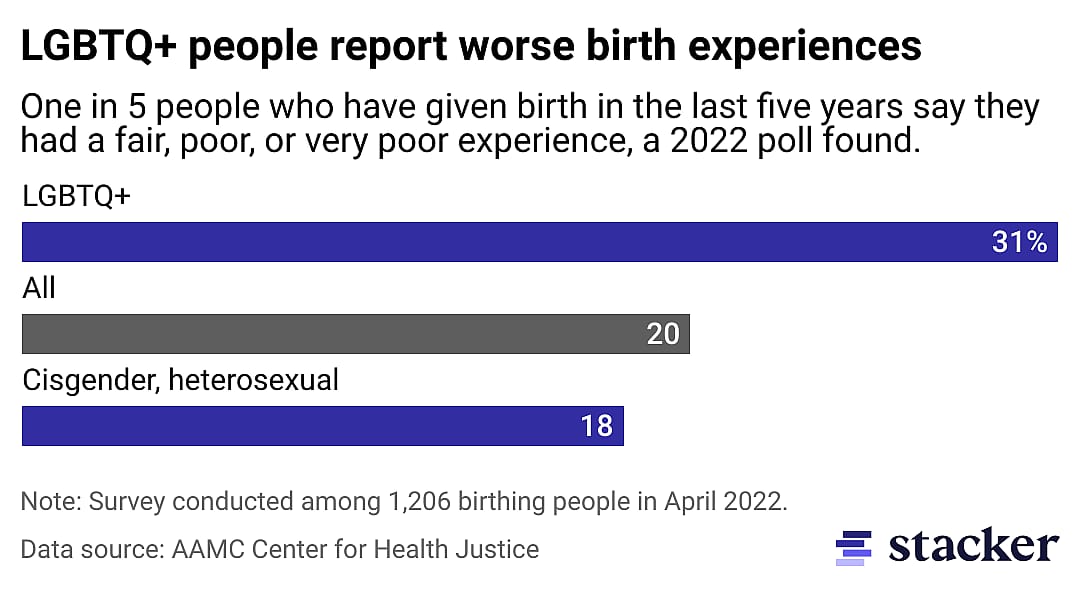
Little data exists on the pregnancy and birth experiences of LGBTQ+ people. One study of bisexual and lesbian women published in 2019 by the Maternal and Child Health Journal found higher rates of miscarriage and premature births compared to heterosexual women, pointing to sexual orientation inequities in birth and pregnancy outcomes.
Trans and gender-nonconforming parents face additional disparities, according to Alexis Robles-Fradet, a policy analyst at the National Health Law Program.
"There's more reported harassment," Robles-Fradet told Stacker. "[There are] more folks that just don't know how to care for trans people, even if they have good intentions and aren't being outright discriminatory."
In addition to dealing with health care providers that often lack expertise on trans health care, transgender and gender-nonconforming birthing people have reported feelings of loneliness and of their experiences of parenting being erased within a health care system built on a binary understanding of gender, anatomy, and parenthood.
For Black and Latina lesbian and bisexual women, birth and pregnancy outcomes are worse than those of their white counterparts, according to another study published in 2021 in the Journal of Health and Social Behavior. This finding lines up with broader racial inequities in birth and pregnancy outcomes, as well as much higher maternal mortality rates among Black and Indigenous women than white women.
Doulas often see these disparate experiences firsthand. Silva, who is Latina and queer, was accompanying a Black client at her birth in a New York City hospital around 2018 and witnessed a nurse ignoring her client's request for an epidural.
"There was this one moment specifically that I remember where the nurse kind of held my patient down on the bed and said, 'You're not in pain. You're just exaggerating,'" Silva recalled.
That was Silva's cue to intervene. "I literally looked at her and I said, 'Take your hands off my client right now. You're being completely inappropriate.'"
This incident is far from an anomaly within the medical system: The systemic dismissal and undertreatment of Black patients' pain by doctors and other medical professionals is a well-documented phenomenon rooted in racist and pseudoscientific beliefs that Black people are less sensitive to pain than white people.
These kinds of experiences can lead to fear and distrust of medical environments. A few years ago, Annie Rosenblum, a white queer full-spectrum doula and abortion worker living in Gainesville, Florida, was driving a client to deliver their baby at a local hospital known for its high maternal and infant mortality rates, particularly among Black and brown patients. Rosenblum remembers their client, who is Black and queer, turning to them in the car and saying, "Don't let them kill me."
Experiences of discrimination and marginalization within medical settings can touch both the person giving birth as well as their accompanying doula. "I have been in situations where my clients are being discriminated against, and I've been in situations where I'm being discriminated against because I am Black," Sabia Wade, a full-spectrum doula and educator based outside Atlanta, told Stacker.
Wade's ability to understand her clients' experiences is an example of the ways in which doulas can be crucial supports in the moments when it matters most: as a humanizing and comforting presence for the person giving birth but also as an active advocate and intervenor. From early on in her doula training, Wade has been hyperaware of this role. "How do you also protect and advocate for someone who other people may not deem as valuable?" she said.