Carren Jao // Stacker
1 / 2How women's participation in the Olympics has changed over time
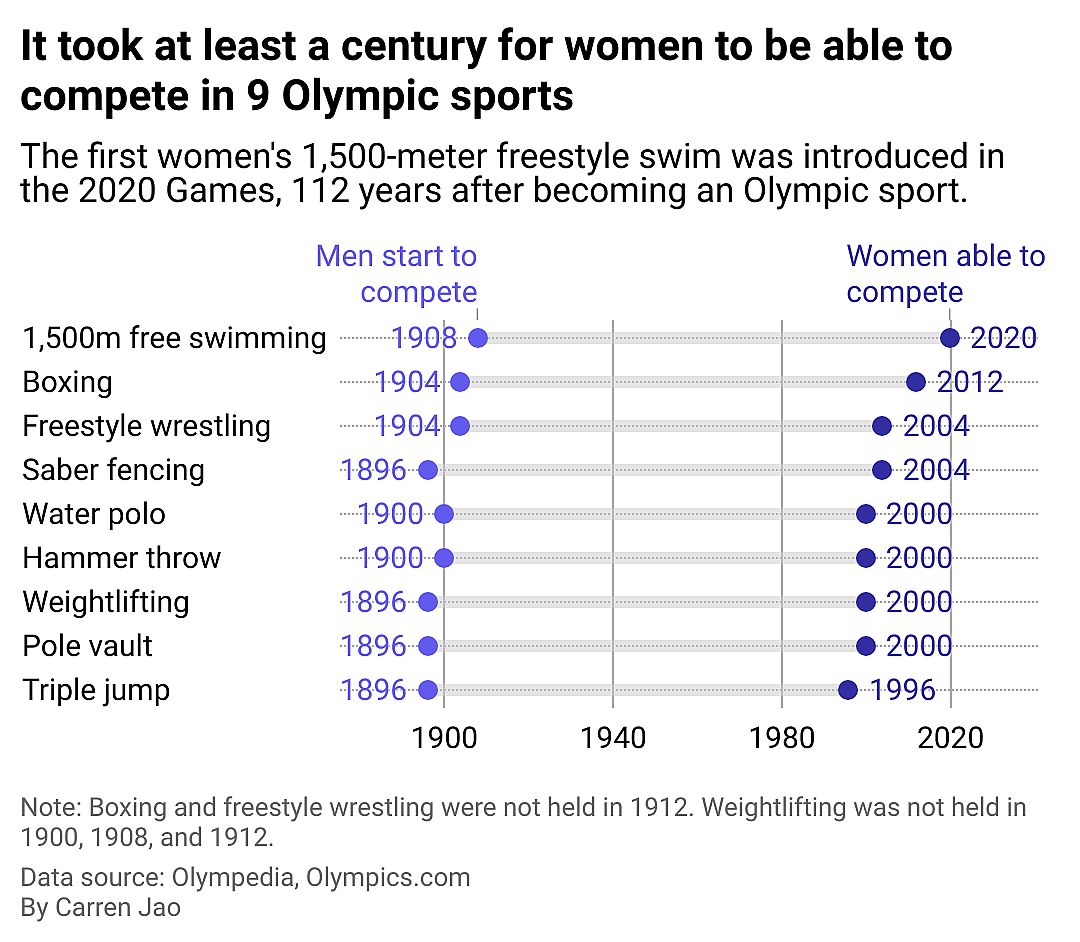
"Well, considering that the modern revival in Athens 1896 made no provision for women to compete, we can certainly see Paris as evidence of improvement—it just took 128 years to get here," Bonnie Hagerman, assistant professor at the University of Virginia and author of "Skimpy Coverage: Sports Illustrated and the Shaping of the Female Athlete," told Stacker.
Hagerman noted that for many years, "women's Olympic participation was an afterthought." Pierre de Coubertin preferred that women be relegated to handing out awards, and subscribed to a popular opinion of the time that sports were detrimental to women's reproductive health.
Although women didn't take part in those first Olympics, they did compete in subsequent Games, due in part to the fact that host cities chose the sports and events, but their participation was minimal. "Once the IOC took control of the docket, women's events were limited," Hagerman explained.
"Perhaps most contentious was the battle over adding track and field events for women," Hagerman said. It was only after pressure from a competing event—the Women's World Games, which ran from 1922 to 1934—that the IOC decided to add five women's events to the 1928 Olympic program, the 800-meter run being one of them. Many IOC members and male sportswriters believed this was too long of a distance for women, and the press fabricated the details of the race, playing to sensationalized notions of women's frailty.
"Below us on the cinder path were 11 wretched women, five of whom dropped out before the finish, while five collapsed after reaching the tape," John Tunis wrote for the New York Evening Post. Other papers fanned fears that such long distances would impair a woman's reproductive abilities. These reports caused the IOC to drop the event and not allow women to run longer than 200 meters, a decision that effectively shut women out of the sport for more than 30 years.
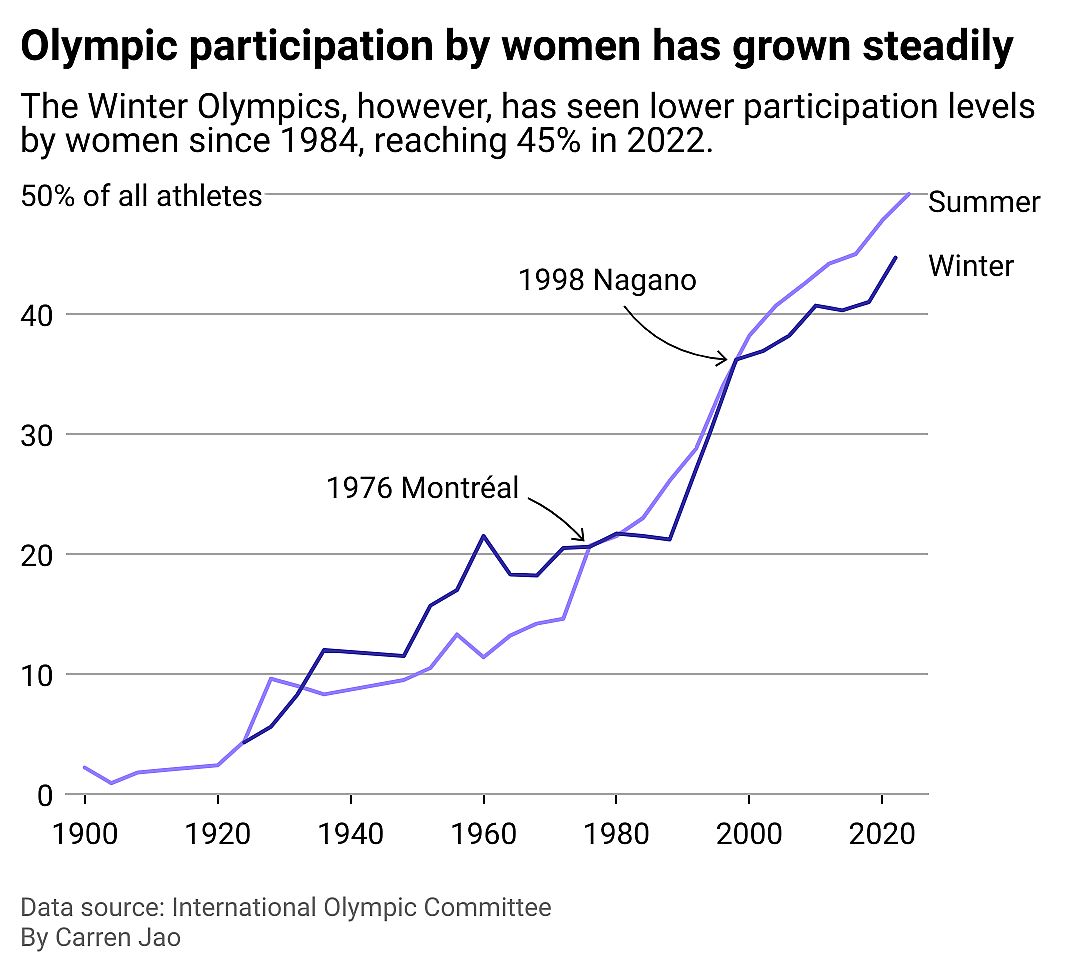
While women's participation slowly increased throughout the 1960s, it spiked at the 1976 Montréal Olympics due to the addition of basketball, rowing, and handball. These team sports increased women's participation to just over 20% of the athlete count, up from 14.6% at the 1972 Munich Games, the largest percentage-point jump in women's participation.
The 1996 Olympics in Atlanta was another watershed moment. The inclusion of women's softball and soccer gave the Summer Games an additional 5 percentage points from 1992. Women now made up 34% of all athletes. "In 1996, there was a lot of discussion about that being sort of the year of the woman, at least for U.S. Olympians," Cheryl Cooky, professor at Purdue University and co-author of the book "Serving Equality: Feminism, Media, and Women's Sports," told Stacker.
That's not to say organizers were convinced women would draw crowds. In the women's soccer tournament, group-stage matches were played as doubleheaders with men's games to ensure attendance. They shouldn't have worried—women drew big crowds, and the gold medal match between the U.S. and China still ranks as one of the highest-attended women's soccer matches of all time with 76,481 fans.
"2012, again, that was framed as the year of the woman," said Cooky. Women's participation had climbed to 44.2%, and researchers Peter Donnelly and Michele K. Donnelly from the Centre for Sport Policy Studies at the University of Toronto noted that this was the first Summer Olympics with both men and women in every sport. Furthermore, all countries allowed women to compete, a first for parts of the world where women struggle for even the right to play.
"I think it's more interesting how the narrative of gender progress gets retold or gets told repeatedly across history and what that retelling of that same narrative signifies," said Cooky. "The IOC, or at least the Olympics itself, is really touting itself as this space of gender progress, progress toward equality, progress toward inclusion, and it's finding sort of different ways to tell that same story without really addressing what I would see as the significant issues."
The Winter Olympics still trails the Summer Games in terms of parity, even though women had a higher participation rate in early editions of the Games, in part due to the smaller number of sports in the program. In 1936, participation rose nearly 4 percentage points when Alpine skiing was added to the Games for both men and women, which gave women opportunities to compete in two of the eight sports on the program. Women's participation also rose 4.5 percentage points in the 1960 Squaw Valley Games, when they were allowed to compete in speed skating, and jumped a hefty 6.2 percentage points from the previous Winter Games to 36.2% in 1998, when women's ice hockey was added.
Winter athletes still face a lack of equality, though. Nordic combined is the one sport—summer or winter—that doesn't have a women's event at the Olympics. Women also face smaller quota numbers in sports like bobsledding, where women compete in monobob and two-women events, while men have historically competed in two-men and four-person sleds.
"There is a longer history of women being excluded than included. So the fact that we've made it to this point I do think it is worth celebrating, although I'm not going to throw the huge party just yet because there's still work to be done," Lindsay Parks Pieper, associate professor of sport management at the University of Lynchburg, told Stacker.