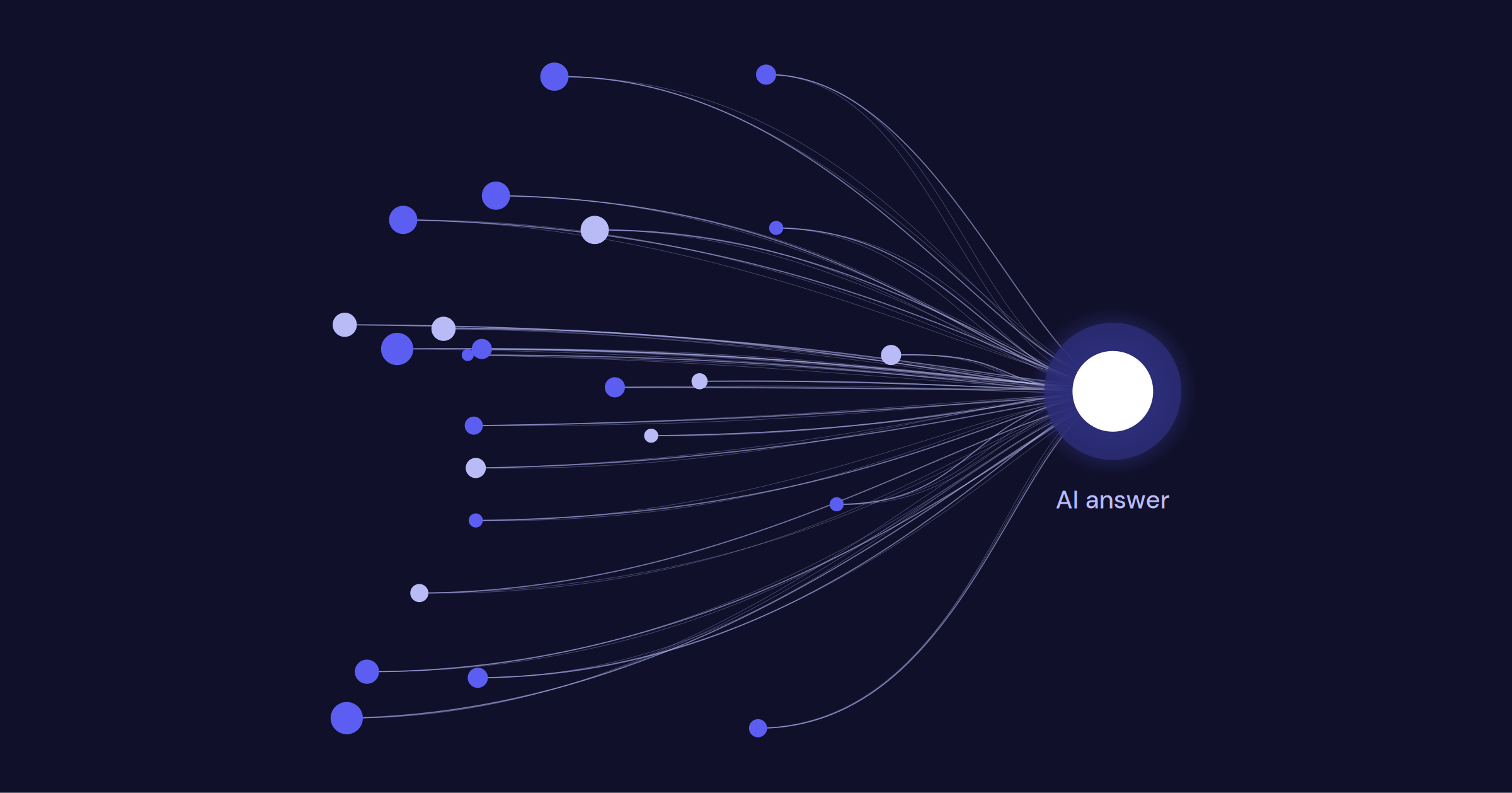

When distributing content, placement quality is all that matters
When considering content distribution solutions, many brands prioritize the number of pickups or placements of a piece over the quality of the domains distributed to. However, our study of 215 stories and 54,702 AI responses showed one very consistent trend: it’s the quality of a distributed placement that matters most.
Specifically, the Ahrefs DR score of a publishing partner’s domain correlated with citation hit rate at r = 0.99 and with citations per pickup (CPP) at r = 0.97 across publisher tiers. These are near-perfect relationships.
This means, as a publisher’s DR rises, so does the probability of an AI citation occurring and the volume of citations when it does.
Because DR predicts citations so precisely, understanding the gap in citation performance between high- and middle-quality network partners will be the deciding factor in whether your content distribution program succeeds or fails.
|
r = +0.99 DR ↔ citation hit rate correlation |
r = +0.97 DR ↔ citations per pickup correlation |
423x More citations per pickup (CPP) for high-DR publishers |
🎯In sum, the only thing that matters when you’re distributing content is the quality of the domain that re-publishes your piece - a single high-quality placement is worth hundreds of middling-quality placements.
Why is Domain Rating such a good predictor of AI citations?
AI platforms don't evaluate every piece of indexed content equally when deciding what to cite. They prefer already-trusted sources, with Google’s engines in particular relying heavily on “traditional” SEO authority metrics.
Domain Rating is that trust metric. It measures, from 1-100, the trustworthiness & authority of a site by looking at both the number and quality of backlinks to the domain. It is a proxy for one of the primary things any AI platform is looking for - a trustworthy, authoritative domain. While not a perfect predictor of AI citation rates, it’s an incredibly strong one.
In SEO; DR is useful as a heuristic for determining a domain’s quality. In AI search (or GEO), it is useful for estimating how likely the domain is to be cited in AI search.
This is a near-perfect correlation identified from 215 published stories and 54K AI response samples. Publishers in the top tier of this study (with an average DR of 81), were cited for 43% of the stories they distributed. Publishers in the bottom tier had an average DR of 62, and were cited for only 2% of distributed stories.
It is important to call out that an average DR of 62 is, by most standards, very high. Regardless; these upper-middle tier publishers cannot compete with high-DR publishers - further emphasizing the need for exceptional quality in one’s distribution network.
AI Powerhouse Publisher examples:
|
Publisher |
DR: |
Avg. Citations per Pickup |
|
Miami Herald (miamiherald.com) — 23.6x CPP, 69 pickups |
86 |
23.6 |
|
Arizona Daily Star (tucson.com) — 20.1x CPP, 73 pickups |
80 |
20.1 |
|
WFMZ (wfmz.com) — 10.5x CPP, 94 pickups |
78 |
10.5 |
Critically, the content distributed through both groups was produced by the same clients, on similar topics, for the same platforms. The difference in citation performance was about who distributed it.
The practical implication is significant.
A brand distributing exclusively through middle-DR publishers would need hundreds of pickups to drive the performance of a single high-DR pickup. Conversely, attracting high-authority publishers can be an outcome-defining win, even if coming at a comparatively smaller volume.
Four tiers, three variables, one pattern
Publisher performance in this dataset breaks cleanly into four clusters, identified through K-means analysis across 64 publisher partners. The patterns are consistent across all metrics: every step down in DR corresponds to a step down in both citation reliability (hit rate) and citation volume.
|
Tier |
Publishers |
Avg DR |
Hit rate |
Avg CPP |
Plain-language interpretation |
|---|---|---|---|---|---|
|
AI Powerhouse |
10 |
81 |
43% |
12.7x |
Cited in ~1 in 2 stories distributed. Each distributed story was cited an average of 12.7 times. |
|
Efficient Amplifier |
11 |
70 |
22% |
2.9x |
Cited in ~1 in 5 stories distributed. Each distributed story was cited an average of 2.9 times. |
|
Mid-Tier Distributor |
22 |
67 |
9% |
0.5x |
Cited in ~1 in 11 stories distributed. Each distributed story was cited an average of 0.5 times. |
|
Infrequently Cited |
21 |
62 |
2% |
0.03x |
Cited in ~1 in 50 stories distributed. Each story cited an average of only 0.03x. |
Network-wide average CPP across all publishers with ≥1 pickup: 3.86x.
Tier-level correlations: r(DR, hit rate) = 0.99 · r(DR, CPP) = 0.97
K-means clustering is a way of sorting these news partner domains into natural categories based on how similar they are to one another. These categories are not decided in advance; they are identified mathematically.
We grouped the 64 publishers in this analysis by how often their pickups produced an AI citation (hit rate) and how many citations each pickup generated (CPP). K-means clustering looks for patterns among publishers, then sorted every publisher into whichever group its neighbours belonged to, iterating until the groupings become stable.
There are two primary metrics in this table: Hit Rate and Citations per Placement (CPP).
Hit rate measures how frequently a publisher’s distributed stories are cited at all - not how deeply an individual story is cited. A 43% hit rate indicates that, among 100 stories distributed, this publisher can expect 43 of those stories to be cited in some format in AI search.
Citations per Placement counts the frequency of a story’s citations, as tracked across 30 prompts for that story. The AI Powerhouse cluster averages 12.7 citations per placement.
In simple terms, a story placed on an AI powerhouse domain can expect more than a dozen citations per placement, while a story placed on a hundred Infrequently Cited partners can expect only 3 citations.
Case study 1: Distribution is the sole source of visibility
Finance story: "How credit card limits work, and why they're risky"
The clearest way to understand the role of distribution quality is to look at stories where the brand domain had very little innate presence, and where distribution achieved massive visibility gains.
A finance client’s piece on credit card limits is one of the starkest examples in the dataset. The brand’s original piece of content (hosted on their domain) saw only a 1.7% citation rate, with only 12 total citations across the 30 queries tracked.
The versions of that piece distributed via Stacker’s network, with the same content, same data, and same publication date, achieved a 25.0% network citation rate, with 523 total network citations across the same query set.
That is a 44x lift to the total number of citations to this story thanks to distribution.
|
1.7% Responses citing the original piece of content |
25.0% Responses citing distributed versions |
44x Citation lift |
On Google AI Mode, the brand domain was cited in 0% of queries, but the Stacker network was cited in 60%. On Google Gemini, the brand was cited 3% of the time and the network 57%. On AI Overviews, brand 0%, network 23%. While results were strong on non-Google engines, within Google citations were gained almost exclusively through network placements.
This does not indicate that brand content is performing poorly, it indicates what happens when that same content reaches third-party publishers that AI platforms already trust. The finance domain used in this example has a meaningful online presence. But the publishers in Stacker’s network, particularly those in the most frequently-cited tier, provided very high levels of pre-existing authority and third-party trust.
This pattern of near-zero brand citation rate & strong network citation rate appeared in 16 of 205 stories across the dataset.
While not the most common outcome, collectively these represent cases where GEO value was created almost exclusively through distribution quality. Without placement on high-DR publishers, these stories would have been invisible in AI responses, making high-quality distribution the only viable option for visibility.
Case study 2: When a strong brand pairs with a strong network
B2B Data Platform: "GTM engineer: A high-impact career to consider in 2026"
A B2B data platform client’s story illustrates what quality distribution tactics do for a brand that already has a strong search presence.
This piece on the GTM engineer role achieved 21.7% brand citation rate. That is genuinely strong performance: roughly 1 in 5 queries cited the brand’s domain directly. Most content marketers would consider this a successful GEO outcome.
However, through Stacker's network, the same story achieved a 52.1% network citation rate - more than doubling the brand's own performance, and producing 1,609 network citations vs. 282 brand citations.
This is a clear sign that, even for already-established brands, high-quality network distribution significantly compounds authority and drastically increases citation potential.
|
21.7% Responses citing the original piece of content |
52.1% Responses citing distributed versions |
571% Citation lift |
The platform data tells a similar story - there is effectively no platform where the brand outperformed the network.
Within 48 responses, both the brand and distributed versions of the piece appeared within the same response (i.e., being cited multiple times within a single response). This is an ideal outcome, with the AI platform treating the brand as a primary source & corroborating it via trusted third parties.
This GTM engineer story is, in a meaningful sense, the ideal-state GEO outcome. It has strong content, strong topical authority, and strong organic brand performance.
This story didn’t need distribution, but it benefitted massively from it.
Strong performance across platforms - but strongest on Google
High-DR publishers, by virtue of their authority profiles, are indexed more thoroughly and more persistently by AI platforms. Lower-DR domains are indexed less reliably, less frequently, and in some cases barely at all for AI citation purposes.
This shows up clearly in the platform-level hit rate data. Google AI Mode produced a network citation in 95% of stories in the dataset, the highest hit rate of any platform measured. AI Overviews cited 84% of stories, Gemini 83%.
These three Google platforms, which collectively account for the largest share of AI citations in the study (64.9% of all citations), are also the platforms where Stacker's high-DR network shows the most consistent coverage.
|
Platform |
Network hit rate |
Avg network cite rate across all stories |
|---|---|---|
|
Google AI Mode |
95.3% |
34.0% |
|
Google AI Overviews |
83.7% |
16.2% |
|
Google Gemini |
82.8% |
20.6% |
|
Perplexity |
71.6% |
11.0% |
|
ChatGPT |
69.8% |
10.7% |
|
Copilot |
56.3% |
5.0% |
|
Claude / Meta |
- |
No URL citation surfacing by design. |
Copilot, the lowest-performing AI network, still shows an impressive 56.3% network hit rate, cited for almost 6 out of every 10 stories. However, compared to 95.3% for AI Mode, which is cited for 19 out of every 20 stories, it highlights the meaningful differences in each platform’s citation infrastructure, reliance on third-party citation sources, and the formatting of replies.
Average citation rates in the table above drive this point home from a different angle, showing that engines that cite third-party sources not only do so more reliably, but more frequently.
Regardless of platform, third-party distribution shows to be an impactful method of improving visibility - and especially impactful on Google platforms.
Nearly 40% of all stories more than double AI presence via strategic distribution
Across the 215 stories in this dataset, 82 (38.1%) fall within the Distribution-Driven cluster: stories where the Stacker network produced more AI citations than the brand domain alone, representing citation lift above 100%. While it’s impossible to compare all distribution environments against one another, this shows that a doubling of lift is a common outcome.
Within that group, 20 stories achieved 10x+ citation lift. For these 20 stories, the brand’s citation rate was 1.8%, and the network's average was 14.3%. For a subset of stories; distribution is the entire visibility profile, suggesting that a strong brand presence is not a hard prerequisite for AI visibility.
The remaining 62% of stories show strong brand citation rates, with a majority showing incremental citation volume due to distribution. These are not necessarily weak performers, they just don’t reach the high 100% growth rates of the top groups.
The practical implication of this data is that pickup quality is a near-perfect predictor of citation likelihood & frequency; and that this trend is strong across clients, topics, and platforms.
Across this dataset, the most defensible finding is that high-quality distribution improves AI visibility outcomes.

Methodology
Data covers 215 stories published by 75 brands across Jan–Mar 2026, measured across 8 AI platforms (Google AI Mode, Google Gemini, Google AI Overviews, ChatGPT, Perplexity, Copilot, Claude, Meta).
Each story was measured against a standardized query set of 30 prompts per citing platform (6 platforms that surface URLs).
Publisher cluster analysis uses K-means clustering across 64 publishers with ≥1 story pickup. Domain rating data sourced from Ahrefs.
Kevin Fowler is Head of SEO at Stacker, where he leads SEO, GEO and data strategy. With over a decade of experience, he has built and executed search strategies for brands in finance, e-commerce, media and tech. He holds an M.S. in Industrial and Organizational Psychology from Angelo State University and has worked in SEO roles at CoPilot, Volusion, Wunderman, and CreditCards.com.
With significant contributions from Jaimie Etkin.
Photo Illustration by Stacker // Shutterstock // Canva