
Welcome to Cited Sidebars: a series of video conversations with leaders in the brand journalism ecosystem.
To continue the conversations we started at our Cited summit in June, we're asking the experts more about what everyone wants to know: How can brands earn attention (and prove it's working) now that clicks and impressions no longer tell the whole story?
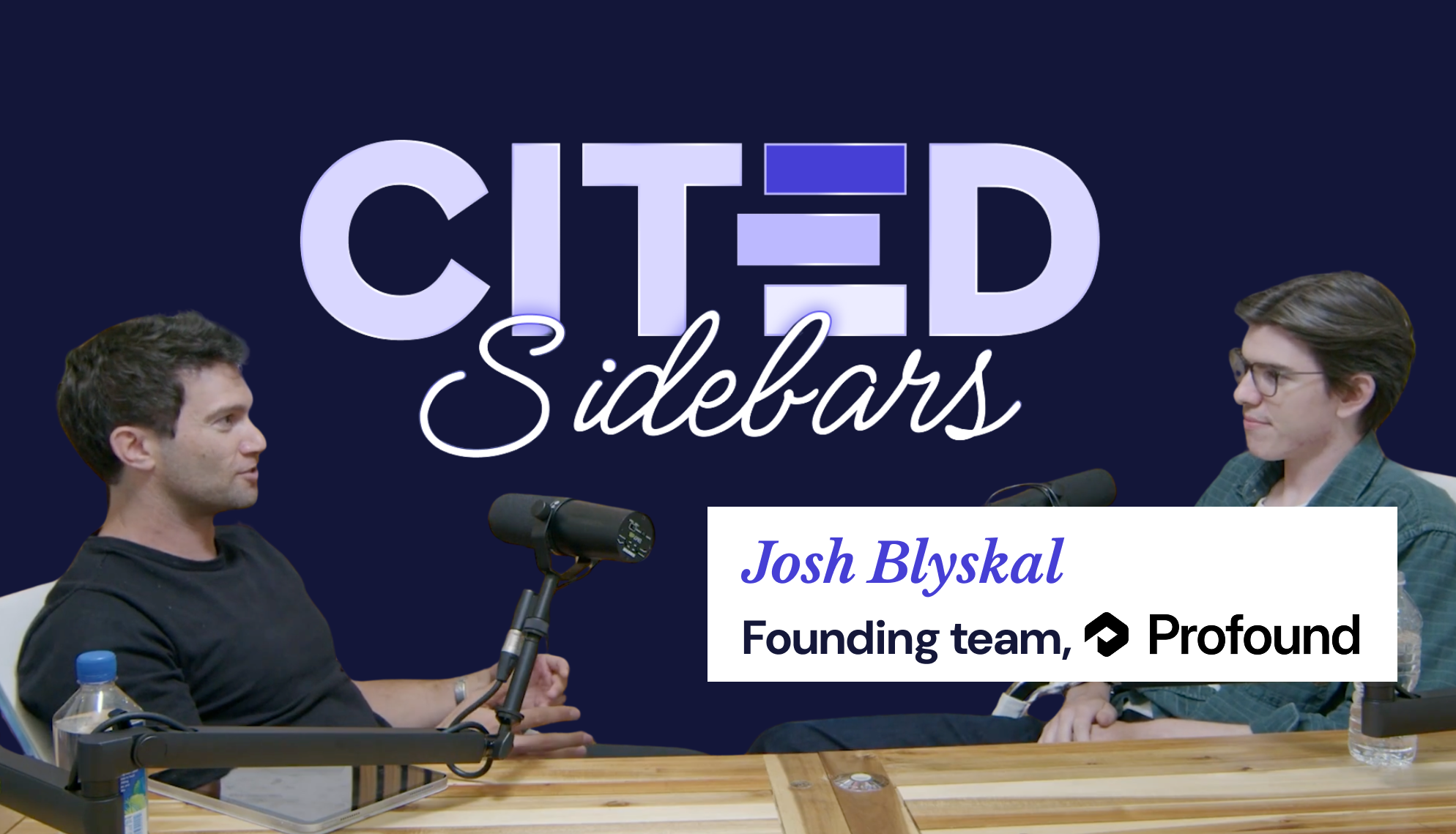
Our first conversation is with Josh Blyskal, a HubSpot alum and founding team member at AI marketing platform Profound.
Here are four key takeaways from the conversation, which you can watch in full above.
1. Be your own source of truth
Where should startups and small businesses even start thinking about AI search? Where will they get the best bang for their buck?
For Josh, it's a simple start: "Put stuff about your brand on the web."
He explained that most people overestimate how much answer engines are willing to piece together about their brand or product.
"If you don't have an explicit place that acts as a source of truth," he said, "you're already behind."
This is the advice he gives brands who approach Profound in search of sophisticated AI strategies: Start with the basics. Consolidate the facts about your company, including your products, team, growth, research, and mission, on your website in a readable and accessible way.
Once you have everything in one place, your website "becomes the source of truth for answer engines, but also for humans."
It seems simple, he said, "but I see so many brands that still don't do it."
2. A great website isn't enough
If setting up a well-organized, thorough website is AI marketing 101, then you can consider Josh's next tip to be the advanced course: A website on its own isn't enough to build a successful marketing strategy. It's just the foundation.
"Answer engines are looking for the breadth of mentions," he said. Perhaps the second most important thing about GEO and AEO overall, he went on, is the fact that you need messaging consistency across multiple platforms. Even a great website "doesn't matter" if your narrative doesn't exist in multiple places in a relatively consistent way. Answer engines expect to see your website, but they're also going to check your blog, LinkedIn, and some news articles.
Once you've taken control of your own channels, "start building on different channels," Josh said. "Start distributing yourself on LinkedIn, start making partnerships with earned media, start getting yourself into the news, start building a blog, start building out consensus around what your brand is doing that’s linked to the overall industry terms."
Once you create a single source of truth about your brand, the effect snowballs over time.
3. Make it easy for AI
Just like you want LLMs to turn to your own website for information about your company, you want to make it easy for them to understand and cite the content you publish.
Josh explained that this is why listicles have historically been so successful in search engines: They do the work of aggregating answers. AI engines want to find information easily, and they’ll favor the websites that provide it.
That's why you want to create answer-forward, highly utilitarian content that genuinely answers the prompts you're trying to track. It's the same as SEO in that you're providing value, he said.
As Josh put it: "I always think in the back of my mind: If OpenAI was sitting here with me right now, would they be like, 'Damn, I wish everyone was writing content like that. It makes our answers look so good?'"
4. Speed matters more than perfection
According to Josh, the number one thing that sets a winning team apart is the willingness and ability to experiment with their content strategy.
"I think the hardest part in an AEO program is the first piece of content shipped," he said. Between writer's block and elaborate approval systems, he's seen customers take two or three months to ship their first piece. And that time really matters.
"It is a race against the clock," Josh said. From where he stands, the future holds both agents consuming information and agents writing information. Brands are going to be "by agents in some part and for agents in some part," he said, which means there’s an urgent question for brands building their web presence today: How much can you learn, and how quickly, before this technology gets democratized and everyone is in the loop?
"It's not just about getting through approvals and getting your first little experiment launched," he said. "It is a question of learning organizationally and changing how you work."

Madeline Stone is the Content Manager for Editorial & Insights at Stacker. She was previously a longtime business and tech journalist at Business Insider and a content and communications consultant for startups.