
For the past year, one of the most common questions we've heard from brands is some version of: "We know our earned distribution efforts are impacting our AI search visibility, but how do I measure the change and optimize for it?"
That question just got a lot easier to answer.
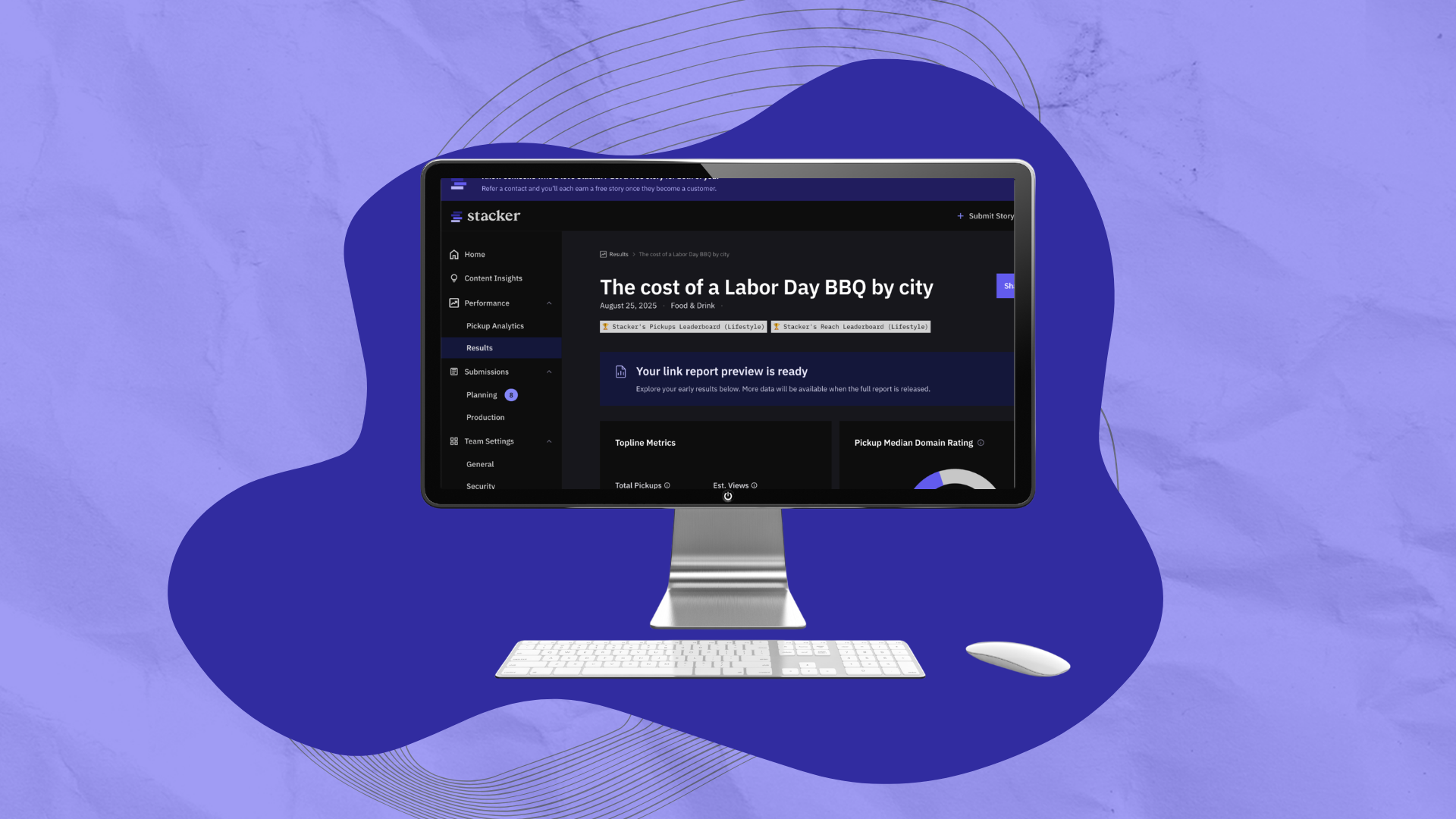
Today, Stacker is launching GEO Reporting — a new feature built directly into the Stacker portal that tracks how your distributed stories perform across AI search platforms, and how these stories contribute to your AI visibility.
This update enables brands to move beyond their owned-channel analytics and get the whole story. As AI engines increasingly reward your brand’s off-page authority, it's imperative that you have visibility everywhere your brand appears. GEO Reporting makes the earned impact from Stacker distribution more measurable than ever.
What GEO Reporting shows you
AI visibility starts with a prompt — a question a user (often a potential customer) asks an AI platform like ChatGPT or Claude. Whether your brand appears in the answer determines your visibility.
Your brand can show up in two ways. A citation is a clickable link inside an AI response pointing to your content, either on your site or through a third-party publisher. A mention is when your brand is referenced by name without a link. Responses can include one or both.
Every story distributed through Stacker is tracked across 30 prompts on six AI platforms, including ChatGPT, Claude, and Google Gemini, for four weeks after distribution.
Prompts are selected to reflect real audience search contexts, drawing on our content strategy team's insights across industries and pickup performance.
Four metrics anchor every story report:
Response Presence Rate — the percentage of tracked AI responses that included your brand, whether through a mention or a citation from your domain or a Stacker network publisher pickup.
Citation Rate — the percentage of all collected citations which are to your brand's content or a Stacker network publisher pickup of your story.
Citation Lift — how much the Stacker network amplifies your citations. This is where you see the network effect in action.
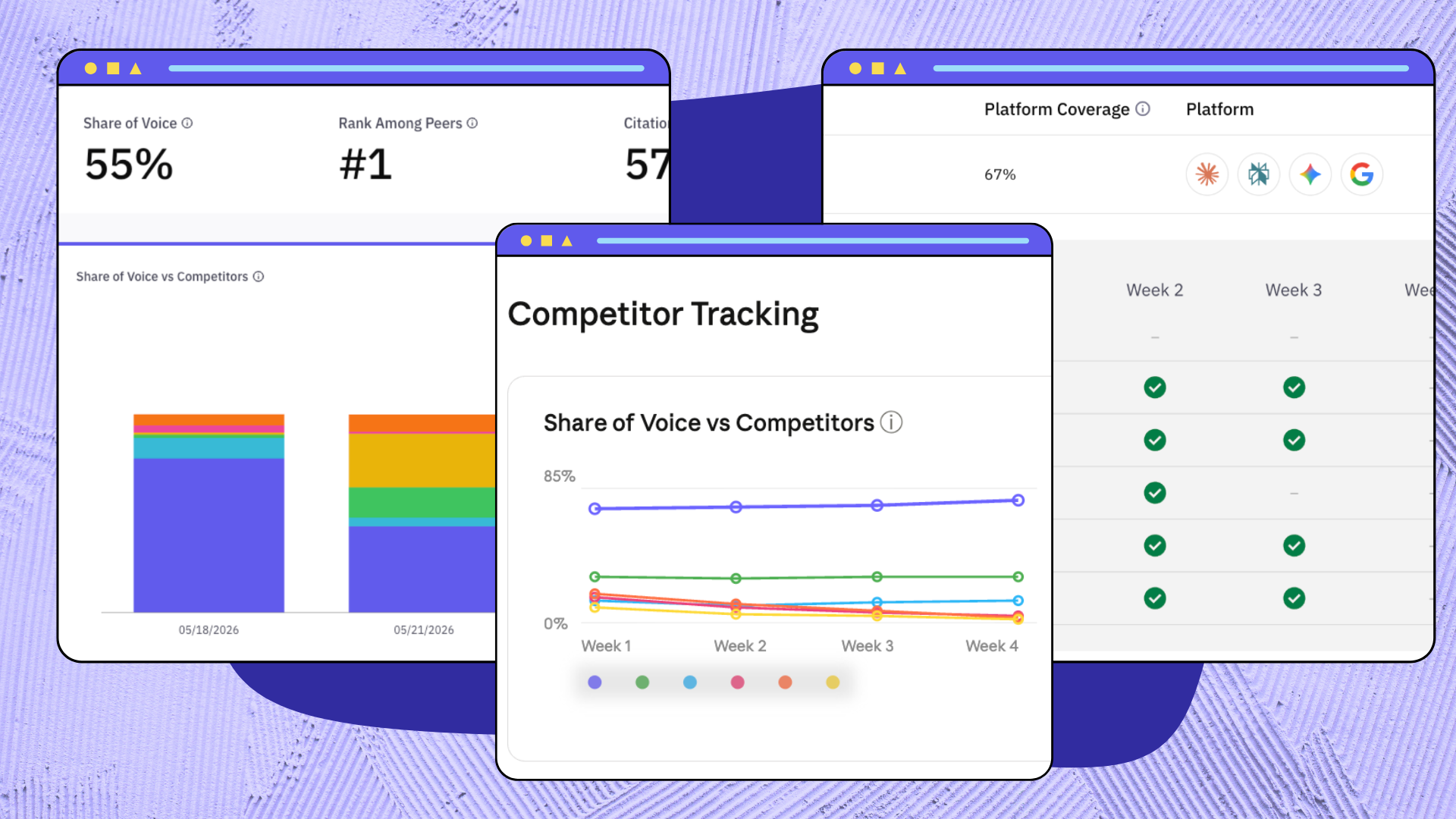
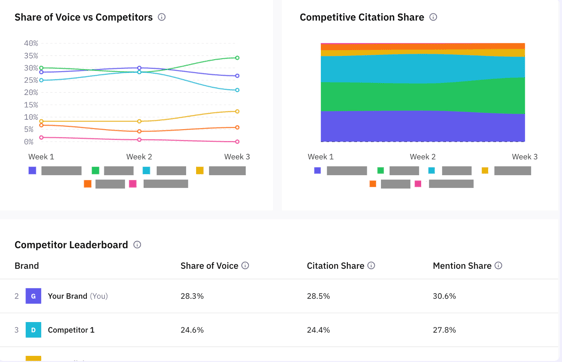
Share of Voice — your brand's share of AI response appearances relative to tracked competitors covering the same topics and prompts.
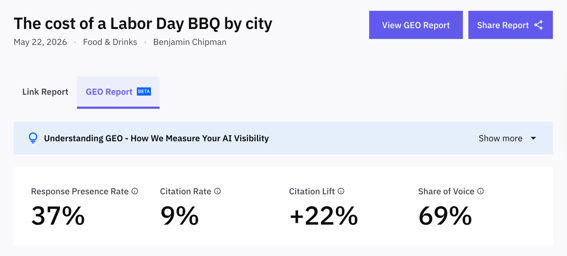
Together, these four metrics give content teams a real answer to the questions that leadership is increasingly asking, like “Are we actually building authority in AI search and can we prove it?”
Visibility over time
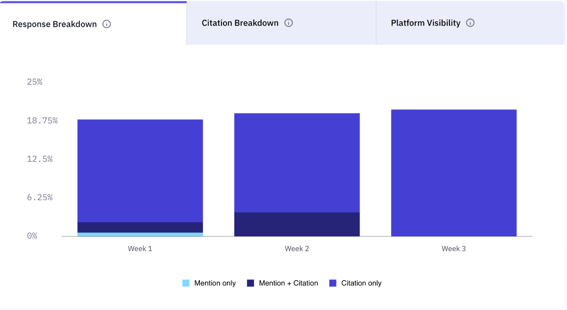
Below the top-line metrics, a weekly chart tracks your story's performance week by week.
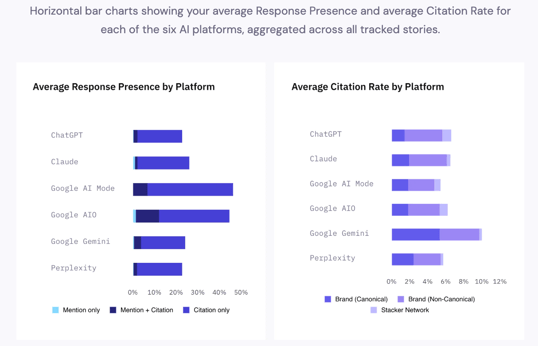
Three views give you different cuts of the same data: Response Breakdown (mentions vs. citations), Citation Breakdown (brand citations vs. Stacker network citations), and Platform Visibility (Response Presence Rate by AI engine).
Platform Visibility is particularly useful for understanding where your content is gaining traction.
Performance varies meaningfully across engines — for example, Perplexity is citation-heavy by design, while others are more selective — and as we work to empower content teams to prove the ROI of their efforts, knowing which platforms are consistently picking up your content is an essential piece of that narrative. At the end of the day, it’s the difference between optimizing in the dark versus making informed decisions about where to focus distribution efforts.
Seeing which platforms are picking up your content consistently is a signal worth tracking, both for individual stories and across your full distribution history. It can also help guide your GEO strategy, depending on which AI platforms your target audience uses most.
Prompt-level data and network citations
Every story report also includes a full breakdown of all 30 tracked prompts — which platforms showed your brand, which weeks, and a Platform Coverage rate for each. This tells you which angles and subtopics of a story are gaining traction in AI search and which aren't.
Over time, that data informs how you frame future content on similar topics and helps teams build more effective prompt strategies.
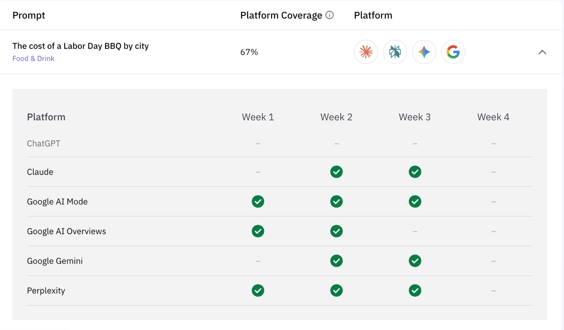
Alongside that, the Stacker Network Citations section shows exactly which publishers in the network are being cited in AI responses for your story — including their domain, publisher segment, Domain Rating, and share of tracked responses. It's a ground-level view of your earned distribution at work, showing where the network is generating the most authority on your behalf.
The GEO Analytics dashboard
Beyond story-level reporting, you get access to the GEO Analytics dashboard, which gives you an aggregate view across your full distribution history, Response Presence Rate and Citation Share trends over time, a full story performance table filterable by category and publish date, and platform-level averages across all tracked stories.
For brands on Scale plans, Competitive GEO Reporting adds a portfolio-level competitive summary — your Share of Voice across all stories, your rank among peers, and how your mention and citation share compare to your competitive set.
Why this matters
GEO Reporting gives Stacker customers the data they need to guide their content strategy and make a clear case for attribution internally.
It’s in service of our commitment to empowering the practitioners creating great content, to continue to create and have the tools they need to do so.
The Stacker Network effect was always there, our research from earlier this year (in partnership with Scrunch) on citation lift, coverage breadth and source decay proved that Stacker Network Partners not only created more visibility for brands in AI search, but also retained those citations 2.1x longer than other sources. And now, GEO Reporting makes it visible at the story level, in your portal, every time you distribute.
And it goes beyond internal reporting. With every story, you now have data to answer the questions that matter most:
- Which topics build the most AI presence?
- Which platforms are responding to your content?
- Where are competitors outpacing you, and where are they absent?
These are now answerable questions:
As Noah Greenberg, Stacker's CEO, put it: "Every piece of content distributed through Stacker now comes with a clear picture of how it's building authority in the places audiences are increasingly turning to for information."
That's what GEO Reporting is built to deliver.
Available now
GEO Reporting is live for Growth and Scale customers starting today.
If you're a current customer, find it under the Performance tab in your portal. If you want to see it in action, request a demo.
Empower your content team by diving deeper into the data.