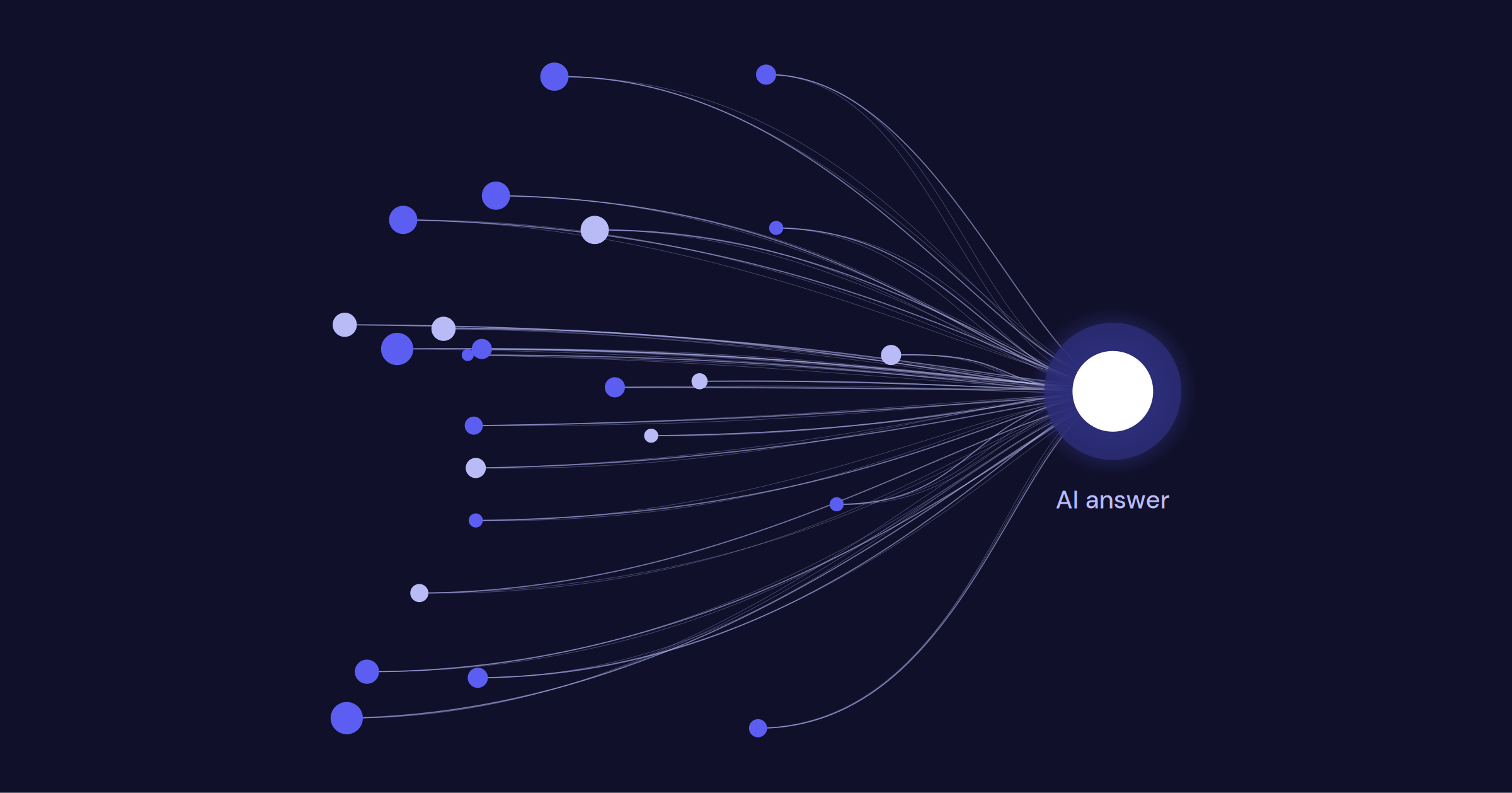

Due to AI overviews and zero-click answers, AI search caused devastating declines in web traffic. The traditional methods for tracking brand visibility fell out of balance and brands have been left scrambling to figure out how to react.
It was this “Great Decoupling,” when web clicks and demand fell out of sync, causing unevolved KPI stacks to make ROI look dismal.
Though, it simply required a new way to look at the situation. It wasn’t that nobody was seeing brand content anymore. Instead, it was that where they were seeing it had changed. Consequently, this changed the rules of measurement.
Earned media has become the key driver of brand visibility in LLM answer engines, surpassing traditional SEO, prompting brands to rethink how they measure ROI for their earned media strategies. This measurement must tie directly to business outcomes in order to prove impact, and relying on outdated last-click attribution, simply isn’t cutting it anymore.
The backstory: Why last click is dying
Users no longer rely on page rank to decide which sites to click on and get answers — AI nearly made those clicks obsolete. As a result, website visits are way down, but that doesn’t mean brands’ bottom lines have bottomed out.
It means that web traffic is no longer a reliable proxy for business growth.
It’s not as easy to follow a clear funnel from traffic to final conversion, whether that's a demo booked or a point of sale. What was once more traceable now relies on higher levels of both brand authority and visibility, as consumers turn to LLMs to inform their purchasing decisions.
It’s more difficult to draw a direct line between ROI from efforts on increasing visibility as compared to marketing efforts meant to increase traffic like paid ads or SEM campaigns.
The lack of the ability to draw that direct line misses a huge piece of your brand’s overall digital footprint.
Brands need new means of measuring and reporting on their LLM presence, in a way that isn’t dependent on traffic. Now that clicks are optional, they’ve fallen off of their pedestal in a traditional KPI stack to make room for new KPIs.
The KPI Stack built around GEO
This fundamental shift in measuring success makes earned media strategies more valuable than ever, due to the direct relation between earned media wins and AI visibility.
As we build this new measurement approach, we need to be able to take it to leadership as a clear story. That means defining the right GEO KPIs at each stage, with some metrics that show early wins quickly, and others that build momentum as brand authority compounds over time.
👀 Layer 1: Platform Visibility - Your KPI Headliner
Measuring platform visibility starts with understanding your baseline LLM performance. These are the KPIs a lot of brands are hungry for right now to guide internal GEO conversations, and the good news is establishing a baseline is pretty straightforward.
- Platform Visibility Rate : Percentage of tracked answers where your brand appears: either in a mention and/or citation by an AI platform, including Google AI Overviews, ChatGPT, Perplexity, Gemini, and Copilot.
- Visibility by topic cluster : How visible the brand is across the topics that matter most to the business, like company comparisons, category terms, and problem/solution queries. This is about identifying gaps to fill– it’s not a hard science.
Hot Tip : Use a GEO visibility platform like Scrunch to track prompt sets, platform-by-platform presence, and brand visibility changes over time.
The Proof
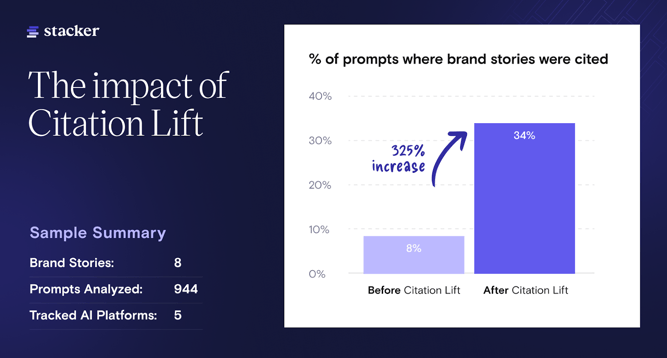
- Earned distribution drove a 325% improvement in citations on LLMs in Stacker’s Citation Lift study.
- After implementing an earned distribution strategy with Stacker, one popular HR technology company saw +251 Google AI Overview citations across +27 pages , with additional early momentum across ChatGPT, Perplexity, Gemini, and Copilot platforms.
🔊 Layer 2: AI Share of Voice - The KPI for Your Competitive Edge
There are only so many brands an AI answer can cite, so how you stack up matters, especially against competitors for the same prompts.
- AI Share of Voice/Answer : Calculate your brand’s mentions/citations, plus total mentions/citations across your identified prompt set, by topic cluster and LLM platform.
- Competitive displacement : Identify clusters or queries where your brand gained visibility within LLMs, knocking your competition down or out of the topic cluster or prompt set.
Why it matters : Stakeholders don’t just want metrics that say your brand showed up in AI. Rather, they want to hear: “We’re winning the conversation,” or “We’ve figured out how to do better.”
🚀 Layer 3: Citation Lift - The KPI Proving That Your Earned-Media Impacts GEO
Early results from Stacker’s Citation Lift Study show that the more brands get their stories republished across third-party news outlets, the more they are cited as sources in LLMs. And it’s not just Stacker research showing this, Muck Rack’s Q4 2025 study reports that around 90% of AI citations come from earned media.
- Baseline vs post-distribution : Use Citation Lift as the core “impact line” to quantify the value of earned media and earned distribution.
- Source mix breakdown : Compare brand domain citations (from owned media) against the citations of third-party published organic content (from earned media) to show how wider distribution expands the reach of brands inside LLM retrieval systems.
📈 Layer 4: Earned Media Pickups - Measuring AI Input instead of Output
These are your traditional PR metrics. They’re not the whole outcome anymore, but they’re still worth tracking now that earned media has new pull in an AI-driven world.
- Pickups/placements volume
- Placement quality mix: Evaluate the outlet’s authority tier and relevance to the brand’s topic. Keyword ownership used to be the brass ring for brands. Now it's topical ownership.
- Pickup velocity: How quickly your brand content spreads across relevant media outlets
- Coverage breadth: Gauge your balance of coverage, from hyperlocal to regional and national.
Hot tip: Don’t overlook local media. Local storytelling carries significant weight in LLMs, especially as major news outlets refuse to let their sites be indexed within many AI platforms.
How to position pickups: Pickups are the critical lever of influence that impacts the outcomes of Platform Visibility and Share of Answer. This makes your brand’s earned media strategy essential.
💸 Layer 5: Business impact
Without last-click attribution, there are still ways to mark the effect of earned media on your brand’s bottom line.
- Branded demand lift: Identify trends in brand searches or direct traffic
- Influenced pipeline: AI educates users on brands and can create demand without direct traffic. Track assisted conversions, or final sales that began with brand visibility in LLMs and brand authority.
- Inbound quality: Calculate percentage of business leads that become opportunities, opportunities that lead to closing sales, and sales cycle length. See how these evolve over time as you expand your strategy.
- Sales-intel signal: Pool qualitative info, like prospects’ and new customers’ quotes that say, “I keep seeing you everywhere,” or “You came up when I searched.”
When LLMs flipped search on its head, brands were actually given an opportunity: their pipeline could flourish without needing to drive proportional website traffic.
In 2026, PR and content marketing reporting should reflect this new reality. That means strategies shift and what’s measured does too. Search isn’t dead, but it definitely looks different.
All the KPI Layers You Need in One
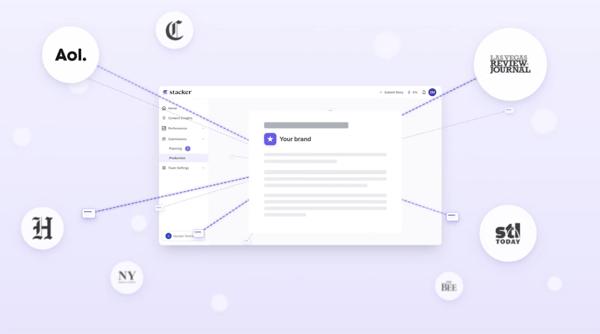
Stacker’s content distribution model is built to expand platform visibility and drive Citation Lift — the ultimate KPI for the AI search era, mapping how brand discovery works in 2026.

Doriane is Stacker’s Director of Marketing. She previously headed marketing departments in various companies, owned a marketing agency for 7 years, and built a startup combining automated marketing workflows with a marketing services marketplace.
Photo Illustration by Stacker // Canva