
Why Utah’s Silicon Slopes hiring feels like it’s at a standstill: ‘It’s taking a toll.’
Cody Scott’s foray into the tech sector began at Snow College, where the then-football player and some of his friends built an app to help fellow students find events and parties. The startup went on to get early accolades, and it planted a seed for Scott.
He found he was good at this type of work, designing software and products for real people, “being very empathetic to the problems that the user’s facing.”
He knows it sounds “cheesy,” but he started to see tech as a relatively quick way to earn a high salary, support his family and achieve the American dream.
“As long as you have the skillset and you understand how to work within that culture, you can sort of climb the ladder,” he said, “which is what I’ve been doing.”
As he jumped to different tech jobs over the years, his income provided everything for his wife and their two kids, he said.
Until November 2024, when Scott lost his remote job as a senior product designer and spent more than a year searching for another. His wife, who was studying nursing, had to get a job. They had to work with their mortgage lender to pause payments so they didn’t lose their home.
“We were OK,“ he said, “but we were literally just scraping by throughout the whole year.”

It’s not just Scott. Many others told The Salt Lake Tribune a similar story — filing job application after job application, seemingly into the void.
Hiring and job growth are slowing nationwide as economic uncertainty remains high, and the national unemployment rate increased to around 4.4%, according to the most recent U.S. Bureau of Labor Statistics report, up a tenth of a percentage point from November. Utah’s is lower at 3.6%, but still up from a year ago.
The tech industry has been hit particularly hard, all as artificial intelligence proliferates and the torrent of investments that once flooded the field have slowed with higher interest rates.
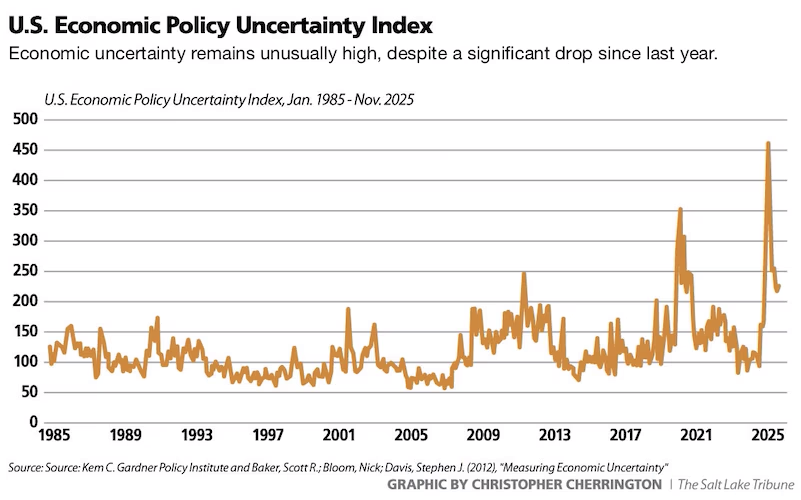
Utah’s Silicon Slopes region is no outlier. The state’s tech hub had been steadily growing until a recent slump “amid a slowing economy and increased funding costs,” Gwen Kervin wrote in a 2024 paper about the state’s tech employment. The Utah nonprofit also called Silicon Slopes, which empowers local startups and businesses, declined comment.
Kervin, a senior economist with the Utah Department of Workforce Services, said there are signs of recovery.
And Madison McCord, chief human resources officer at Domo, the Utah-based business intelligence company, said the situation is “really a sign of durability,” and the “natural effects of success.”
“We see this moment less as a slowdown and more as a reset toward sustainable growth, one that strengthens the local ecosystem. And at the same time,” McCord added, “it is creating room for the next wave of scrappy startups.”
When the search starts to wear people down
For many displaced workers, though, a rebound doesn’t feel realistic.
It’s not unusual in the tech sector to weather layoffs and restructuring. But Scott is one of many who have struggled to find work in this particular period of disruption.
“I stopped counting my applications around 500,” Scott said in January. He estimates he submitted about double that number.
As the search dragged on, Scott said, he started to think — despite his qualifications and years of experience — that he was the problem.
Was he not talented enough? Had he not developed enough new skills, what the industry refers to as “upskilling”? He wondered whether he’s not the type of Black guy people might “want him to be” — “entertaining,” like “Kevin Hart, Will Smith,” instead of the “laid back and chill” person he is.
“It’s like, that’s ridiculous. I can’t even believe I was thinking it, but it does it to you, when you’re being told no over and over again,” he said. “You’re just searching for answers.”
Matt Schulz, LendingTree’s chief consumer finance analyst, said social media is full of posts from people feeling dejected.
“All it takes is spending 30 seconds on LinkedIn to see the frustration that is out there among job seekers,” Schulz said.
The ones who spend months, a year, or more looking for work aren’t just struggling financially, he said. “It’s taking a toll on them emotionally, and they’re trying to keep their hopes up,” Schulz said. “It isn’t easy.”
Right now, there just aren’t enough Utah tech jobs for the amount of people seeking them, according to “Hold My Fry Sauce,” a popular Silicon Slopes parody and gossip-gathering Instagram account with more than 7,400 followers.
The person who runs the account told The Tribune that they have worked in Utah’s tech industry for years. They fear revealing their identity could lead to retaliation from employers, and The Tribune has agreed to not use their name.
They said they’ve heard from people who are “well-connected” who have gotten jobs within months — giving credence, they said, to the idea that it’s less about what you know than who you know.
But they’ve also heard from well-connected people who spent nearly a year searching before eventually taking other “transitional” jobs to make ends meet.
Hiring managers are also feeling the pressure, the “Fry Sauce” admin said, adding they’ve heard that some roles have received 500 to 800 applications within a week of being posted.
“I don’t think most companies are intentionally excluding people; it’s more that the sheer volume of applicants has broken the traditional hiring process,” they said. “Combined with risk-averse hiring, budget freezes, and fewer open roles overall, it creates a system where a lot of good candidates are effectively invisible.”
Greg Green lost his job at Oracle in March, after more than 20 years with the company. While job hopping can be a good thing — and can lead to higher wages and career advancement — Green stayed at Oracle because he needed security.
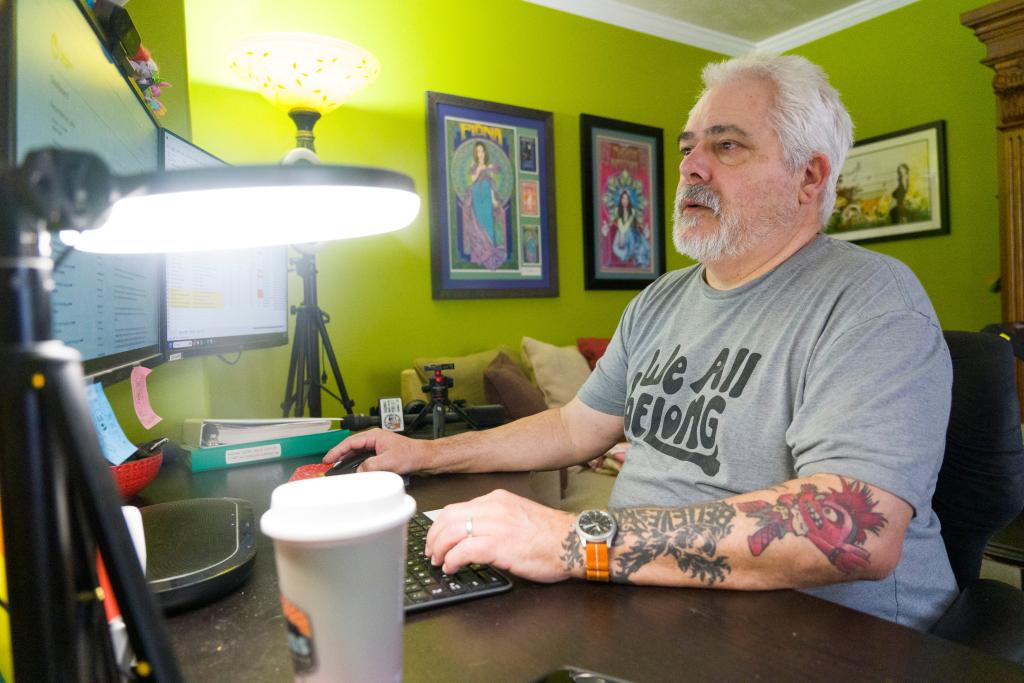
Green, 58, has diabetes. He and his wife also have three children, two of whom are permanently disabled and dependent on them. He needed to make sure he didn’t lose health insurance or other benefits and could take care of himself and everyone else. The remote aspect of his job was also important.
“Because I could stay at home and take care of my daughter, and I could also get insurance, and get my job done, and be appreciated for that,” he said, “but it wasn’t enough.”
Since he was laid off, Green has applied to hundreds of jobs. And nearly as many times, he’s heard some version of this same refrain: We appreciate the time that it took to complete this application. Due to the overwhelming number of applicants, we’ve decided to continue with other applicants for this role.
Or, he said: We regret to inform you that the role was filled. Good luck.
“It’s just over and over,” he said.
At Domo, managers haven’t “slowed hiring,” according to McCord.
“But we have gotten more intentional about it,” she continued.
“As the business has matured,” McCord said, “we’ve focused our hiring on roles that directly support customer value and long-term growth strategy.”
For Domo, that means hiring developers and salespeople with experience that aligns with their cloud partnerships with Snowflake, Databricks and Google.
Is AI to blame?
At least part of the industry’s slowdown is because of artificial intelligence.
The proof was in a chart projected around the Grand America’s ballroom in January, where lawmakers and business leaders gathered ahead of the legislative session to discuss the economic outlook and weigh the impact of public policy.
As the graph indicated, the rollout of ChatGPT in late 2022 coincided with the slowdown job seekers are seeing.
“Like every tool that’s ever been invented, it can be a positive,” Gov. Spencer Cox said about AI. Former Arizona Sen. Kyrsten Sinema, who joined Cox in a panel discussion, pointed to AI benefits for public safety, such as using it to time street lights or guide first responders to emergencies.
But it also comes with disruption.
“AI will take some of our jobs,” Cox continued. “And what’s a little different about this disruption, or this evolution, that we’re seeing right now is historically, when we’ve had new tools, the disruptions have really affected the blue-collar workers.”
“Plumbers,” Cox said, “are going to do really well in this evolution.”
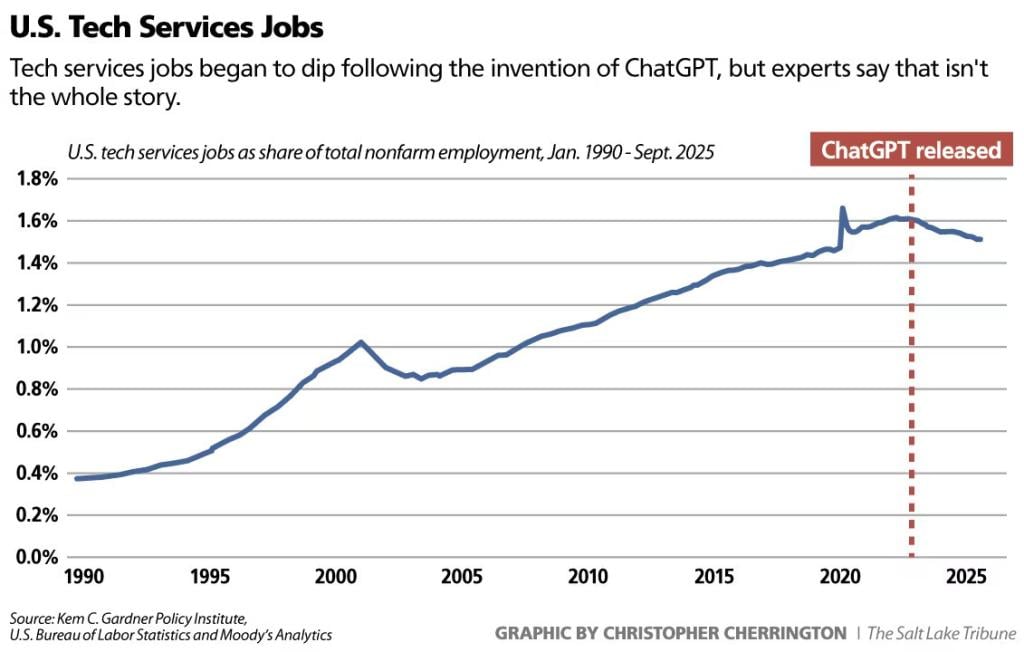
But AI isn’t the only force contributing to the slowdown. High interest rates and economic uncertainty also play a role. Years of overhiring during the pandemic-era tech boom, followed now by a shift to investing in data centers, are also factors, said Mary Hall, director of the University of Utah’s Kahlert School of Computing.
White-collar workers faced similar challenges when the personal computer, the internet, the cellphone and cloud computing were invented. Despite earlier challenges, those technologies all led to new industries and jobs, she said.
“There may be a transition period now,” Hall said, “but we expect this to follow that same pattern, with normalization and then another period of growth.”
Right now, the tech industry seems to want people with more experience as AI takes over tasks typically reserved for junior engineers.
At Domo, McCord said, “AI is definitely part of what is reshaping the talent market, but for us it’s not about replacing people, it’s about changing how work gets done.”
She said the company has created an “AI council” to evaluate how the technology is used internally.
“The goal is to help teams work smarter while keeping humans firmly in the loop when it comes to judgment, context, and accountability,” she said.
Reasons for optimism
Younger workers new to the labor market are having the most trouble finding jobs. The unemployment rate for those age 20-24 is well above the national rate, at 8.2%, according to federal data. Since at least 2001, a gap like that has existed, but it’s widening.
“The current no-hire, no-fire labor market — and the prospect of a jobless expansion — is an enormous challenge for members of Gen Z who are just now entering the labor force,” according to a November research briefing from Oxford Economics.
These workers are “more vulnerable to economic downturns,” the briefing continued, because they haven’t yet accumulated wealth. That means a “weak labor market can have a lasting negative impact on wage growth and earning potential.”
Job seekers are also getting trapped by an increase in so-called ghost jobs, according to NPR, where a listing is posted but no one is ever hired, either because it’s fake or because a company posted for more open positions than needed. For every two job postings, one doesn’t get filled, NPR reported.
Employers are implementing AI to help filter the large pool of applicants they get, too, which can cull good candidates in the process. Some candidates are using AI to fight back and send out hundreds of applications.
Hall said her school is updating its curriculum to help better prepare students. They’re adding a new minor in AI this fall, as well as AI pathways within their majors and additional courses on cloud computing and data centers. Professors are also coaching students to look beyond traditional tech jobs, she said.
There’s some good news on the horizon: The percentage of Utah businesses that planned to add new employees in the coming months was higher than the percentage who expected to cut staff, according to the U.S. Labor Department’s December jobs report.
Schulz, with LendingTree, said a downturn in Utah’s tech industry would be “a big deal” for the state.
“This data doesn’t suggest that, though,” he said, adding that “I think, in all, that bodes well for Utah.”
Utah’s own jobs report also had promising signs, Kervin said.
That report, released about a week ago, shows the state added 21,800 jobs in a year — a 1.2% gain compared to national growth of 0.3%.
Growth in the information sector was even higher, Kervin said, at 6.3%.
“I’m not seeing, in Utah, what is perhaps happening in the rest of the United States,” she said.
Utah has made attracting tech companies a priority, she said, and the state’s efforts — and talent pool — are paying off.
“It looks like Utah’s growth in this sector is outpacing what we see in the rest of the United States,” Kervin said, especially in software development, data processing and data warehousing.
Whether that holds true, she said, is harder to say. The state will release its annual projections in the spring.
Green, whose severance ran out six months after he was laid off, is still holding out for a tech role. He thinks this AI “hype bubble” will eventually pop. “If I can survive that long,” Green said, “I might get a job coming off the end of that.”
In the meantime, he said, he stopped taking medications that helped control his blood sugar to cut costs. He also recently tapered off his antidepressants, both to save money and to avoid the potential side effects of stopping cold.
Thanksgiving and Christmas, he said, were hard. “I don’t feel very hopeful about the future,” he said.
Scott did end up landing a job — 13 months after his search began. It pays less than he hoped and it’s not remote, requiring him to come into an Orem office, but it’s a job.
“Even though I landed on my feet, like, it’s not without some collateral damage,” he said, “and it’s just like, I just have a sour taste in my mouth to this industry.”
He said when he got started in tech about eight years ago, there seemed to be more of an “entrepreneurial spirit.” Jobs allowed more autonomy and the culture felt more optimistic and exciting, where the “best idea wins.”
Now, Scott said, it feels like there’s less interest in solving problems or creating new ways to do things.
“It’s more [about] creating shareholder value,” he said, “and whatever’s best for the bottom line.”
This story was produced by The Salt Lake Tribune and reviewed and distributed by Stacker.