
Don’t quit your day job: ‘The Great Stay’ has arrived
Punctuated by high-profile layoffs at companies like Amazon, Microsoft, Target, and Verizon, the U.S. unemployment rate rose to 4.4% in September 2025. For employees, who often consider new job prospects around the start of a new year, this data begs an important question: Should I take a leap of faith and start a new job in 2026 or hold on tight to the role I already have?
According to new research from Pave, a compensation intelligence platform that collects real-time pay and workforce data from thousands of companies, employees are leaning toward the latter. People are staying put, ushering in a new workforce trend called “The Great Stay.”
This article delves deeper into this phenomenon, exploring its implications for employees and businesses as we move into 2026.
“Job Hugging” is on the Rise
The term “job hugging” refers to the idea that people are more likely to stay in their existing jobs as economic uncertainty rises, even if they are increasingly unhappy. In a job-hugging environment, we can expect to see two related trends emerge over time: employee turnover rates drop, and job tenure increases. Pave examined both of these key metrics across a three-year period, and the results are clear: Job hugging is on the rise, meaning employees are growing less likely to leave their jobs.
Among 1,500-plus companies with more than 100 employees participating in Pave’s dataset over the past three years, employee turnover, which includes both voluntary and involuntary departures, is down.
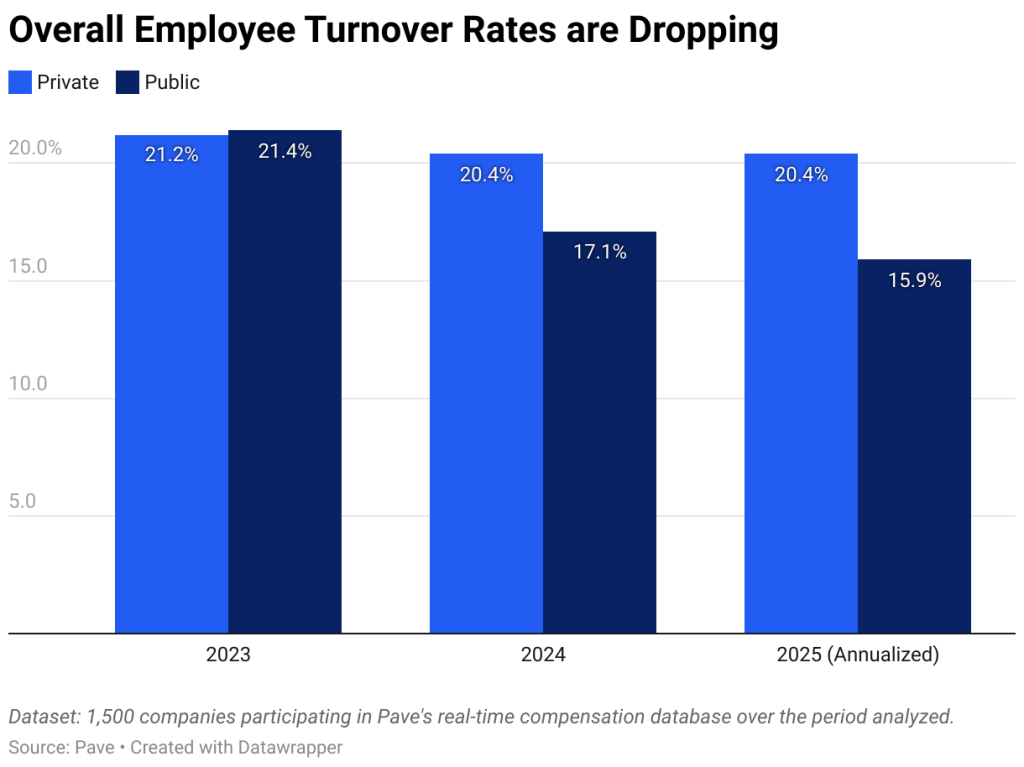
This trend is even more pronounced at public companies, where overall turnover rates dropped from 21.2% in 2023 to 15.9% year-to-date in 2025.
This nuance isn’t a surprise. Once layoffs start at public companies, employees quickly get more conservative. Rather than risking a job change in a moment of volatility, people often decide to hold on, calculating that they will survive job cuts or at least receive a severance package if they’re laid off. Importantly, severance packages tend to increase with tenure, so payouts are typically larger when employees are laid off from a long-term job than a new one.
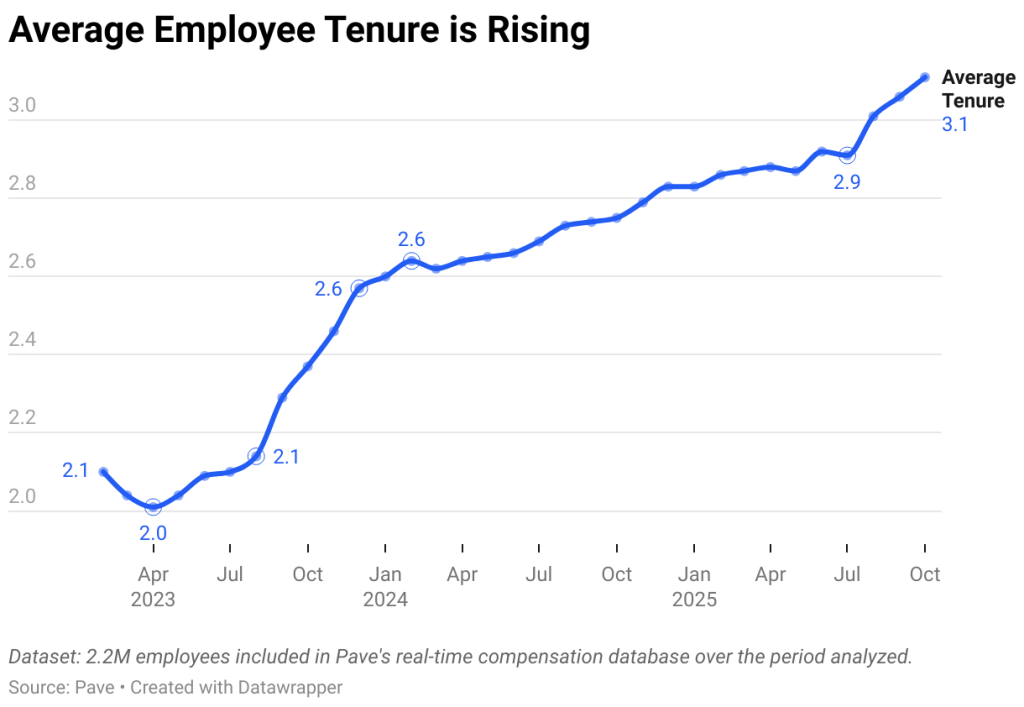
As turnover rates decline, employee tenure increases, and once again, new data from Pave paints an even clearer job-hugging picture. Between early 2023 and the present, average employee tenure is up by a full year and rising faster as of mid-2025.
Who is Job Hugging the Most?
The workforce is complex, so job-hugging trends can vary widely by industry, job function, and job level. Pave examined each of these dimensions to pinpoint areas where employees are most apprehensive about making a career change.
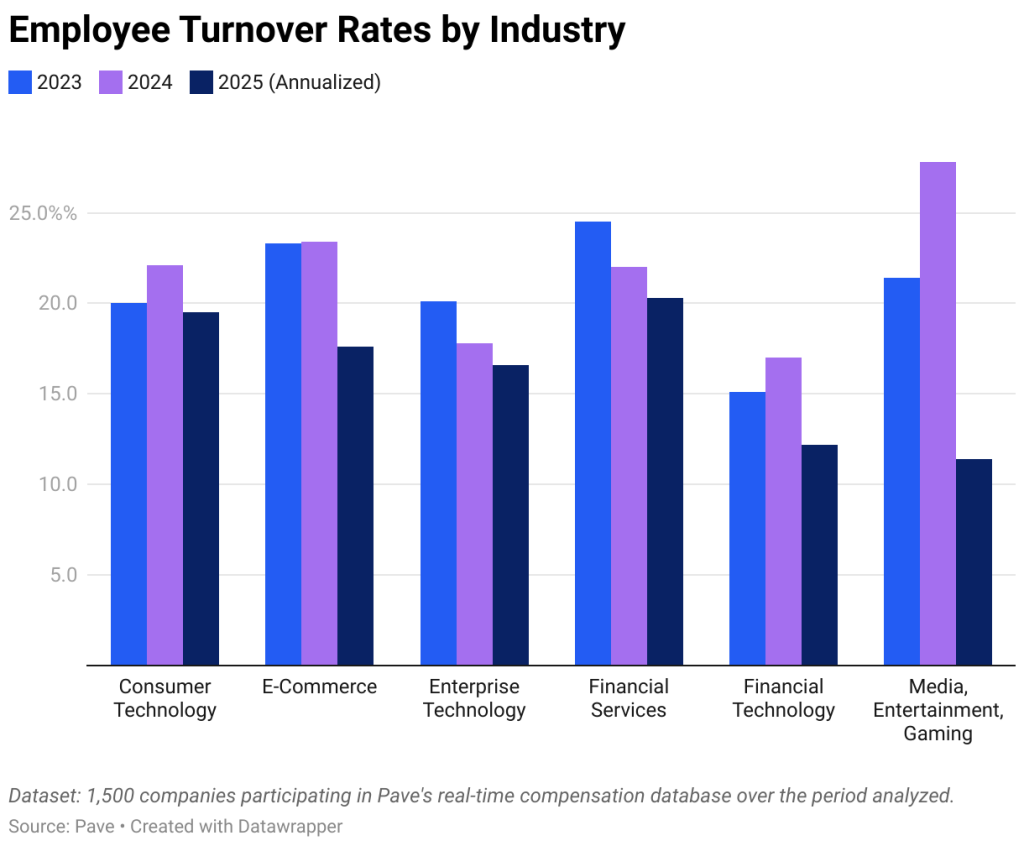
For example, when analyzing overall employee turnover rates in subsectors of the technology industry, turnover has slowed most dramatically at financial technology and media, entertainment and gaming companies. Turnover is down across the board, but clearly, employees in these two subsectors are most cautious.
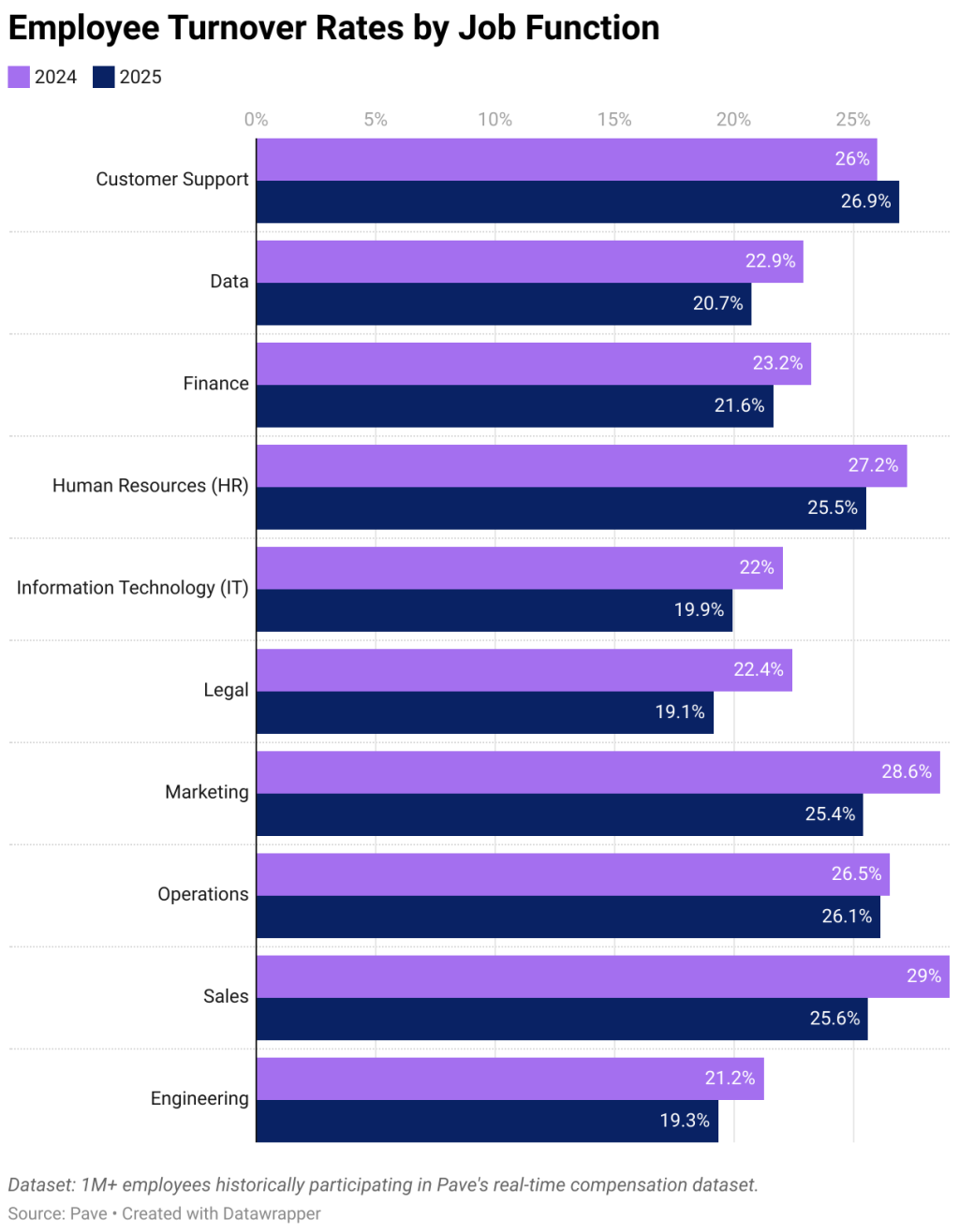
Next, Pave examined overall employee turnover rates by job function in 2024 and 2025. And, with the exception of customer support, turnover rates have decreased, with the lowest turnover rates observed in the engineering, information technology, and legal functions. In all cases, the adoption of AI technologies is likely to have an impact. There’s already evidence AI is replacing some customer success roles, leading to increased involuntary turnover (e.g., layoffs), while in other functions, fear of replacement by AI is boosting job-hugging behavior.
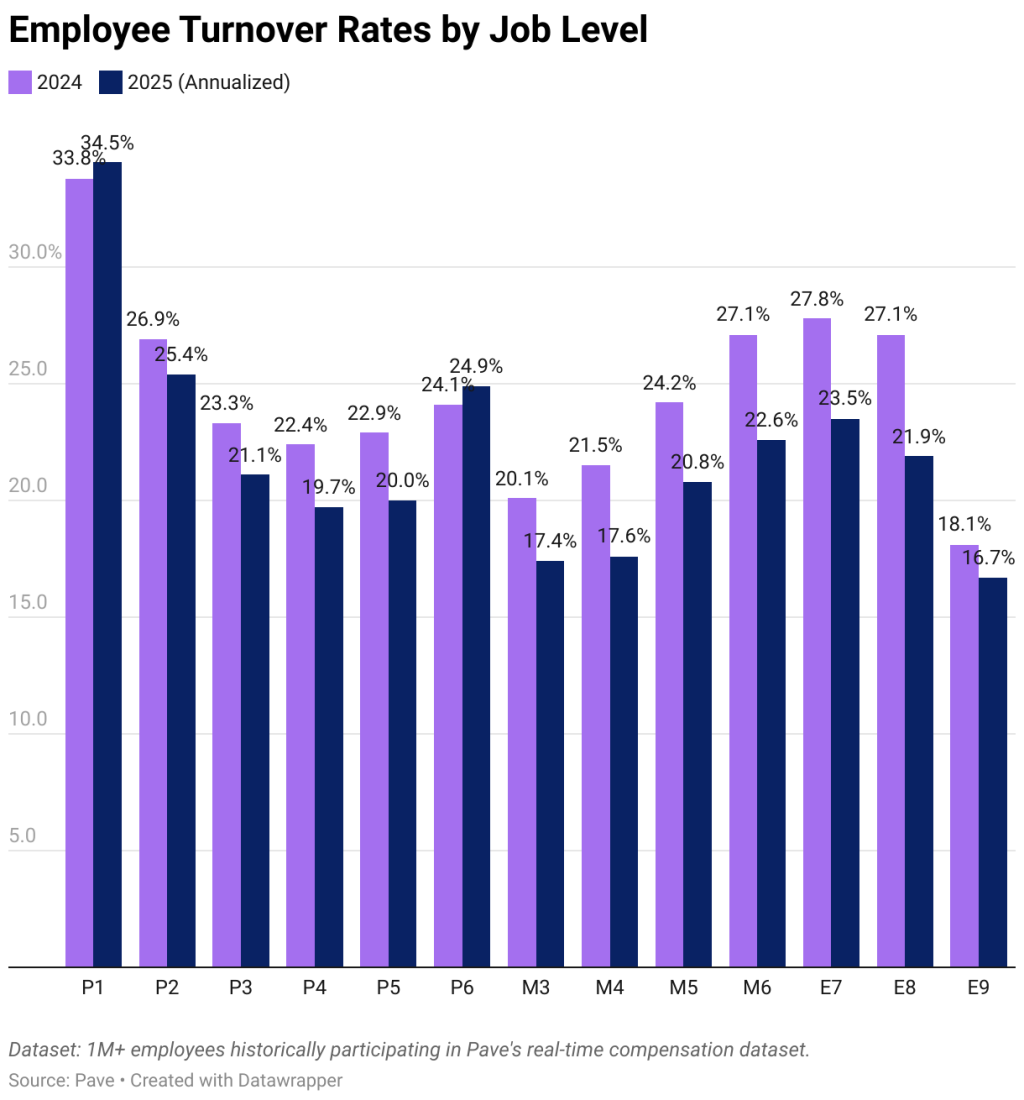
Another dimension to explore are overall employee turnover rates by job level. Among companies in Pave’s real-time dataset, turnover rates are down across almost every job level from 2024 to 2025. The only exceptions are entry-level professional individual contributors (P1 in the chart below), where early career job changes tend to inflate turnover, and the most experienced professional individual contributors (P6), who tend to have advanced degrees and highly specialized, in-demand skills allowing them to switch jobs more readily even in harsher employment markets.
Interestingly, year-over-year turnover rates are dropping fastest among management (M3 to M6) and executive (E7 to E9) level employees. Leaders in these roles have more visibility into upcoming workforce changes and tend to be more aware of overall business conditions. Reduced turnover at these levels is a particularly powerful signal of rising concern that changing jobs is not a great move at this time.
Looking Ahead to 2026
Will employees continue to hold onto their jobs in the future? Patterns observed in Pave’s latest research indicate that this is indeed the case.
Many of the factors behind The Great Stay have to do with market volatility and economic uncertainty, and neither of these macro trends shows signs of changing, especially as talk of an AI bubble looms. Thus, you can expect to see workers continuing to take a “wait and see” approach to their career paths in 2026.
For employers, it’s important to note that reduced turnover is not necessarily a sign of a happier workforce. Efforts to engage and retain employees, especially key talent and high performers, should not be taken for granted and put on autopilot. Your top talent will always have more options than everyone else.
Similarly, maintaining high engagement levels is important, as unhappy employees who remain in seats longer can hurt morale and culture. Companies should continue to nurture their employee engagement strategies and consider whether pay programs reward performance or just longevity.
This story was produced by Pave and reviewed and distributed by Stacker.