
GTM engineer: A high-impact career to consider in 2026
As companies race to scale revenue operations efficiently, a new role is emerging at the intersection of technology and business strategy: the GTM (go-to-market) engineer. According to ZoomInfo data, hiring for the role has doubled year over year for the last two years, with hiring peaks in January and July. In mid-2025 LinkedIn had over 1,400 postings for GTM engineering roles, with over 3,000 listed in January of 2026 and salaries ranging from low to high six figures. This position combines technical skills with commercial acumen to build, automate, and optimize the systems that power lead generation, sales intelligence, and customer acquisition.
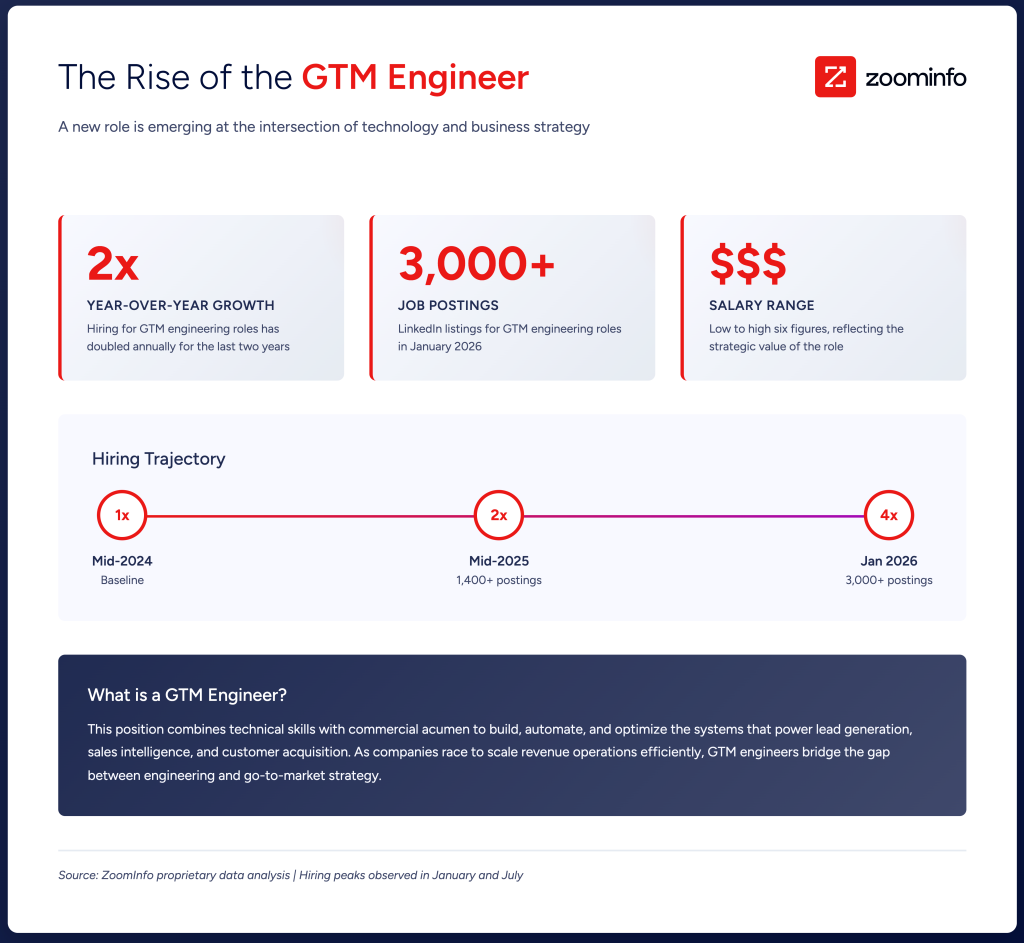
For professionals looking to pivot into a high-impact role in 2026, GTM engineering offers a compelling opportunity. The position is in demand, commands competitive compensation, and sits at the center of how modern companies drive growth through automated lead generation and sales prospecting tools.
What Is GTM Engineering?
GTM engineering is the application of an engineering mindset to revenue operations. GTM engineers design and automate the systems that power growth—from data pipelines and workflow automation to tool integrations and AI-powered processes.
The role spans software infrastructure, data management, and workflow automation, all working together to help revenue teams move faster, stay aligned, and execute without friction.
Some describe it as revenue systems engineering. Others see it as the next evolution of revenue operations. Either way, it's a critical function for companies building scalable, efficient, and intelligent go-to-market motions.
Wait—Isn't This Just Demand Generation?
The short answer: no. While GTM engineering and demand generation both touch marketing systems and care about growth, they sit in fundamentally different parts of the value chain.
Demand generation has historically focused on creating top-of-funnel leads through campaigns and programs. The role centers on volume: running ads, executing email campaigns, hosting events, and optimizing channels to drive more prospects into the pipeline. Demand gen teams answer questions like "How do we get more leads?" and "Which channels drive the most pipeline?"
GTM engineering operates differently. Rather than running individual campaigns, GTM engineers build the underlying systems that make revenue generation repeatable, automated, and scalable across the entire funnel.
Here's the distinction:
Demand generation asks: "How do we get more people in?"
GTM engineering asks: "How does the entire system work once they're in—and how do we make it automatic, intelligent, and compounding?"
Demand gen is about execution. GTM engineering is about architecture.
Consider the evolution: Demand generation traditionally ran one-off programs to generate leads. That approach worked when sales cycles were simpler and tech stacks were smaller. But as buying processes became more complex, the role needed to evolve. Modern demand generation now operates in an "always-on" mode—identifying signals that indicate demand and routing those signals to the right person to act on them.
GTM engineers take that evolution further. They're still responsible for systems that drive top-of-funnel demand, but they also own what happens after the lead comes in: routing, enrichment, scoring, nurturing, and conversion optimization. They build the infrastructure that turns signals into action and action into revenue.
A simple test: If the role primarily involves running programs, that's demand generation. If it involves designing how revenue happens at a systems level, that's GTM engineering.
How GTM Engineering Differs from RevOps, Marketing Ops, and Sales Ops
The confusion doesn't stop with demand generation. GTM engineering also overlaps with revenue operations, marketing operations, and sales operations—roles that have existed for years and already handle pieces of what GTM engineers do.
So what's the difference?
Revenue Operations (RevOps) focuses on process optimization, reporting, and tool administration across the revenue organization. RevOps professionals ensure teams follow consistent processes, maintain data hygiene, and have visibility into performance metrics. They answer questions like "Are our processes efficient?" and "What's our pipeline forecast?"
Marketing Operations manages campaign execution, marketing automation platforms, and lead lifecycle management. Marketing ops teams build email workflows, manage lead scoring models, and ensure marketing technology runs smoothly. They focus on making marketing programs scalable and measurable.
Sales Operations handles territory planning, quota management, compensation structures, and sales forecasting. Sales ops professionals optimize how sales teams are organized and ensure they have the resources and data needed to close deals.
GTM Engineering sits at a different level. Rather than optimizing individual functions, GTM engineers design cross-functional systems that connect sales, marketing, and customer success. They build the technical infrastructure that allows data to flow seamlessly between systems, automate workflows that span multiple teams, and implement AI tools that make the entire revenue engine more intelligent.
The reality is that existing operations roles do handle pieces of what GTM engineers do. A marketing ops professional might build a lead scoring model. A RevOps analyst might create a dashboard. A sales ops specialist might integrate two tools.
But GTM engineers approach these tasks from a systems-thinking perspective. They're not just solving point problems—they're designing how the entire revenue machine operates.
This creates an important organizational consideration: Companies can't simply hire a GTM engineer and expect them to replace existing operations roles. These historical functions still need to exist. Instead, forward-thinking companies are rethinking how their entire go-to-market organization works together, with GTM engineers serving as the architects who design systems that operations teams then maintain and optimize.
For professionals in demand gen, RevOps, marketing ops, or sales ops roles, GTM engineering represents an evolution—an opportunity to expand from functional optimization into cross-functional system design.
The Role Is New—and Growing Fast
GTM engineering is still an emerging discipline. The job title only recently began appearing in recruiting platforms and LinkedIn profiles. But the pattern is clear: tech-forward companies are creating dedicated positions to own the technical infrastructure behind their revenue engines.
The role emerged due to several converging forces:
Pressure for efficiency: In an era of tighter budgets, companies need to scale revenue without proportionally scaling headcount. GTM engineers build systems that multiply team output.
Tech stack complexity: Most B2B companies now run dozens of tools across sales, marketing, and customer success. Without tight integration, these tools create data silos and slow execution. GTM engineers connect these systems.
Rise of accessible automation: No-code and low-code platforms, combined with AI tools, have made sophisticated automation accessible to non-developers. GTM engineers leverage these tools to build revenue infrastructure.
Demand for personalization at scale: Generic outreach no longer works. GTM engineers build systems that use data enrichment and AI to personalize interactions at scale.
What Do GTM Engineers Actually Do?
GTM engineers sit at the intersection of strategy and technical execution. Their day-to-day work includes:
Integrating tools: Connecting CRMs, marketing automation platforms, analytics systems, enrichment tools, and product usage platforms so data flows seamlessly across the tech stack.
Automating workflows: Building systems that automate lead routing, follow-ups, data entry, and campaign execution, freeing revenue teams to focus on high-value interactions.
Managing data quality: Ensuring data accuracy, resolving identity issues, and maintaining clean schemas so every system runs on reliable information.
Building dashboards and alerts: Creating real-time visibility into GTM performance so teams can iterate quickly and act on what's working.
Implementing AI: Integrating machine learning tools for predictive lead scoring, personalized outreach, and identifying high-intent prospects.
For example, a GTM engineer might connect product usage data with CRM records and trigger automated alerts to customer success teams when engagement drops—giving them time to intervene before churn occurs.
Why Consider This Career Path
Several factors make GTM engineering an attractive career option for 2026:
High demand, limited supply: The role is new enough that talent pipelines haven't caught up with demand. Companies are actively hiring, and competition for qualified candidates is intense.
Competitive compensation: Because the role requires both technical and business skills, compensation tends to be strong. Professionals with this hybrid skill set command premium salaries.
Cross-functional impact: GTM engineers work across sales, marketing, customer success, and leadership. The role offers visibility and influence across the organization.
Future-proof skills: As companies increasingly rely on systems-led growth, the technical and strategic skills GTM engineers develop will remain valuable.
Rapid learning curve: The role exposes professionals to the full revenue lifecycle, modern tech stacks, AI implementation, and strategic decision-making.
Measurable impact: GTM engineers build systems that directly affect revenue metrics. Companies implementing automated GTM systems often report reduced customer acquisition costs and improved conversion rates.
Evolution opportunity: For professionals already in demand generation, RevOps, marketing ops, or sales ops roles, GTM engineering represents a natural next step—expanding from functional optimization into cross-functional system design.
Who Should Consider GTM Engineering
GTM engineers come from several backgrounds:
From operations roles: Sales operations, marketing operations, or revenue operations professionals who want to deepen their technical skills represent the most common pathway. These individuals already understand GTM processes and pain points—they just need to add technical capabilities.
From demand generation: Demand gen professionals who want to move from campaign execution to system design can transition by learning automation, integration, and data management skills.
From engineering or data roles: Software engineers or data analysts interested in the commercial side of business can transition by learning sales cycles, marketing fundamentals, and GTM-specific tools.
From sales or marketing roles: High-performing sales development representatives or marketers who are technically inclined can learn automation and data skills to build systems that scale their own manual work.
The ideal candidate combines curiosity about technology with interest in how businesses generate revenue.
Skills You’ll Need
GTM engineers blend technical ability with commercial understanding. Key skills include:
Technical proficiency
- Experience with CRMs like Salesforce or HubSpot
- Familiarity with automation platforms such as Zapier or Make
- Familiarity with - Basic scripting knowledge (Python or SQL helpful but not always required)
- Understanding of APIs and data integration
- Comfort with analytics and business intelligence tools
Commercial acumen
- Understanding of sales cycles and pipeline stages
- Knowledge of marketing fundamentals and campaign mechanics
- Familiarity with customer lifecycle and retention strategies
- Ability to translate business goals into technical requirements
Problem-solving mindset
- Identifying bottlenecks in in revenue processes
- Designing scalable technical solutions
- Testing and iterating on workflows
- Measuring and optimizing system performance
Communication skills
- Explaining technical concepts to non-technical stakeholders
- Collaborating across sales, marketing, and customer success teams
- Documenting systems and processes clearly
Where GTM Engineers Work
GTM engineers are most commonly found in:
High-growth B2B SaaS companies. These organizations need to scale efficiently and experiment rapidly. They often hire generalist GTM engineers who can bridge multiple functions.
Mid-size to large enterprises. Larger organizations use GTM engineers to break down data silos, manage complex tech stacks, and implement sophisticated operations like predictive analytics and account-based marketing.
Product-led growth companies. Organizations with PLG motions generate significant user data that needs to be operationalized for sales. GTM engineers build the systems that turn product signals into revenue actions.
How to Break Into GTM Engineering
There's no single formal path, but most successful transitions follow these steps:
Build a portfolio: Create and document projects that solve real business problems. Showcase quantifiable impact such as "automated lead scoring system, reducing manual effort by 60 percent" or "integrated three tools via API, eliminating data entry for 10-person team."
Understand the full revenue lifecycle: Study how leads move through the funnel, how marketing and sales collaborate, and how customer success drives retention. Read case studies and follow GTM thought leaders.
Network strategically: Join professional communities and online groups focused on revenue operations and GTM engineering. Many roles are filled through referrals and community connections.
Position your experience: When applying, emphasize projects where you built systems, automated processes, or integrated tools—even if those weren't your primary responsibilities. Frame your experience around impact on revenue metrics.
Real-World Impact: What Success Looks Like
GTM engineers create measurable business value by replacing manual work with automated systems. Consider a B2B sales team where 10 sales development representatives manually research prospects using LinkedIn and search engines, then write personalized outreach emails one by one. The process caps output at roughly 20 quality touches per person per day.
A GTM engineer might design an automated system using a no-code platform, data enrichment APIs, and an email sequencer. The system identifies prospects based on specific signals—such as recent funding, new executive hires, or competitor mentions—then enriches contact data and generates personalized email copy using AI.
The automated system handles thousands of personalized outreach efforts while the sales team focuses on conversations with engaged prospects. Customer acquisition costs drop, qualified leads increase, and representatives spend time on high-value activities rather than research and data entry.
This type of force multiplication defines the GTM engineering role.
Is GTM Engineering Right for You?
Consider this career path if you:
- Enjoy solving problems through systems and automation
- Want to work at the intersection of technology and business strategy
- Prefer building infrastructure over managing day-to-day operations
- Are comfortable learning new tools and technologies quickly
- Want measurable impact on company revenue and growth
- Thrive in cross-functional environments
- Are currently in demand gen, RevOps, or operations roles and want to expand your scope
The role may not suit professionals who prefer deep specialization in a single domain or those who want to avoid technical work entirely.
Looking Ahead in 2026
As companies continue prioritizing efficient growth and systems-led revenue operations, demand for GTM engineers will likely accelerate. The role offers an opportunity to develop valuable hybrid skills, work on high-impact projects, and position yourself at the center of how modern businesses scale.
For professionals considering a career move in 2026, GTM engineering represents a path worth exploring—particularly for those who want to combine technical capabilities with strategic business impact.
The discipline is still emerging, which means early adopters have the opportunity to shape the role, build expertise while competition is limited, and establish themselves as specialists in a growing field.
Whether you're in operations and want to build more, in demand generation and want to design systems rather than run campaigns, in engineering and want commercial context, or in sales and marketing and want to create leverage through systems, GTM engineering offers a compelling next step.
This story was produced by ZoomInfo and reviewed and distributed by Stacker.