Remote job market still strong despite return-to-office mandates
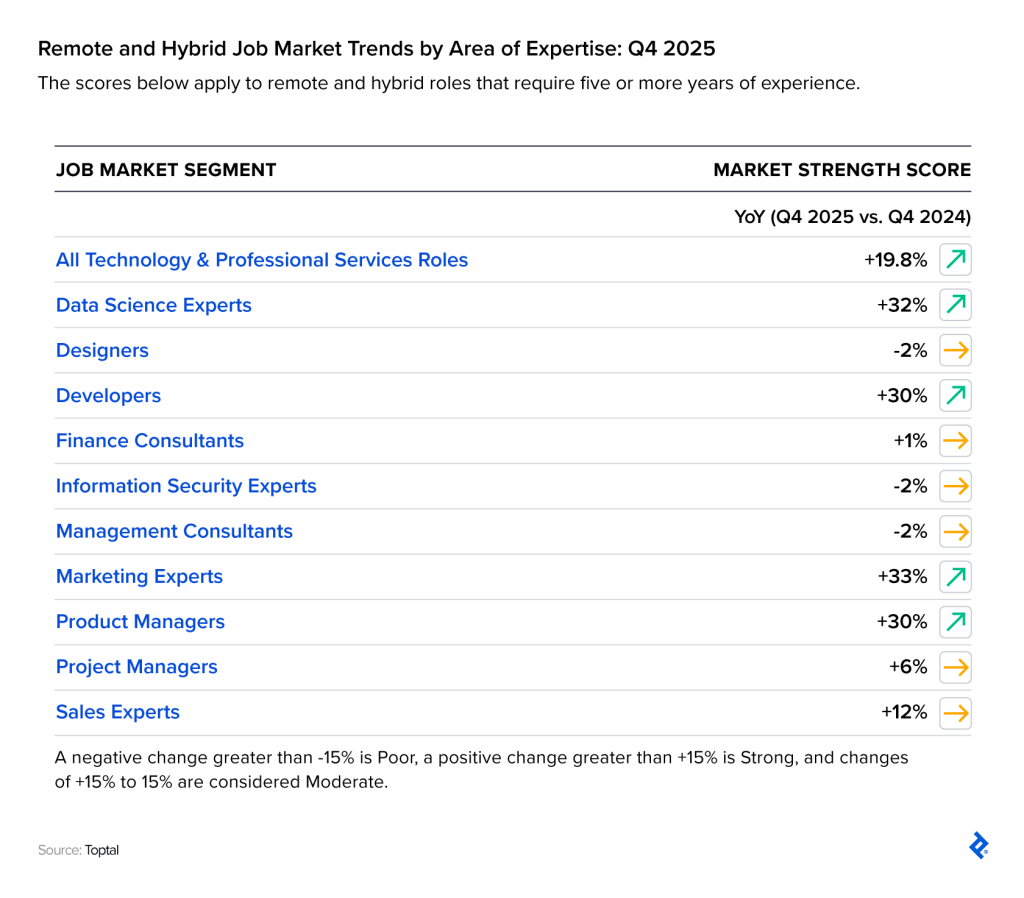
High-profile return-to-office mandates at companies like JPMorgan Chase and Microsoft dominated headlines in 2025, but a new job report shows that remote work continues to play an important role in the modern labor market. Toptal’s High-Skilled Job Report for Q4 2025 found that demand for experienced remote and hybrid technology and professional services personnel is actually slightly stronger than that for comparable in-office positions.
The report found that global demand for these remote and hybrid professionals increased by 19.8% in Q4 2025 versus Q4 2024. Looking at the entire year, demand increased 10.9% in 2025 versus 2024. Meanwhile, demand for similar professionals across all work models, including remote, hybrid, and in-office roles, increased by slightly smaller magnitudes (19.4% for Q4 2025 versus Q4 2024 and 10.4% for full-year 2025 versus 2024).
The difference in the trends is very small, but still worth noting, according to the report. For remote and hybrid roles to exceed the blended average, in-office roles must be lagging behind, pulling down the overall figure.
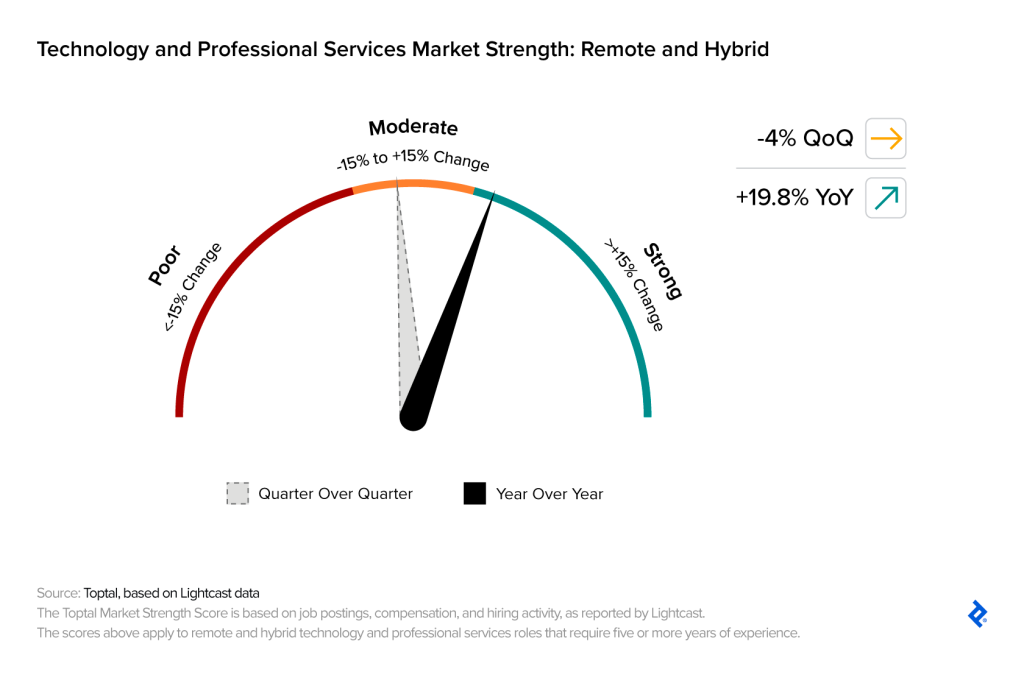
Quarter-over-quarter data tells a similar story. Demand for remote and hybrid talent declined by 4%, a typical late-year contraction; however, the broader experienced market, which includes in-office roles, showed a slightly larger decline of 4.7%.
Remote Work Is Finding Its Level
Five years after the height of COVID-19 pandemic disruption, data suggests that distributed work has settled into a more stable phase. The report notes that office occupancy in major U.S. markets has recovered from its pandemic lows but remains well below 2019 levels. This points to an emerging equilibrium between remote, hybrid, and in-office work in which companies have begun to pinpoint when in-person collaboration is essential and when work can be done remotely.
This shift mirrors the adoption of AI, in which companies’ early experiments have evolved into strategic combinations of technology and human insight. Together, these changes point to a more deliberate approach to the future of work. Having tested remote policies and AI tools for several years, companies are now making clearer choices about where work happens and how technology supports it. They are increasingly implementing AI-driven tools and in-person work into the parts of the workflow where they add the most value.
While it’s clear that many employees enjoy the flexibility of remote and hybrid work, the availability of these roles has grown for reasons that go beyond employee preference or cost-savings for companies, according to the report. Firms that strategically employ remote and hybrid teams are able to access larger and more diverse talent pools and hire faster, especially when scaling or experimenting with new capabilities.
This transitional job market is challenging for both workers and employers, but this data points to a potential bright spot: that flexible work for experienced professionals is not dying, rather it is maturing into a permanent feature of the market.
This story was produced by Toptal and reviewed and distributed by Stacker.