The skills gap crisis: Boomers are retiring before the next generation is ready
For decades, experienced professionals have quietly kept the world running, training new hires, solving crises and carrying institutional knowledge built over long careers. Now, many of those workers are preparing to retire, taking with them expertise that cannot be quickly replaced.
A new global survey from Kelly shows that while most organizations know the “Silver Tsunami” is coming, few are prepared for what happens next.
Across regions, executives say experience is slipping away faster than they can replace it. In Europe and North America, retirements are already affecting operations, while in Asia and the Middle East, demand for technical expertise continues to climb.
As millions of baby boomers exit the workforce, companies across industries are struggling to replace both the labor and the know-how that leave with them.
Prepared on paper, not in practice
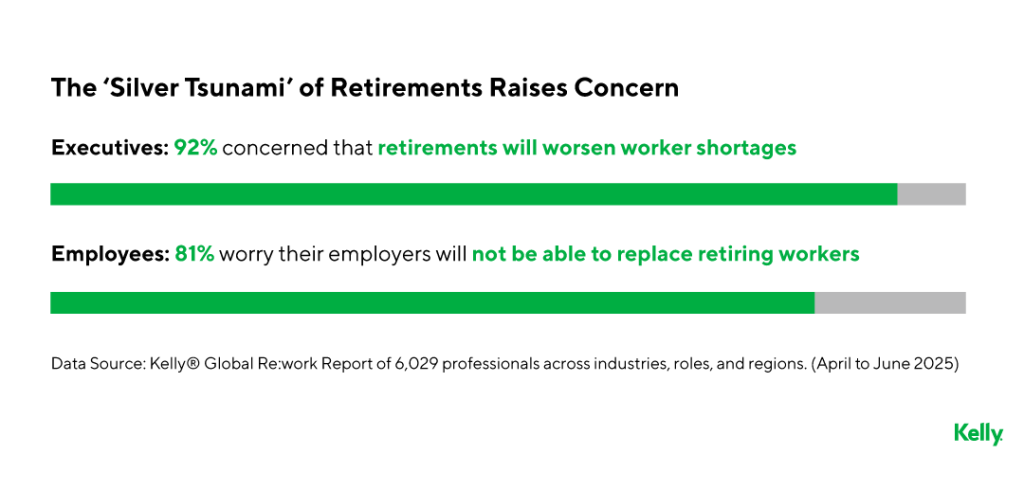
Executives and employees know the retirement wave is coming, but they do not know what happens next. Ninety-two percent of executives say they are concerned that retirements will worsen worker shortages, leaving critical gaps in the workforce, and nearly 4 in 10 are very or extremely worried, according to the research. Workers share those concerns. Eighty-one percent say they worry their employers will not be able to replace outgoing employees, including 28 percent who are highly concerned.
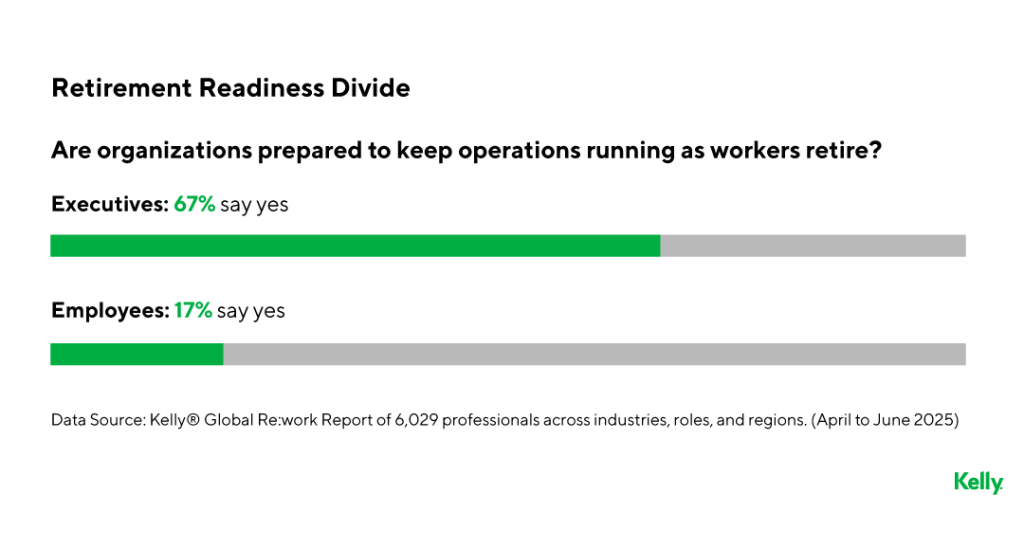
The views are split on preparedness. Two in 3 executives say their organizations are ready to keep operations running as older workers retire. Only 17 percent of employees agree.
Many workers see a system running on borrowed time, with institutional knowledge walking out the door faster than it can be passed down.
A problem money cannot fix
Across industries, organizations are trying to offset the loss of experienced workers by redesigning roles, investing in technology or relying more heavily on automation. But replacing people with tools does not replace experience. Knowledge takes time to build, and many midcareer professionals have not received the training or mentorship needed to step into more complex roles.
Researchers warn that when expertise is not transferred, productivity dips, innovation slows and mistakes multiply. The impact is not just technical. Entire ways of working risk being lost as organizations modernize without preparing their people for what comes next.
Fewer than half of executives say they have formal programs to transfer knowledge before employees retire, and only 38 percent report investing in midcareer development at scale. The result is a widening experience gap between senior specialists and the workers expected to replace them.
Rebuilding the pipeline
Research points to a few solutions that go beyond short-term hiring. Successful organizations are pairing senior and junior workers to capture insights before they disappear. Many are adopting a “skills-first” approach that looks past resumes to find potential in veterans, midcareer switchers and people with nontraditional backgrounds. They are also making learning part of advancement, linking training programs to real opportunities for growth.
Some companies are looking outside their walls for support, using strategic outsourcing to bridge experience gaps and maintain continuity during transitions.
A turning point for talent
The skills gap is not a distant threat. It is already reshaping teams, production lines and offices around the world. How organizations respond will determine whether they lose momentum or create a new generation of capable, confident workers ready to lead.
Research makes the choice clear. Future-ready companies invest in people before the crisis hits. The expertise leaving today can become the foundation for tomorrow if leaders act now to transfer it.
The report notes that organizations focused on resilience, including those that prioritize upskilling, flexible teams and inclusive hiring, are twice as likely to say they are prepared for the future. Building that resilience now could determine which companies thrive in the next decade of work.
This story was produced by Kelly and reviewed and distributed by Stacker.