
What laid-off workers need to know to succeed in this volatile job market
Layoffs keep rippling through the workforce, pushing many displaced people into a job market defined by longer timelines and greater uncertainty. But there are things professionals can do to stand out and increase their chances of success, according to a new job report.
Toptal’s High-skilled Job Report for Q4 2025 notes that the job market is changing in fundamental ways, in part due to the rapid adoption of AI across industries and companies. These changes are causing a skills mismatch between the workers who are available and the jobs companies need to fill. As more tasks become automated, especially in tech and other white-collar jobs, the report shows that employers are concentrating investment in roles where human judgment is indispensable, particularly when work involves ambiguity, trade-offs, and business context.
In compiling the report, Toptal calculated QoQ and YoY market strength scores based on new job postings, median advertised compensation, and hiring activity for technology and professional services personnel with at least five years of experience, as reported by Lightcast. Other trends have been calculated based on data from Staffing Industry Analysts, Hacker News, LinkedIn, Indeed, Layoffs.fyi, and We Work Remotely.
This article explores insights from the report and other recent research, and shares advice for employment-seekers on how to succeed in a tough job market.
The Scope of Recent Job Cuts
Employers in the United States announced 108,435 layoffs last month, more than three times the number announced in December, according to the global outplacement firm Challenger, Gray & Christmas. Historical data from the past several years, however, shows that overall levels are relatively stable and far from approaching the surge seen during the COVID-19 pandemic recession.
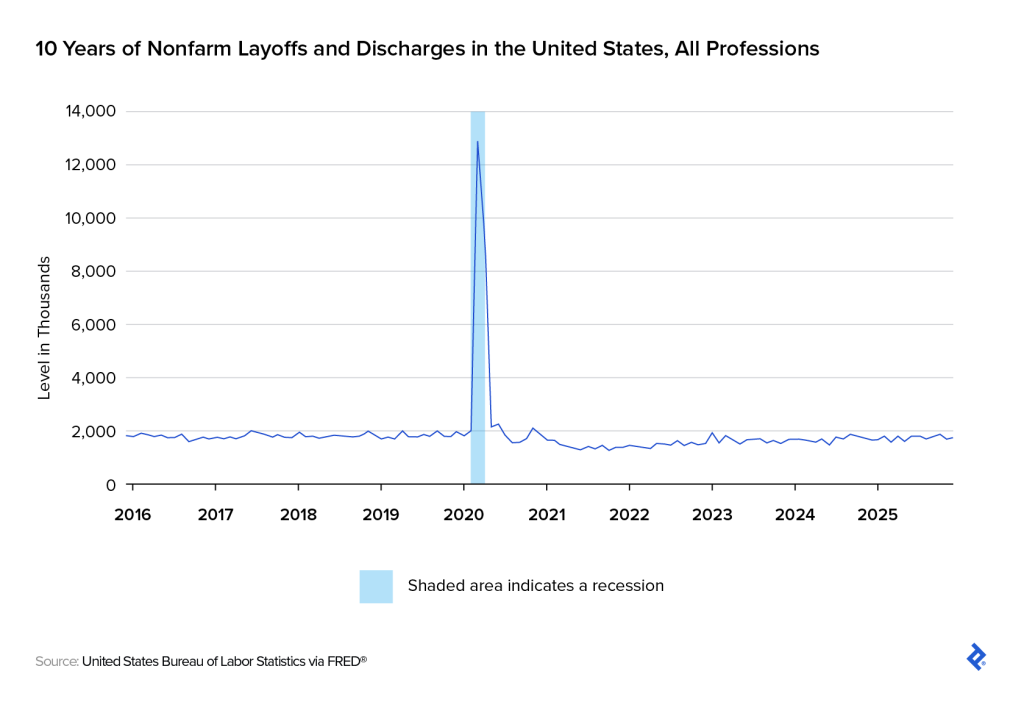
Even so, some segments of the economy have been hit harder than others. Job cuts at technology companies, for example, are significantly higher than a few years ago. Setting aside the unusual spike when COVID-19 hit in early 2020, tech firms averaged about 5,800 global layoffs per quarter from 2020 to 2022, according to Toptal’s job report. But in the fourth quarter of 2025 alone, that figure climbed to more than 28,000 worldwide.
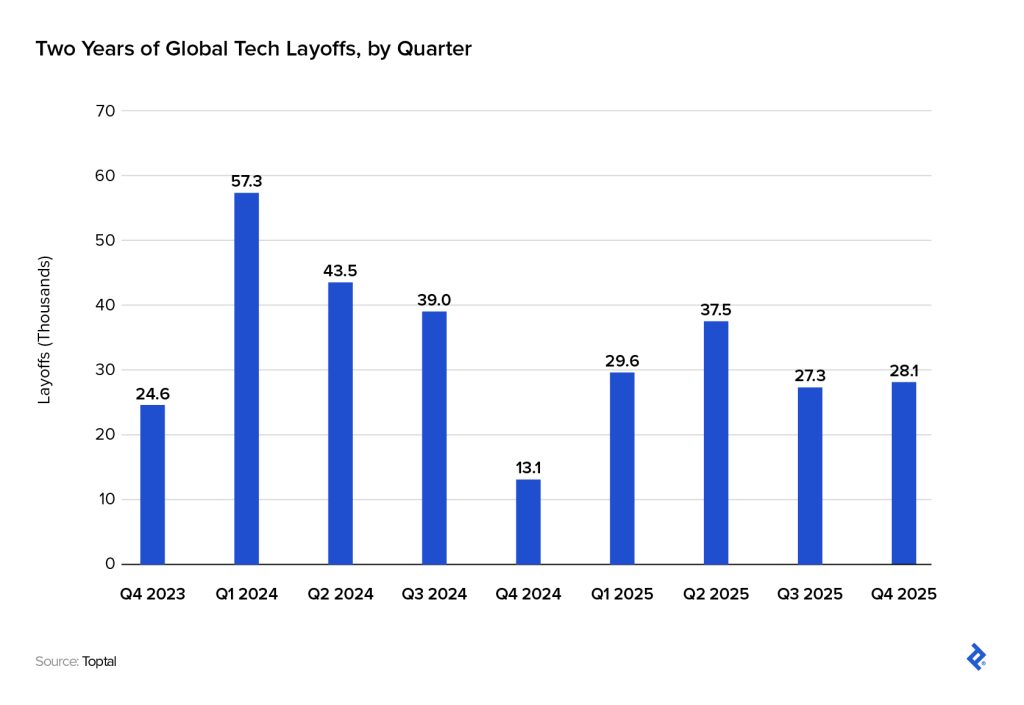
One important contextual factor is how narrowly recent cuts have been distributed, with just four companies accounting for roughly three-quarters of the total. Generally, concentrated layoffs suggest deliberate restructuring or specific challenges faced by a company or an industry, rather than broad economic distress. “These companies are all doing well business-wise,” says Erik Stettler, the data scientist and economist who authored the report. “But these giant organizations may be feeling the need to ‘change or die.’ That they need to be leaner and meaner and act more like a startup to keep succeeding.”
Concentrated layoffs can also result from peer pressure or a herd mentality, he notes. “If one of these big companies does a large layoff and Wall Street rewards them with stock surges, the other companies may look at that and want to do the same.”
That said, layoff trends at large technology companies are important to track since these large companies do act as economic bellwethers, notes Stettler; the technology sector also generally adopts AI and other new technologies first, meaning what is happening in this sector may point to the future direction of other categories.
What Can Laid-off Workers and Other Job Seekers Do?
Success in today’s job market requires understanding what’s driving these changes and how to position yourself for opportunities. The growing consensus among employment leaders is that the old playbook won’t work anymore: Searches are stretching on for months, even for people who’ve held big jobs at well-known companies. “Unfortunately, laid-off workers are likely looking at a job search that will last at least two quarters,” says Stettler. Given the restructuring and shakeups at Amazon, Meta, Microsoft, and other big tech companies, the luster of these companies has dimmed a little, and laid-off workers “can’t rely on the prestige of having had a big tech name on their resume like they could in the past,” he notes.
Here is advice on what to do instead.
Reskill, Upskill, or Pivot
Consider pursuing advanced education or microcredentials to deepen your skill set and enhance your resume. Recent research suggests that skill-based certificates strengthen job applications, and could lead to higher salary offers. For financial support, review professional development opportunities and vocational grants or scholarships at the CareerOneStop website from the US Department of Labor.
In terms of which skills and occupations are most in demand, the United States Bureau of Labor Statistics (BLS) says that opportunities in computer and network jobs, such as computer scientists, network architects, programmers, IT support specialists, systems analysts, database administrators, digital designers, and network administrators, will grow much faster than other job opportunities through 2034.
Other fast-growing professions over the next eight years include wind and solar technicians, health services managers, physical and occupational therapy assistants, actuaries, and hearing aid specialists, per the BLS.
Aim High, but Think Small
Stettler says that people looking for a new role should search for opportunities beyond big, traditional employers and look into small and medium-sized businesses and startups they may not have heard of, but that are focused on growth. Growth means hiring. A new survey of more than 1,000 small business owners in the US found that 78% are optimistic about their profitability in the coming year, despite challenges like inflation and tariffs. As of January 2026, 25% of small businesses surveyed by the National Federation of Independent Business had job openings for skilled workers.
Highlight Your Judgment and Creativity
While high interest rates and general macroeconomic uncertainty are major drivers of layoffs, widespread adoption of artificial intelligence is also a factor, especially at technology companies. “To stand out to their next employer, people need to focus on the ways they can demonstrate creativity and judgment,” says Stettler. “Those are the two skills that are very critical in the age of AI, and that AI cannot compete with. So whether your role was a statistician or a designer, you need to drill down to what you are really good at that falls under one of those buckets, and you need to be ready to make that extremely clear to a potential employer.”
This story was produced by Toptal and reviewed and distributed by Stacker.