SmartAsset
1 / 1Top 10 states with the highest proportions of clean electricity production
- Washington
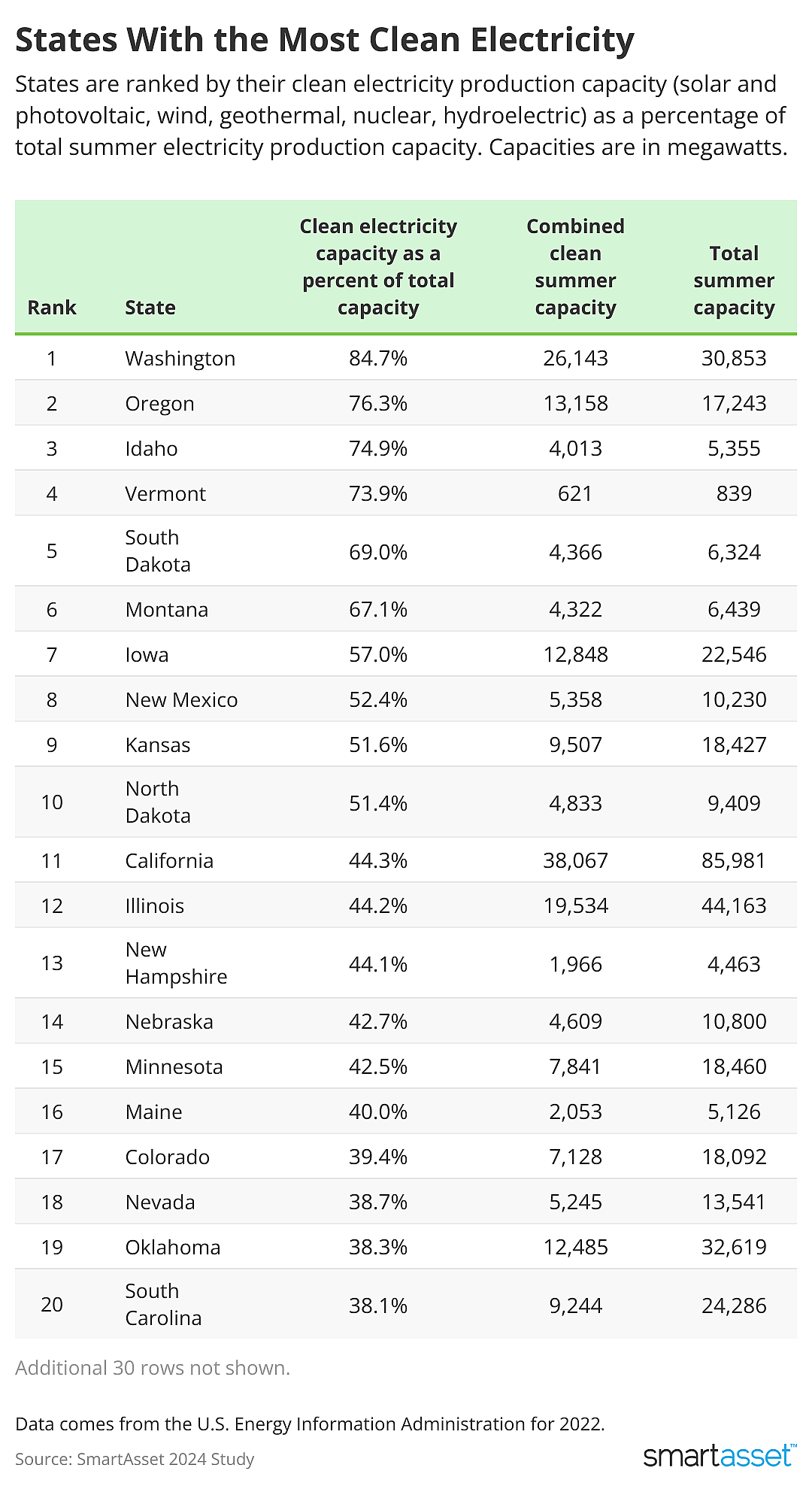
Washington's clean electricity made up 84.7% of its total summer capacity (30,852.7 megawatts). Hydroelectric power was the major contributor with 21,428.6 megawatts, followed by wind (3,374.9 megawatts), solar (188.4 megawatts) and nuclear (1,151 megawatts).
- Oregon
Oregon's clean electricity accounted for 76.3% of its total capacity (17,242.5 megawatts), with hydroelectric sources providing almost half (8,367.9 megawatts). Additionally, solar and wind generated 793.7 and 3,976.5 megawatts, respectively, while geothermal produced 19.5 megawatts.
- Idaho
Idaho's clean electricity made up 74.9% of its total capacity (5,355.3 megawatts). Hydroelectric sources generated roughly half (2,672.3 megawatts), with wind having added an additional 968.3 megawatts. Solar and geothermal produced 362 and 10 megawatts, respectively.
- Vermont
Almost three-quarters (73.9%) of Vermont's total energy capacity (839.4 megawatts) came from clean electricity. Hydroelectric power accounted for 331.3 megawatts, while solar and wind generated 139.2 and 150.2 megawatts, respectively.
- South Dakota
South Dakota's clean electricity made up 69.0% of its total capacity (6,323.9 megawatts), with wind power delivering 2,767.2 megawatts and hydroelectric generating 1,598 megawatts. Solar capacity was minimal at 1 megawatt.
- Montana
Over two-thirds (67.1%) of Montana's total energy capacity (6,438.8 megawatts) came from clean electricity. The state's wind and hydroelectric capacities were 1,478.9 and 2,826.3 megawatts, respectively, with solar having made a small contribution of 17 megawatts.
- Iowa
Clean electricity made up 57.0% of Iowa's total energy capacity (22,546.4 megawatts). Wind energy accounted for the most (12,378.5 megawatts), with solar and hydroelectric having generated 260.5 and 209.4 megawatts, respectively.
- New Mexico
New Mexico's clean electricity made up 52.4% of its total energy capacity (10,229.9 megawatts), with wind and solar having generated 4,410.9 and 855.7 megawatts, respectively. The state also had a geothermal capacity of 8.6 megawatts.
- Kansas
Clean electricity accounted for just over half (51.6%) of the total energy capacity in Kansas (18,426.6 megawatts). Wind capacity reached 8,238.1 megawatts, while solar and nuclear energy produced 36.5 and 1,225 megawatts, respectively.
- North Dakota
North Dakota's clean electricity made up 51.4% of its total energy capacity (9,409 megawatts). Wind provided 4,323.3 megawatts and while hydroelectric sources added 510 megawatts.
Data and methodology
States are ranked by the percentage of clean energy sources used to generate the total net summer electricity production capacity. Clean energy sources include wind, solar and photovoltaic, nuclear, geothermal and hydroelectric. Total electric power industry includes industrial, commercial, and residential power. Data is for 2022 and comes from the U.S. Energy Information Administration.
This story was produced by SmartAsset and reviewed and distributed by Stacker Media.