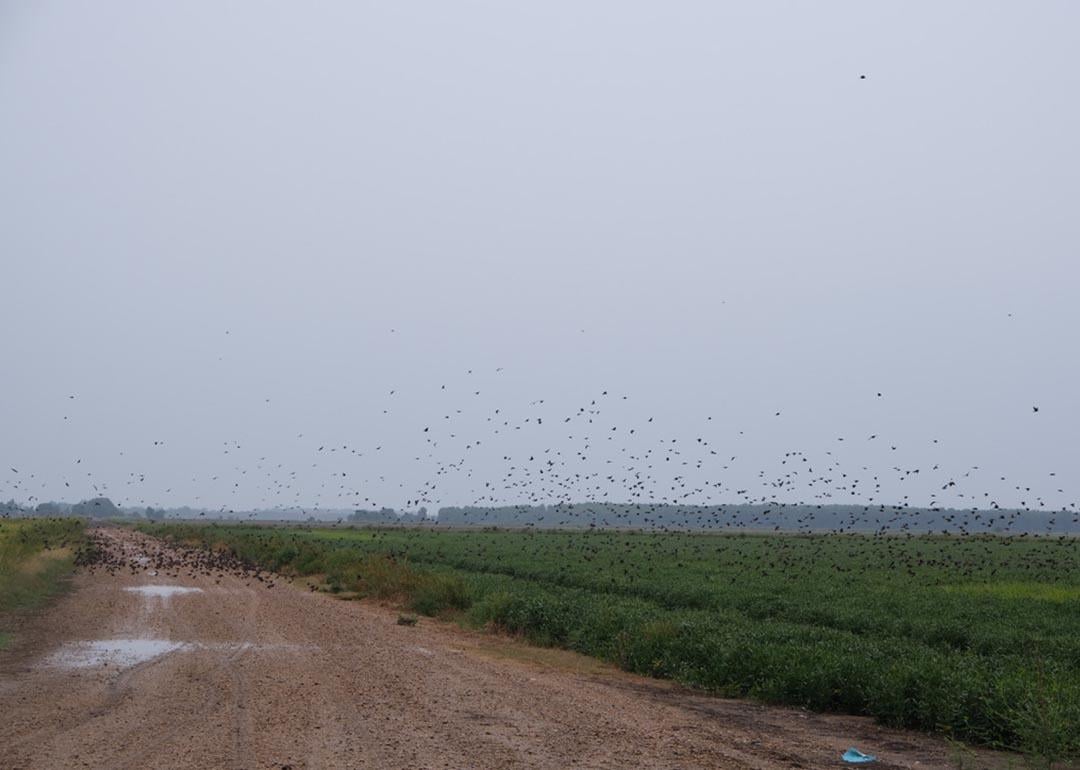
Migratory birds and rice farmers are helping each other soar
About four inches of clear water pools around Mike Wagner’s rubber boots as he wades into one of his rice fields in northwestern Mississippi on a rainy late summer morning.
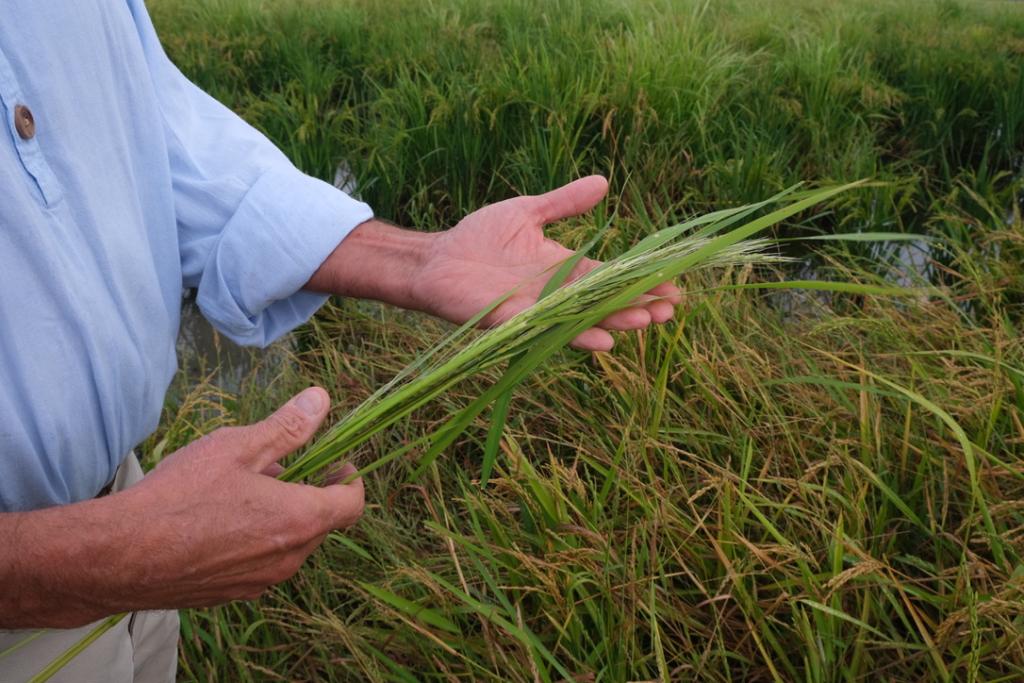
Tufts of tall, dark green grasses grow dense across the flat landscape around him, stems arcing with the weight of nearly ripe kernels. But Wagner grabs a stalk off a slightly lighter green plant at the field’s edge. He shakes it, and a few grains fall into his hand. This, he explains, is weedy rice — a wild variety that intrudes on his cultivated crop.
In his early years of running Two Brooks Farm here in the Mississippi Delta, Wagner tried to pull out this nuisance species so it didn’t mix with the likes of his basmati and jasmine, . These days, he leaves it. It’s a favored food of the thousands of ducks, geese and shorebirds that arrive on his farmland after harvest every autumn.
Over winter and early spring, the birds munch on the fallen weedy rice and critters that live in the ground, and clean up leftovers from the growing season, Reasons to be Cheerful reports.
Thousands of webbed feet mix up soil and water, leaving the fields ready for planting when they depart in the spring. And their droppings are so rich that Wagner has cut how much synthetic fertilizer he needs for his crop by more than a third.
Sure, Wagner acknowledges, it can be annoying that the birds move stray grains of weedy rice around randomly, so the plants come back dotted all over the place again the next year.
“I value their input so much that I work with it,” he says.
Two Brooks Farm is among about 3 million acres of land in rice production across the U.S., in California, the lower Mississippi River region and the Gulf Coast. Collectively, these farms provide an estimated third of the food energy that migrating waterfowl eat each winter across North America. Wagner and other farmers are embracing bird-friendly strategies that not only provide habitat for migrating species, but also help farms lower input costs, manage water more efficiently and improve water quality.
“It’s a give and take system,” says Scott Manley, who leads the Rice Stewardship Program at Ducks Unlimited, a nonprofit established to conserve wetlands, grasslands and associated habitats to benefit waterfowl and other wildlife. “Nature’s given us our food, but we have to give back to nature in order for it all to work for generations to come.”
One of the major rice producing regions in the U.S. includes the area around the lower Mississippi River basin — Missouri, Arkansas, Mississippi and Louisiana. This falls at the southern end of the Mississippi Flyway, the path migratory waterfowl follow each year from Canada and the northern U.S. for winter.
Historically, the area in Mississippi where Wagner farms was filled with swamps and flood-tolerant forests. Today, much of the region has been converted to cropland. As native wetlands have disappeared, rice fields have proven to be a natural host for migrating birds. That’s because, unlike other common crops like corn and soybeans that need drier soils, rice thrives in an aquatic system.
Migrating birds are anyway attracted to rice farms, but some practices can make them even more hospitable. One of the best things farmers can do, explains Manley, is leave some water on fields over winter — whether in puddles or a few inches deep. “Every depth is perfect for some different little bird,” he says.
Wagner discovered the benefits of creating winter bird habitat by accident. After one wet growing season, his fields were getting badly rutted by machinery. So the farm just plugged up the drains and let a little water sit on the field through the winter.
That year, ducks and geese arrived in abundance.
Ahead of the next growing season, when the farm drained off the water, Wagner found that the soil was ready to be planted. The birds’ feet, along with the movement of the water, had done the same task of mixing and flattening out the soil that his farm team would usually do with heavy machinery.
“I finally figured out that the ducks and the geese were doing the same thing as what we were doing,” Wagner says. “It was free of charge.”
According to Wagner, the birds aren’t only attracted by the rice stumps and kernels left from the crop, but from the whole ecosystem on his farm.
On the edge of one of his fields, he scrapes back some of the dark soil with the edge of his boot, exposing small white-shelled snails. Critters like crawfish and mussels also live around his farm, providing other food sources.
“It looks like a broad, flat landscape. It is, but I try to provide homes for as much wildlife as I can,” Wagner says, pointing out patches of forest he leaves untouched to create refuges.
Beginning each fall and lasting through winter and spring, the farm hosts a parade of birds as they migrate. Waterfowl like Canada geese, snow geese and myriad species of duck descend in late fall and through winter. Shorebirds — like pelicans, stilts, even the odd bright pink roseate spoonbill — also pass through on their long migrations.
While Wagner figured out his process through trial and error, research backs it up. A study on Two Brooks Farm in the winter of 2017-18 found that bird droppings were contributing almost a third of the recommended nitrogen for rice in the highest instances, likely linked to the sheer number of birds and the compounding effects of repeating the practice over time. On average, researchers estimated that producers using winter field flooding could cut synthetic nitrogen fertilizer by more than 13%.
The research, led by Lexi Firth, now of Colorado State University, and Beth Baker, of Mississippi State University Extension Service, also found a slew of other benefits from off-season practices that attract birds to rice farms. As the birds tromp around on the water-logged fields, they help decompose organic matter in the field, which supports soil health and benefits crops. Meanwhile, as water sits, sediment settles down, keeping it on the field instead of washing away into rivers.
That helps with water quality issues downstream, according to Baker. Runoff from farms often carries nutrients like phosphorus and nitrogen that contribute to the dead zone in the Gulf, which is significantly larger than the state of Delaware. But by mimicking wetlands on farm fields through the winter, that stimulates a denitrification process. And as sediment settles, that keeps more phosphorus on the land.
“It's just really great habitat for waterfowl and migratory birds,” says Firth, noting that many wetlands that these species once frequented have been converted to farmland.
“It really is a critical resource for conservation of our wildlife.”
Winter field flooding is a relatively cost-effective proposition for farmers, Baker notes. It takes place in the off-season, and usually doesn’t require much additional infrastructure on top of what a farm already has. But it does depend on having enough rain to keep water on the fields.
And the setting matters, she notes. Two Brooks Farm’s conditions are particularly advantageous, because of the landscape, adjacent water sources and type of soil.
Some of the other challenges are intrinsic to the industry. Rice farming is expensive, says Manley, and producers are squeezed with low profit margins. Manley’s goal through Ducks Unlimited is simply to keep rice farmers in production, because their lands are naturally such good habitat. The organization tries to support farmers by helping them upgrade on-farm infrastructure and promoting practices that work both for birds and crops.
Wagner says not every farmer can implement his system, but others can find ways to use their unique features. “I want people to understand that what I’m doing might not work, but there’s something you can do.”
For all the benefits birds bring to Two Brooks Farms, there are also some hassles, acknowledges Wagner, like the way the birds spread the weedy rice so it mixes with his crop.
But even there, he’s found a silver lining. In a storage room off the farm’s processing facility, he opens a large white sack, revealing a rainbow of rice grains that a sorting machine deemed rejects.
There are specks of white and black — varieties cultivated on the farm — amid shorter, fatter, deep red grains. These, he explains, are weedy rice.
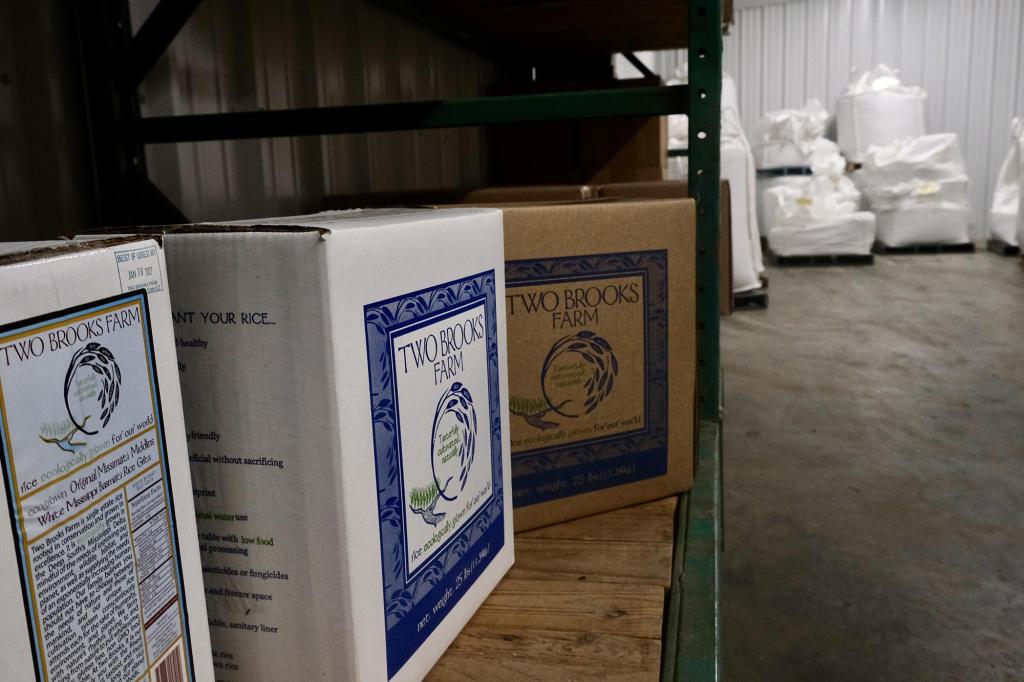
This mix isn’t one of the farm’s regular products. But Wagner has found restaurant chefs interested in the mélange, and he eats it himself.
It’s part of his vision of a farm connected with the local ecosystem.
“I don't have a corner on the market,” Wagner says. “I don't have the right to kick wildlife off this place. This is their home more than it is anyone's home.”
This story was produced by Reasons to be Cheerful and reviewed and distributed by Stacker.