AI-powered mental health solutions: What helps and what's hype?
AI-powered mental health solutions: What helps and what's hype?
The need for lasting, effective mental health support is growing. For example, Gen Z is far more likely (27%) than millennials (15%) and Gen X (13%) to report their mental health as fair or poor. This increased demand is fueling an increased interest in scaling care with AI-powered mental health solutions.
But with this potential comes risks, as many healthcare leaders have pointed out.
With AI-powered tools playing an increasingly larger role in all aspects of daily life, including mental health, Spring Health shares what works and what doesn’t to help you ensure your organization and your employees are supported in a scalable way.
What is an AI-powered mental health solution?
An AI-powered mental health solution can be defined as any solution that relies on AI as part of its support and care delivery.
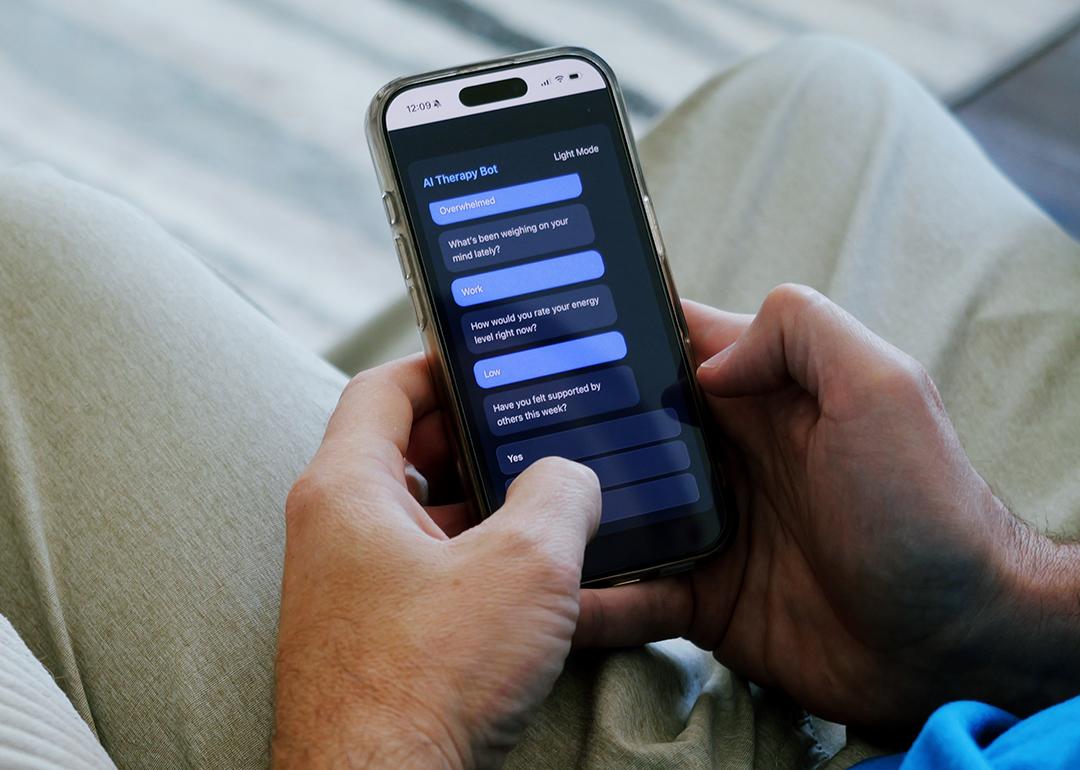
This might look like mental health chatbots, provider matching, real-time analytics, transcribing, and care planning.
So how can you tell what’s helpful and what’s just hype when it comes to AI-powered mental health solutions? Read on for a breakdown.
What helps?
1. Clinically validated care
Nearly half (48.7%) of U.S. adults have used Large Language Model (LLM)s for psychological support in the last year. But are these LLMs really suited to provide mental health support? Here are some questions to consider as you evaluate these tools:
- Are they built to handle both low-acuity and high-acuity needs?
- Are they constructed to identify risk and escalate to appropriate resources like psychiatrists when the risk is high?
- Are they built with clinical input and oversight?
- Are they built upon standards to ensure safety and ethical use?
For many LLMs, the answer is no.
AI-augmented mental health solutions should be implementing AI that’s built to be ethical, inclusive, appropriate, and clinically impactful.
2. Private, secure data retention
Privacy remains a primary concern for most people engaging in mental health care. In a recent American Medical Association (AMA) survey, nearly 75% of Americans said they are concerned about the privacy of their personal health data. When AI-powered capability is introduced into a mental health solution, it’s important that these models run in HIPAA-compliant, secure environments where no third-party data is retained.
3. Transparent design and usage
In the same AMA survey, only 20% of those surveyed said they knew the scope of companies and individuals with access to their data. Transparency into data access and AI touchpoints is a really important component in building trust in a mental health solution.
4. Faster care routing and triaging
The median wait time for an in-person behavioral health appointment is 67 days. That’s a significant barrier to getting mental health support. Delays in receiving care, particularly for those with high-acute needs, can negatively impact outcomes.
AI-powered mental health solutions that are clinically grounded can help match people to the right therapist, self-care, or crisis support quickly to improve outcomes. That means getting the care they need and feeling better faster.
5. Provider support
Providers have a number of super-powers. They’re clinical experts, attentive listeners, and trust builders, to name a few. By automating administrative tasks such as scheduling, note-taking, and data entry, AI can help to free up providers to spend more time doing what makes them truly special.
What doesn’t help?
1. Off-label AI usage
"Off-label AI" refers to the application of general-purpose AI tools, such as LLMs, for purposes for which they were not originally developed or clinically validated, particularly in the realm of employee mental health support.
The accessibility of LLMs has led many people to turn to them for their mental health needs. But, as one research paper put it, “the current risks associated with clinical use might surpass their benefits.”
2. Superficial integration
There’s a lot of buzz around AI. As a result, many companies are touting their integration of AI. But is it real? Is it making a positive impact? For any AI-powered mental health solution you're evaluating, ensure that AI is a thoughtful part of its DNA, rather than a hasty add-on.
This story was produced by Spring Health and reviewed and distributed by Stacker.