QMedic
1 / 2Carrying a lifelong burden of racism and ageism
The harms experienced by Black people are well documented: The majority (75%) of Black adults say they've experienced racial discrimination either regularly or occasionally, according to Pew Research Center. Black Americans are statistically more likely than whites to have experienced the death of an immediate family member before midlife, an often overlooked source of stress and trauma. These types of consistent physical and psychological stressors contribute to what's known as the allostatic load, or chronic stress that accumulates in the body, which exacerbates numerous health issues, including poor appetite or overeating, frequent headaches and stomachaches, and alcohol and substance abuse issues—all of which are more common among Black Americans.
For older Black people, this means that the natural effects of aging are accelerated. The additional "wear and tear" is a phenomenon known as "weathering," first introduced by public health researcher Dr. Arline Geronimus. It illustrates how, for older Black people, prolonged exposure to stress and adversity can accelerate the aging process, leading to the earlier onset of chronic health issues.
Researchers at the Mayo Clinic and elsewhere found that Black Americans had a biological age nearly 12 years older on average than their chronological age. In comparison, their white counterparts had an average biological age that was 10 years younger than their actual age. In other words, Black Americans weather 6.1 years faster than their white counterparts.
Medical experts note that social determinants include policies that determine or limit access to housing, education, and economic opportunities, all critical to long-term health. For example, redlining, a practice where lenders assess financial risk based on property values and a property owner's race and ethnicity, continues to harm communities of color more than 50 after the 1968 Fair Housing Act made redlining illegal, according to the University of California, Berkeley, School of Public Health. ZIP codes corresponding to formerly redlined neighborhoods were shown to have higher rates of COVID-19, according to a study from the IZA Institute of Labor Economics.
Formerly lower-grade D neighborhoods, which had higher portions of non-white residents, were close to nearly twice the density of oil and gas wells compared to higher-grade A neighborhoods. Women's reproductive health was also affected with more associations to low birth weight and preterm births in these historically redlined areas.
"Systemic barriers and misdiagnoses are rampant, even with resources; without an advocate, navigating the health care network can be nearly impossible," Dr. Ryon Cobb, a professor of social work at Rutgers University, told Stacker. Many Black people live in health care deserts, according to Cobb, where they do not have access to information or even doctors with the expertise to provide treatment.
The intersection of ageism and systemic racism compounds is often called a "double disadvantage" for older Black people, according to the American Geriatrics Society. This means navigating a health care system that often overlooks their specific needs, from implicit biases in diagnostic practices to underrepresentation in clinical trials.
The impact of discriminatory practices and mistrust heightens with age
Reliable transportation, an often overlooked barrier, plays a significant role in health disparities, especially among older Black populations. Urban Institute data from 2022 found that 8% of Black adults missed or delayed medical care due to transportation issues, compared to 4% of white adults. Another major compounding factor is inadequate health insurance coverage. Black beneficiaries comprise just under 11% (6 million) of the U.S. Medicare population, though they account for a disproportionate number in some states. In Mississippi, for instance, Black beneficiaries account for 31% of total Medicare recipients, and in Washington, D.C., that number surges to 63%. Notably, Black Americans have a lower life expectancy after age 65 than their white or Hispanic counterparts.
The importance of transportation was recognized in 2021, when transportation services for nonemergencies were included on a list of mandatory benefits for people with Medicaid who lack reliable modes of travel. A growing number of Medicare Advantage plans now include this benefit.
Historical discriminatory practices within the medical system have also been well-documented throughout history, and this legacy also plays a role. Some 7 in 10 Black Americans say they've received unfair treatment by the health care system, and over half (55%) say they distrust it. Black adults are more likely than whites to report they have to be careful about their appearance to be treated fairly by health practitioners, and that a health care provider has refused them prescription pain medication they thought they needed, according to 2024 KFF data.
These types of negative experiences and unfair treatment contribute to a persistent lack of confidence in the system. This can heighten mistrust and discourage seeking preventative care, according to a 2024 qualitative study of 25 Black patients discharged from emergency room departments published in JAMA Health Forum.
Study participants reported experiencing dismissiveness and a lack of confidence in their health literacy, making them hesitant to seek medical attention. That, in turn, can exacerbate existing conditions and delay diagnoses.
As one study participant put it, "seeking health care for a Black person is a roll of a dice all the time. [There will never] be a moment at this time in [the US] that a person of color [is] like, 'Oh, I'll just go to the doctor.' No, it'll be…'Okay, what doctor am I going to? Is it bad enough that they'll treat my condition [seriously], or should I wait until it's bad enough that they have to?' That's a terrible way to live, and that's how we live. We show up in the emergency room because everything else gets dismissed…so it gets bad enough that [there's] no other choice until we have to get treated…it's terrible."
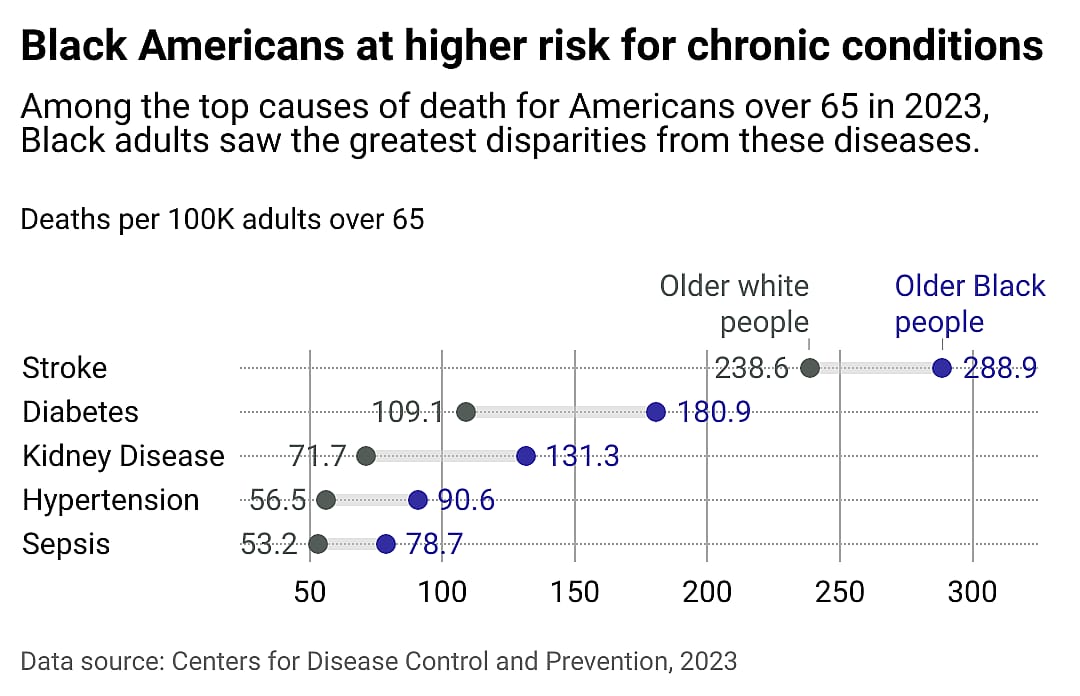
Chronic kidney disease, for example, often goes undiagnosed among Black communities, according to Cobb. Yet Black Americans are more likely to progress to end-stage kidney disease: Without tailored interventions that address both systemic racism and ageism, these health disparities can continue to widen, posing the same risk to future generations.