Soundry Health
1 / 3Doctors face 'administrative load,' hampering care
Administrative costs are the "leftover" costs after accounting for clinical activities, explained a Health Affairs research brief on health spending.
Some costs—such as money needed to market an insurance company, the overhead cost of operating a doctor's office, or expenses associated with training hospital staff—are a regular part of doing business, and those expenses aren't likely to go away.
Other, more hidden costs, such as the work it takes providers to locate and log the proper insurer-specific medical codes or the time it takes physicians to seek and obtain prior authorization from an insurance company, can be altered with new nationwide policies or practices.
Many experts suggest a universal health care system as a solution, and in some cases, it has proven to be more cost-effective for the government to set the rates and pay out insurance claims for everyone.
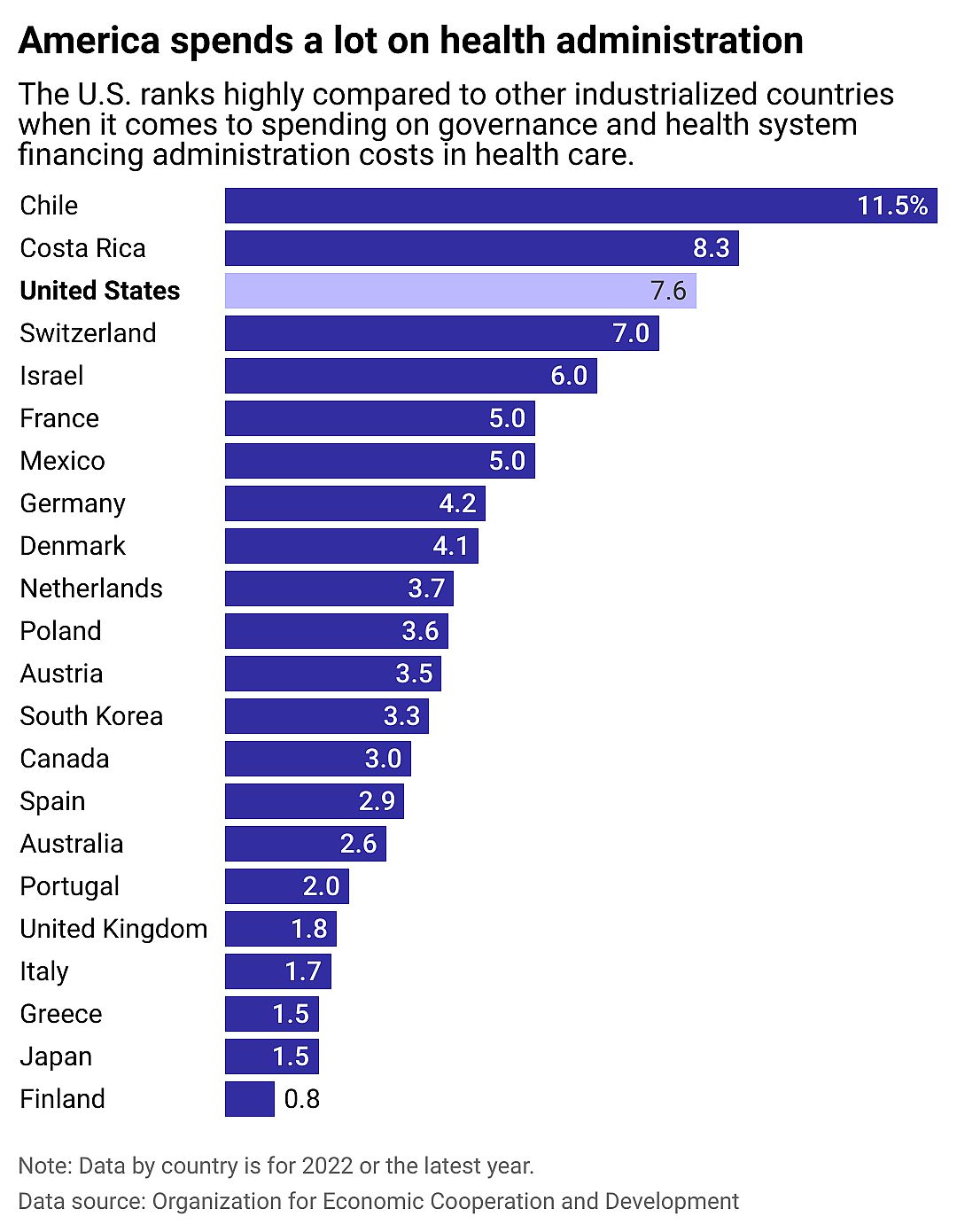
"Reducing U.S. per capita spending for hospital administration to Scottish or Canadian levels would have saved more than $150 billion in 2011," according to one study published in Health Affairs. Scotland and Canada both have universal health care systems.
That same study found administrative costs accounted for more than 25% of U.S. hospital expenditures in 2011, while the same costs made up only about 20% and 15% in the Netherlands and England, respectively.
A separate study, which quantified 2017 spending for administration by both insurers and providers, noted that the gap between Canada and the United States' administrative spending is not only large, but widening. The gap "reflects the inefficiencies of the U.S. private insurance-based, multipayer system. The prices that U.S. medical providers charge incorporate a hidden surcharge to cover their costly administrative burden."
However, universal health care has some drawbacks, and cost savings would depend on how policy is implemented in the states, David Cutler, Harvard professor for applied economics, explained in a policy proposal. For example, one way Canada saves money is by regulating who can obtain medical technology, resulting in fewer MRI machines available to patients—Canada has only one-quarter the number of MRI machines per person compared to the U.S.
Additionally, unless the U.S. implements spending constraints along with universal health care, a remaining concern is that lower administrative costs would cause the volume of services to increase, therefore counteractively causing higher spending. It could also lead back to costly constraints out of necessity, such as the currently used prior authorization requirements.