Lyft Economic Impact Report 2023
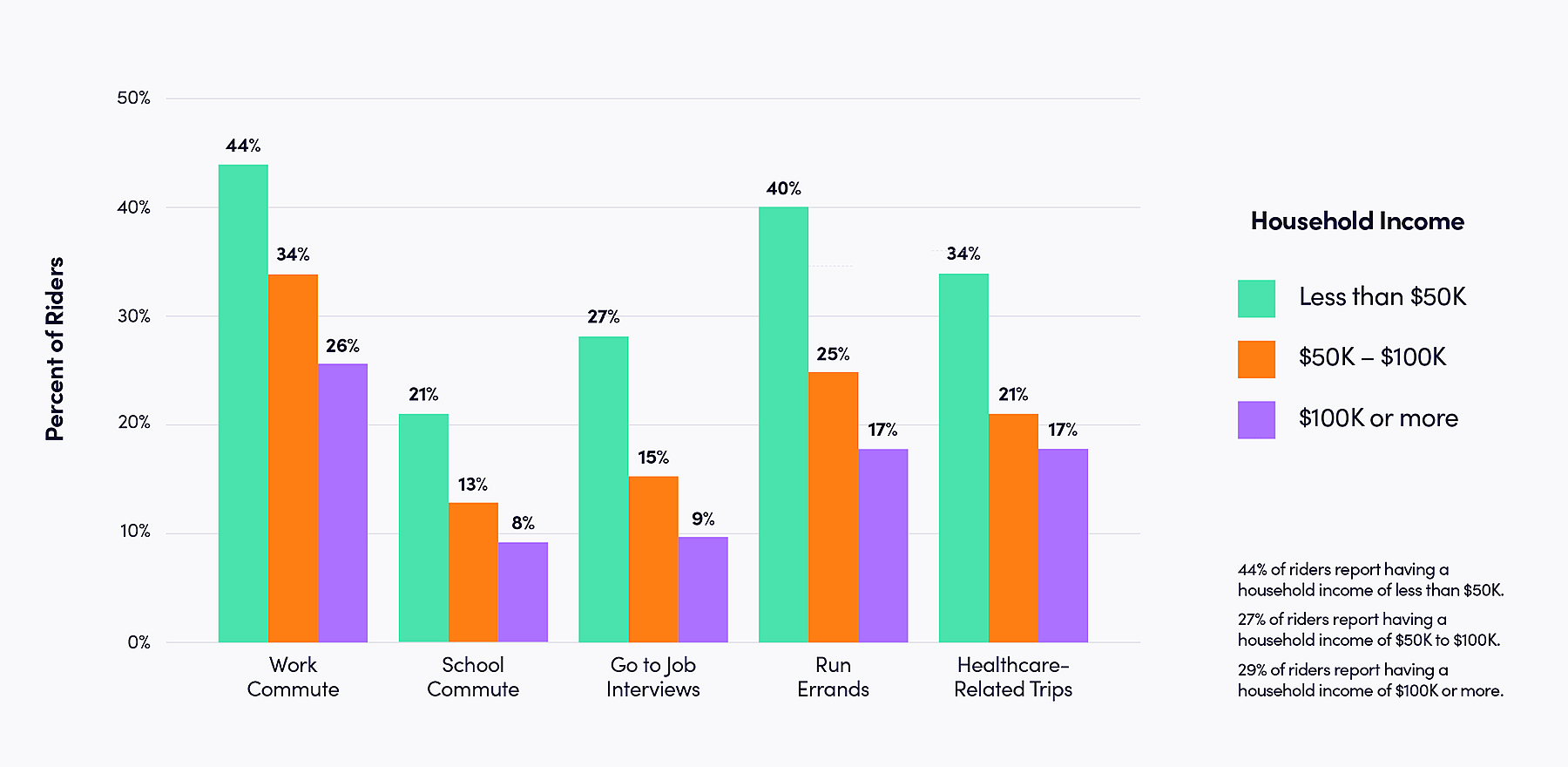
1 / 1Riders were asked about their destination and their answers were analyzed by income, revealing a very clear pattern across all categories
Lyft's largest category — at 44% — is low-income riders, defined as those with annual household incomes under $50,000. Around 27% of riders are middle income (making between $50,000 and $100,000). And 29% are high-income households (making $100,000 or more).
The pattern identified shows low-income individuals relying on Lyft for help with their most important transportation needs. Around 44% of them use rideshare for commuting to work, compared to only 26% of high-income riders. Low-income riders are also far likelier than high-income ones to use rideshare to access rides to school (21% vs. 8%), job interviews (27% vs. 9%), health care appointments (34% vs. 17%), and to run errands (40% vs. 17%).
Meanwhile, high-income riders are far more likely than low-income riders to use the platform to access rides to and from the airport (81% vs. 40%) and for leisure travel (63% vs. 29%). The same pattern holds true for middle-income riders, who also use the platform for access to transportation to and from the airport (64%) and leisure travel (49%) more often than low-income riders.
These results support prior findings of independent researchers, who also observed that low-income households increasingly rely on rideshare. A 2020 study of ride subsidy programs found participants preferred rideshare services to taxis and paratransit because they were on-demand and offered more comfortable and dependable service. A 2021 study of low-income individuals in Michigan also found that rideshare "can be especially beneficial for the low-income, aged, car-less, and disabled travelers."
All of which is to say, even though app-based rideshare services are relatively new in the long history of transportation, they're already playing a crucial role in people's lives, especially for those with fewer resources.