'The kids everyone forgot': The faltering post-pandemic push to reengage teens and young adults not in school, college, or the workforce
This story was produced by Chalkbeat and reviewed and distributed by Stacker.
'The kids everyone forgot': The faltering post-pandemic push to reengage teens and young adults not in school, college, or the workforce
Lucian O'Donnell sat curled up in the lower bunk in a friend's house, a two-story clapboard in a neighborhood crowded with other faded homes in Southwest Detroit.
Spring was sprucing up the trees lining the narrow one-way street. But on that day in March 2023, in the bedroom where Lucian was crashing, the blinds were drawn, draining the color from the pale blue walls.
In the previous years, he had hustled at long shifts in two restaurants and taken night classes after dropping out of high school. He had brainstormed life goals with his "success coach" at a neighborhood nonprofit working with teens and tried to better manage the diabetic kidney disease that had claimed his mom during the pandemic. He had seen a therapist.
Now, the 18-year-old had surrendered to the screens, Chalkbeat reports.
He toggled between "Minecraft" on his laptop—endlessly stacking blocks on a virtual grid—and social media on his phone. He knew the algorithms steered him toward negativity and conspiracy theories. He went along anyway.
The moment felt like a flashback to COVID-19-era isolation, except even lonelier: America had moved on from the pandemic. A resurgent Detroit was getting its swagger back, its population and median income inching up a decade after a bruising bankruptcy. But Lucian felt shut out from that sense of possibility.
At one point, he told his success coach that he thought of harming himself. They made a plan: He'd get in touch immediately if these thoughts escalated. They put together a list of good reasons to be alive.
That day, he glanced at the list. It was short: High school friends. Music. His goal of managing a restaurant.
He sank back into stacking blocks.
Youth advocates call young people like Lucian—16- to 24-year-olds who are not in school, college, or the workforce—"opportunity youth," focusing on untapped potential, not failure. Many are high school dropouts. As many as half earn a diploma or GED but flounder after graduation.
If the 4.2 million opportunity youth in the U.S. all lived in one city, it would be the second largest in the country.
They have long been "the kids everyone forgot," as one nonprofit leader put it. But roughly a decade ago, with youth employment ravaged by the Great Recession, the Obama White House made reconnecting these young people a signature issue. Experts decried the lasting toll of even relatively brief stints of disconnection: lower incomes, but also poorer health and personal relationships. Congress passed the Workforce Opportunity and Innovation Act in 2014, tapping hundreds of millions for youth employment efforts.
But the programs that sprang up were often small-scale and insular, with modest, short-lived results. After COVID-19 emerged in early 2020, advocates worried its upheaval could turn Lucian's generation into the most deeply disconnected yet. So they pushed to rethink reengagement programs. They argued these efforts had focused too much on quickly steering youth toward a job—any job—often low-skill, unstable work vulnerable to economic downturns. Meanwhile, trauma and mental health issues kept young people from gaining a foothold in the workforce.
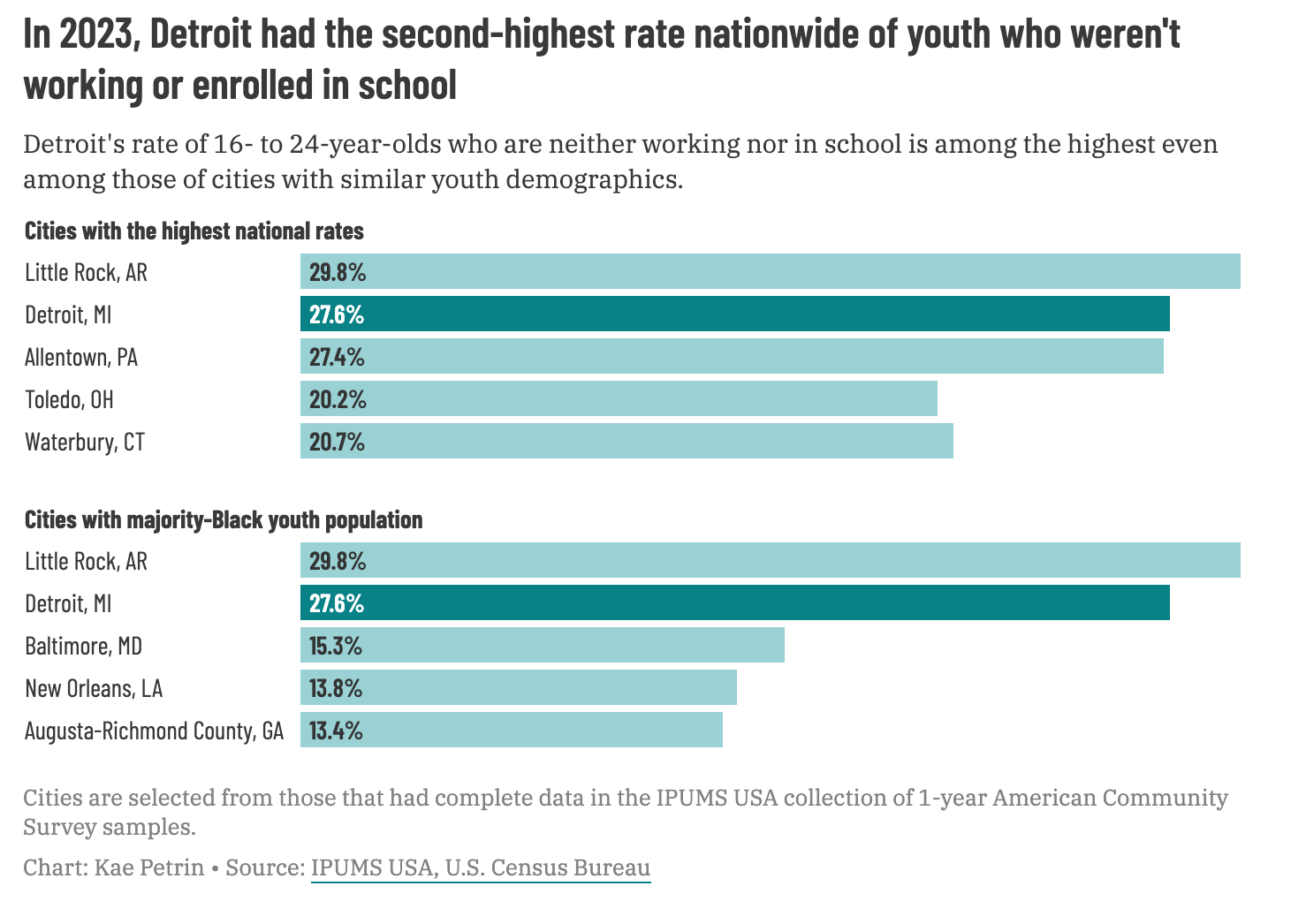
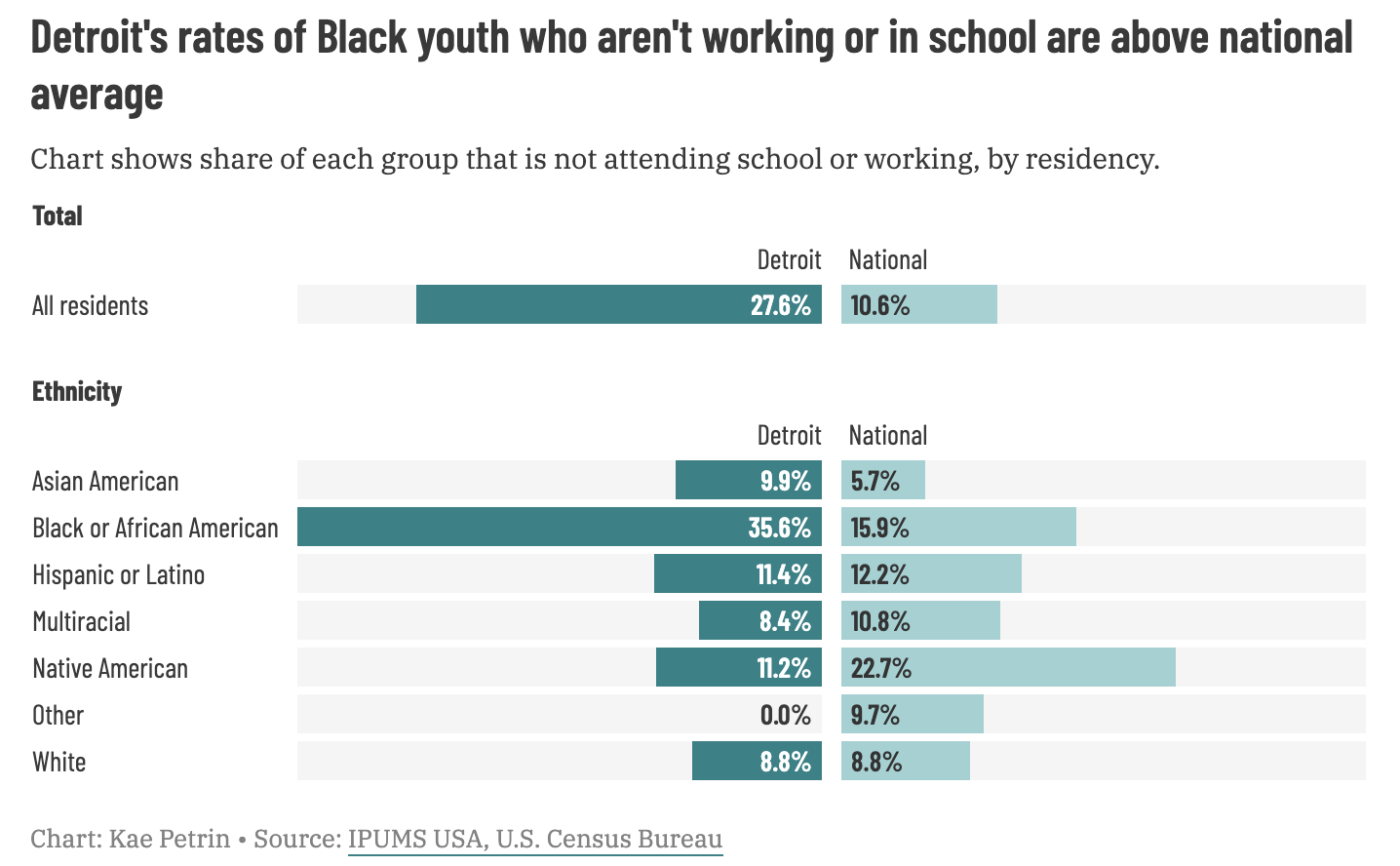
In Detroit, the city's Employment Solutions Corporation, an agency reporting to the mayor's workforce development board, enlisted six nonprofits that vowed to bring a more holistic approach to connecting with youth. It's a crucial mission. As Detroit clamors for skilled young workers to power its growth, more than a quarter of Detroiters aged 16 to 24 are not going to school or working, the country's second-highest youth disconnection rate, according to a Chalkbeat analysis of Census Bureau data released last month.
Reconnecting Disengaged Detroit Youth Amid New Challenges
Among the nonprofits that signed contracts worth a collective $3.4 million in federal money to tackle the issue were two groups with different backgrounds.
One, Urban Neighborhood Initiatives, known as UNI, had offered programs to steer students to high school graduation and college for years. But amid the pandemic, it ramped up efforts to help teens who had dropped out of school or had graduated with no clue what to do next. A UNI success coach set out to triage Lucian's complex needs through a turmoil-filled stretch.
Another nonprofit, SER Metro Detroit, has long been the largest local player in working with disengaged youth, offering job training programs and an alternative high school. Here, GED teacher Anthony Tejada—who brought his own backstory of youth disconnection—set out to help a homeless teen named Seth get back on track.
Studies have suggested the empathetic approach is showing some promise. But efforts are running up against perennial hurdles: fragmented programs, fickle funding—and the lack of opportunities in ZIP codes with long histories of disinvestment where many opportunity youths live.
In a highly polarized country preoccupied with the economy, reengaging these young people and forging non-college pathways to good jobs has drawn some bipartisan agreement. After years of deadlock, a lame-duck Congress is on the verge of reauthorizing the sprawling Workforce Innovation and Opportunity Act, potentially beefing up funding for youth programs.
But in a moment ripe with uncertainty, will Detroit and other cities around the country be able to help young people like Lucian and Seth forge a path to stability? Or will they remain the kids everyone forgot?
In the spring of 2021, Lucian walked from the home where he was staying at the time to a community garden in Southwest Detroit run by Urban Neighborhood Initiatives.
A group of teens wearing facemasks stood in a circle in the middle of a grassy expanse with just a few raised boxes of tomatoes. Lucian resisted the urge to turn and flee.
UNI had long worked with middle and high school students in the Springwells neighborhood: a 1.3-square-mile, densely populated, and predominantly Latino area. But during the pandemic, Los HQ, the nonprofit's hangar-like space down the street from the garden, welcomed more youth like Lucian—members of the COVID-19 shutdown generation, who bore the brunt of the pandemic's learning disruption and mental health toll.
The nonprofit set out to help them with funding cobbled together from philanthropy, the Workplace Innovation and Opportunity Act, and federal COVID-19 relief. It started offering short-term counseling and referrals to therapists with normally yearslong waits for new patients. It kicked off the gardening and cooking program to expose youth to culinary and green careers—and bring them back together outside.
A friend told Lucian about the culinary program, and he'd come to interview for the last spot left. The teen, who'd dreamt of designing video games, had never considered working with food. But the small stipend the program offered was a big draw.
Lucian had tuned out of high school during remote learning, which dragged on his entire sophomore year at Western High. He returned in 2021 when school buildings reopened, only to find he'd fallen too far behind. So he stopped going.
For most of his childhood, his single mom had been sick and rarely held on to a job or an apartment. Then, around the time COVID-19 hit, her kidneys failed and other ailments reared up, confining her to the hospital for most of 2020. She died in early 2021. Lucian decided he wouldn't let himself mourn her. He was on his own; he couldn't afford to fall apart emotionally.
As he approached the group in the garden, his social anxiety spiked. He had forgotten how to talk to people in person.
Danielle Dillard, the program lead and a trained social worker, stepped aside to talk with Lucian, who stared at his beat-up sneakers and dribbled one-word answers. He felt he was blowing the interview.
Dillard offered the last open spot to Lucian.
SER Metro's Youth Reengagement Center sits on a treeless commercial stretch in southwest Detroit, with a shuttered strip club and boarded-up adult bookstore across the street. The building was unveiled in 2023, remodeled and expanded with $4 million in state and philanthropic dollars.
Earlier that year, Anthony Tejada started working with 19-year-old Seth in the center's GED classroom. The teen—who Chalkbeat is not identifying by his full name to protect his privacy—was coming off a rough couple of years. After dropping out of high school, he faltered in night school and another reconnection program in Flint, where a staffer urged him to give finishing high school one more try at SER. He was jobless and staying with his brother.
Tejada met Seth at a time when efforts to reconnect youth like him were in a new spotlight.
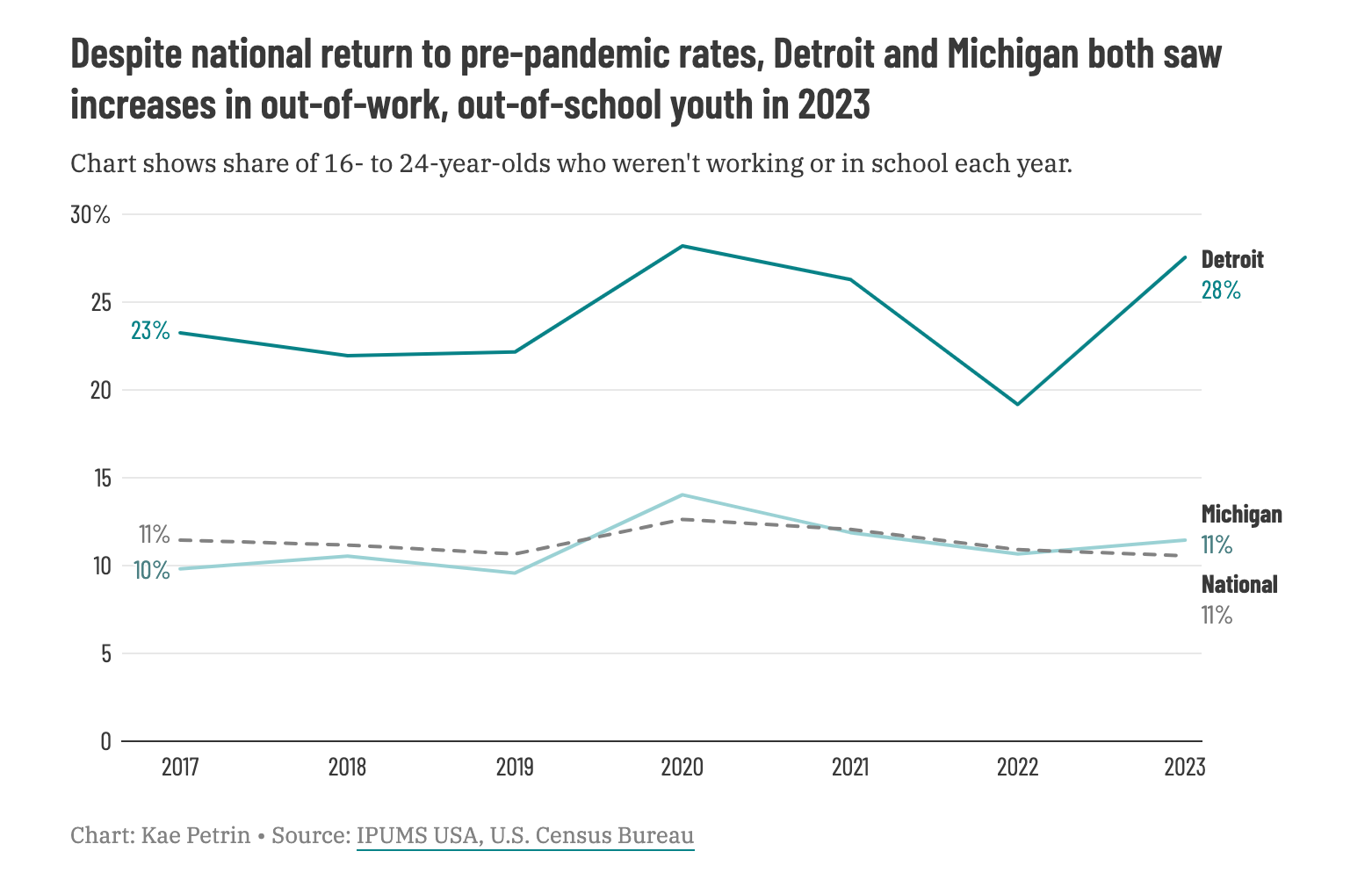
In the years leading up to COVID-19, youth disconnection rates across the country had been steadily declining. Some advocates and practitioners saw it as evidence that their efforts were paying off.
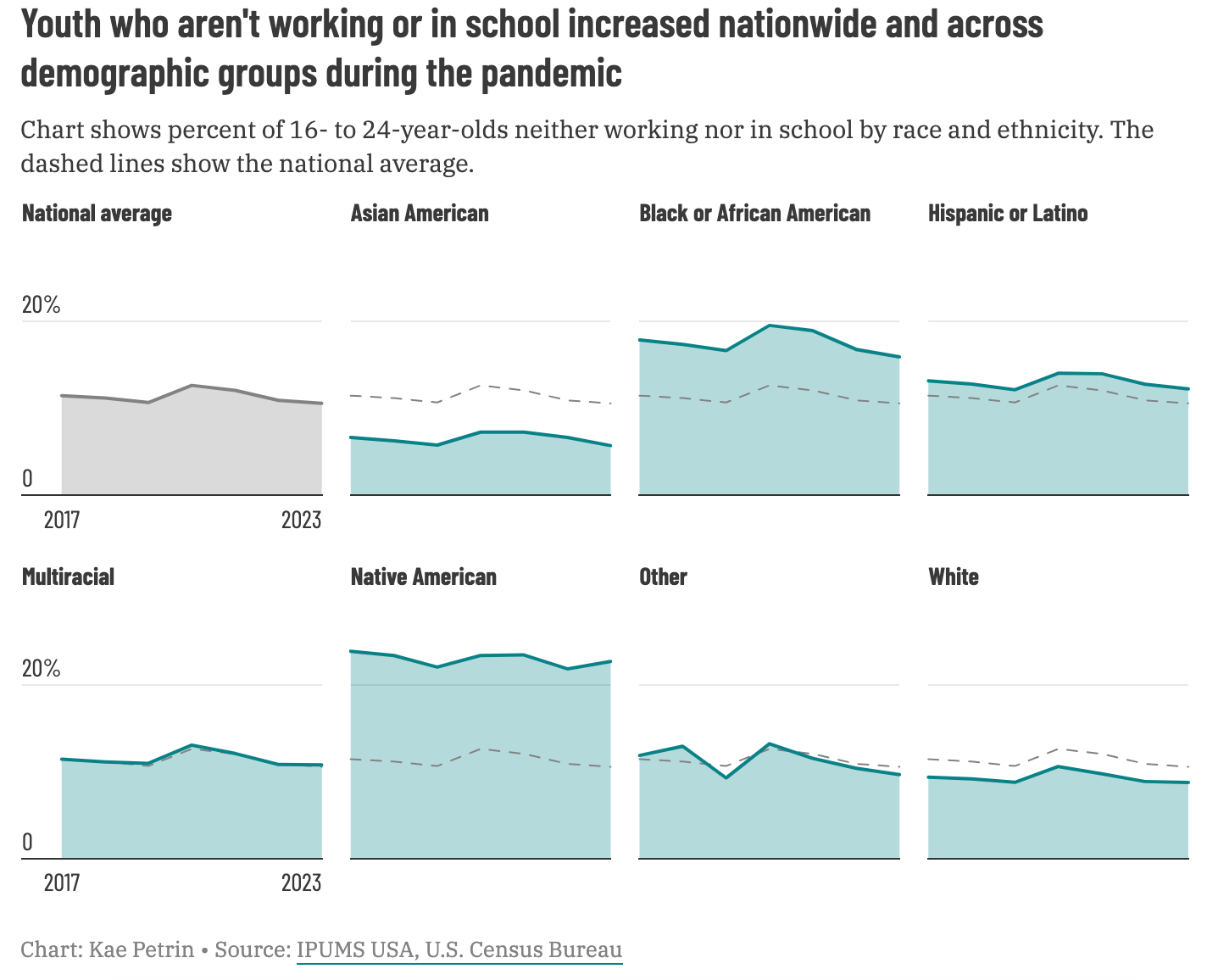
But experts credited a recovering economy, noting that most of the relatively few reengagement programs studied rigorously have shown modest gains—a single-digit increase in high school completion, say, or several hundred dollars more in annual earnings. And even as the overall rate improved, the disconnection rate for Native American youth, such as Lucian and Black youth, such as Seth remained double or even triple that for Asian American and white youth.
Meanwhile, scientists had been rethinking the very definition of adolescence. The prefrontal cortex is developing well into the mid-20s, they noted, offering a make-or-break window to do the social-emotional repair many young people need to navigate the workplace—and life.
Then COVID-19 hit. The national disconnection rate rose from 10.7% to 12.6%, or about 716,200 more youth, bringing new urgency to building better reconnection programs.
Healing Through Education and Connection at SER Metro
At SER Metro, staff embraced trauma-informed case management and got restorative practices and "healing-centered" training, rooted in the idea that trauma and disconnection feed each other in a vicious cycle.
Tejada wants the young people he works with to take the lead. He lets students, who increasingly come in reading at an early elementary level, do the GED prep class at their own pace and tackle the tests in their chosen order.
In late 2023, Tejada felt Seth had momentum. He'd been coming to class consistently and had passed the science exam. He'd found a social circle in the GED classroom, even dating another student, his first real relationship.
It was easy for Tejada to root for Seth. In high school, Tejada—like Seth—had struggled with ADHD. Tejada graduated and went to college, but in his freshman year, crippling depression set in. He stopped going to classes and dropped out.
Navigating an Uncertain Path to Resilience
But Tejada was a middle-class kid from the Detroit suburbs whose close-knit family rallied around him. Society is much harder on kids like Seth—poor, family scattered—when they take the same detours.
As Seth geared up to take the social studies exam, Tejada told him about his years pulling shifts in his family's Mexican restaurant. Eventually, he made his way back to college. Look at his life now, he told Seth: a home, a family, a job he loved. Stability.
Tejada told Seth he didn't need to stay in lockstep with an arbitrary timeline or a predetermined path: "A lot of us have many twists and turns along the way."
For Lucian, the two years after he turned up at UNI's community garden were full of twists and turns. He slept on a series of couches and beds, then rented a small apartment—only to get evicted a few months later. He worked several jobs, sometimes with pay under the table, which he often spent on expensive gifts for his friends in a bid to cobble together the family he never had.
There was one constant: Danielle Dillard, Lucian's UNI supervisor and "success coach." Dillard sat him down to make a "success plan" with goals for the year and beyond. She pushed him to go back to school—a top goal on his list, but one for which he didn't feel ready. She pushed him to see UNI's new in-house therapist and to address health issues.
After Lucian completed UNI's culinary program in 2021, the nonprofit helped him find a job as a server's assistant at a high-end Detroit restaurant. The shifts were long and fast-paced, but he was learning a lot.
Then the restaurant closed abruptly, a pandemic casualty. He eventually found a job at Family Treat, a Springwells neighborhood fast food fixture. But it was only open in the warmer months. It was after the restaurant closed for the season that Lucian found himself isolated—and sliding downward—in that friend's bedroom in the spring of 2023.
When Family Treat reopened a month later, for a brief moment Lucian felt freed from his entrapment. He loved the bustle and camaraderie of restaurant kitchens. He just wanted a restaurant job with more stability, benefits, room to grow.
For now, he picked up all the shifts he could, working up to 60 hours a week.
After work, his mind descended to the same dark place it had staked out during his jobless stretch. Exhaustion made things worse.
The grief over his mom's death that he'd suppressed two years earlier reared up. By May 2023, that despondency turned to despair.
On Mother's Day, in a park not far from the cemetery where his mom was buried, Lucian slashed his wrists.
Tejada's work day was drawing to a close at the SER Metro reengagement center when a distraught Seth burst through the door. A few weeks earlier, the teen had failed the social studies GED test by just a few points. He had righted himself for a bit, turning his attention to the language arts exam.
For almost a year, he had chipped away at the GED at his own pace as Tejada, his instructor, had urged. But his momentum was fizzling out. He had been wondering if it might be time to get a job—any job.
What sent him pushing through the door minutes after he'd left the center was dropping his phone and cracking it while he was running to catch a bus. Suddenly, Seth found himself beset by all the complications in his life. His girlfriend, a classmate at SER, was pregnant. He was panicking that his baby would have two jobless parents slogging through a GED class.
"Nothing good's ever coming to me," he railed as Tejada and two other staffers sought to calm him down in the lobby. "Every little good thing I get is taken away."
As Seth tried to slam his phone against the floor, Tejada enveloped him in a hug that was part comfort, part restraint.
"You've been through worse things than breaking a phone and missing a bus," he reminded him.
Recent studies suggest that adding social-emotional support to reconnection programs can work. A 2021 report of the Opportunity Reboot model in Minnesota, which layers mentoring and social-emotional guidance onto existing re-engagement programs, found it increased the odds of youth getting and keeping jobs. A study of One Summer Chicago Plus, a summer jobs program that paired minimum-wage jobs with cognitive behavioral therapy and mentorship, showed it significantly reduced teens' involvement in violent crime—a goal that has often fueled efforts to reengage disconnected youth in that city and others.
The Fight for Stability to Reconnect Detroit's Opportunity Youth
The results so far in Detroit illustrate the challenges that persist. Ericka Page, point person for youth programs at the Detroit Employment Solutions Corporation, the agency contracting with the six nonprofits running programs, said data on these programs' outcomes shows many young people bouncing in and out of re-engagement programs and from job to job. Often, these are minimum-wage, part-time, or gig jobs.
The programs are connecting with youth and getting some of them employed. But sustaining their momentum over the extended time it takes to remake their lives is hard, Page said.
"The biggest challenge with opportunity youth is retention," says Ann Leen, who heads the SER Metro center. "It could be a $15 an hour job. It could be the streets calling. It could be, 'Mom needs help.' It could be, 'It's just too hard.' We have to be louder than those other voices."
On the afternoon Seth burst into the SER lobby, the staff helped him calm down. But after that day, he started showing up less and less. By last spring, he had stopped coming. By fall, he returned, on and off. By winter, Tejada worried he was losing him again.
Lucian was not alone at the park when he harmed himself on Mother's Day 2023. A friend who was with him called an ambulance that rushed him to the emergency room. He spent a week at a psychiatric hospital.
When he left, staffers from Urban Neighborhood Initiatives kicked into high gear. They set him up with an outside therapist and gave him rides to appointments. When he stopped going, they pushed him to go back. They found him a bed at a small shelter all the way across the city.
Lucian was eager to get back to work. He needed the money, but he also missed the steadying rhythms of working full-time. He walked the drab commercial stretch with boarded-up storefronts near the shelter and found the few businesses left were not hiring. For occasional shifts at a fried chicken place in his old neighborhood, he sometimes commuted as much as two-and-half hours one way.
Then in early 2024, a friend invited Lucian to move in with him, his mom, and his eight siblings in a house not far from Los HQ. The move back to the Springwells neighborhood was a game-changer, bringing him closer to jobs and friends.
By this spring, he was on full-time grill duty at Family Treat. He had picked up more shifts at the fried chicken place. And UNI brought him on to help out with the culinary program two evenings a week and soon promoted him to program lead. At that rate, he felt, he might be able to afford to rent his own place with a friend by summer's end.
Across the country, young people like Lucian had been getting back to work, pushing post-pandemic disconnection rates down as the labor market ramped up. But some experts and advocates worry there's a catch to that good news.
Kristen Lewis, director of the think tank Measure of America, says she worries that many young people are choosing unstable jobs that can breed more disconnection in the longer run over opportunities to finish high school and get training that could actually open up a path out of poverty. The post-pandemic data has reaffirmed something experts knew before COVID-19: The fates of vulnerable young people like Lucian are chained to their ZIP codes and the whims of the economy.
"We've been searching for silver bullets: Summer jobs will solve everything! Mental health care will solve everything!" she said. "But look at the deep structural problems and profound inequities some neighborhoods face. It's the story of what's wrong with America."
Lucian, too, felt keenly the precariousness of his situation last spring. His worries came to a head when a diabetic seizure struck near the end of his shift at Family Treat one April afternoon.
He had just started on an order of five footlongs in the narrow kitchen when a buzzing in his ears muffled the sizzle of the fryers, and his vision faded to white. As he convulsed on the floor, his manager kneeling beside him, one thought cut through Lucian's brain fog: He had to get back to making hot dogs.
He couldn't lose that $11.50-an-hour job—and the fragile stability he'd just started regaining.
Lucian staggered up to his feet. His vision still swam, and arms stung as though jabbed by needles. But he dashed back to his work station, where the hot dogs he had set on the grill still rotated.
"You still need five of these, right?" Lucian called to the young woman working the front register.
This November, with Family Treat closed for the season, Lucian, now almost 20, walked into a GED prep classroom in Southwest Detroit.
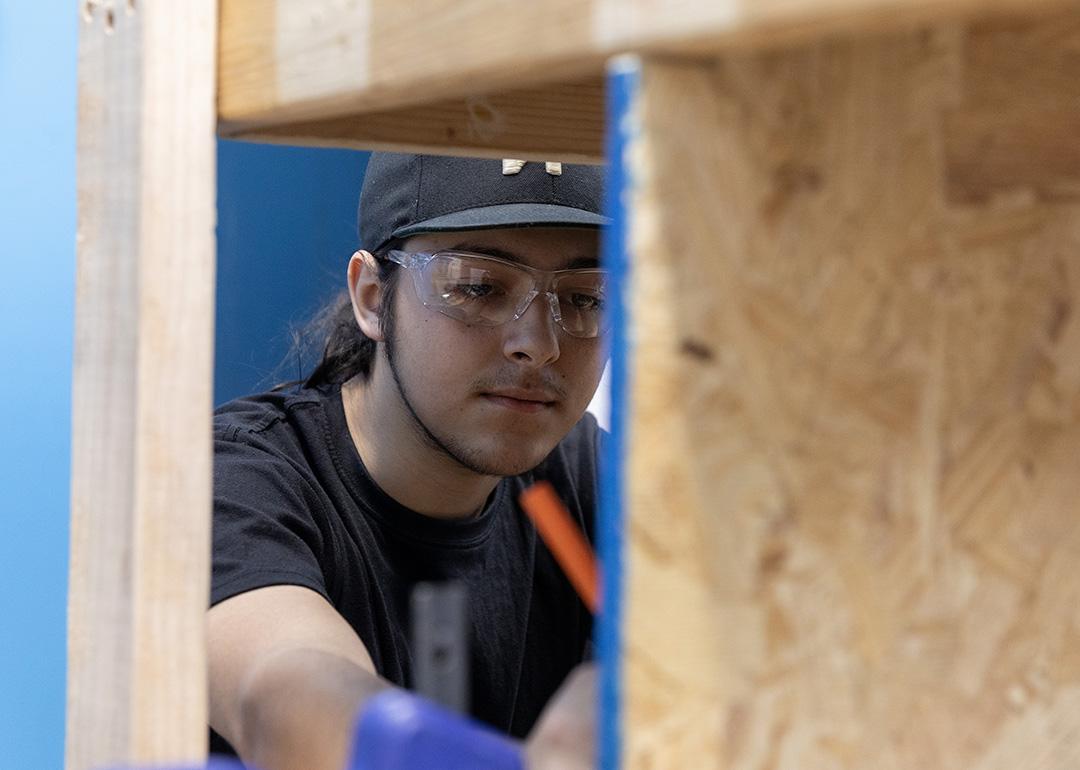
UNI had referred him to the program, which would pay him $200 a week and introduce him to a career in carpentry. Lucian felt it would be good insurance against the fickleness of restaurant work—and a chance to finally tackle his longtime goal of getting a high school credential.
But uncertainty still plagued Lucian. He and his roommate were both unemployed, and the bills kept coming. The staff at UNI collected almost $400 for Lucian's November rent and got him a free Thanksgiving turkey. He was quickly learning that it was tough to find a job while tied up in a carpentry and GED program for most of the day.
Some advocates worry that the COVID-19-era sense of urgency around opportunity youth might be fading even as many young people like Seth and Lucian haven't yet regained their footing. But boosting funding for re-engaging and training disconnected youth has been a key area of bipartisan consensus in the federal push to reauthorize the Workforce Innovation and Opportunity Act, which expired in 2020.
Lawmakers launched a bipartisan Opportunity Youth caucus this summer. And a bipartisan agreement on the law earlier this year would have steered more money to youth programs, including a new $65 million apprenticeship program. But in late December the bill was shelved amid a congressional standoff over funding the federal government, leaving uncertain the fate of the law and the programs it powers.
On the campaign trail, President Donald Trump and running mate JD Vance at times appeared to speak directly to young men like Lucian and Seth, promising a return to an era of robust manufacturing and access to good jobs that don't require college. But practitioners worry about what the incoming administration's appetite for federal spending cuts might mean.
In Detroit, the Ballmer Group, former Microsoft CEO Steve Ballmer's foundation, has been pushing the city for a big-picture vision for attacking youth disconnection. Here and nationally, the focus is shifting back to the training and credentials young people need to access high-demand jobs employers are trying to fill.
It's impossible to know where Lucian and Seth would be now if their lives had not intersected with the agencies and people helping them. But their experiences these last few years affirm that young people who become disconnected from school and work need more than jobs that pay the bills. They need social-emotional backing—and also a way to see a clear path to more stable, fulfilling lives.
Their stories show that rebuilding after a stint of disconnection takes time. And programs often aren't set up to serve young people in the long run, so the years ahead could bring more uncertainty.
It's easy, Lucian realizes, to miss the growth he'd made amid the rollercoaster of the last three years. He is taking better care of his physical and mental health. Time spent "jotting and rambling" in his journal about his long-term goals grounds him.
Dillard moved to the West Coast earlier this year, but they've stayed in touch, catching up on Zoom. She told him she was proud of him. He told her he was anxious, but also determined.
"I think a lot about the future," Lucian said this month. "I am always thinking about when I am going to reach my goals—not if."