Prosper
1 / 2How to set financial goals
- Start with reflection: Consider what you value most in life and how your finances can support those values. Your goals should resonate with your personal priorities—whether that's buying a home, traveling, having a baby, taking a gap year, or saving for retirement.
- Set short-term, midterm and long-term goals: Short-term and midterm goals are achievable within a year or two, like saving for a vacation or paying off a credit card. Long-term goals may take several years or decades, such as saving for retirement or paying off a mortgage.
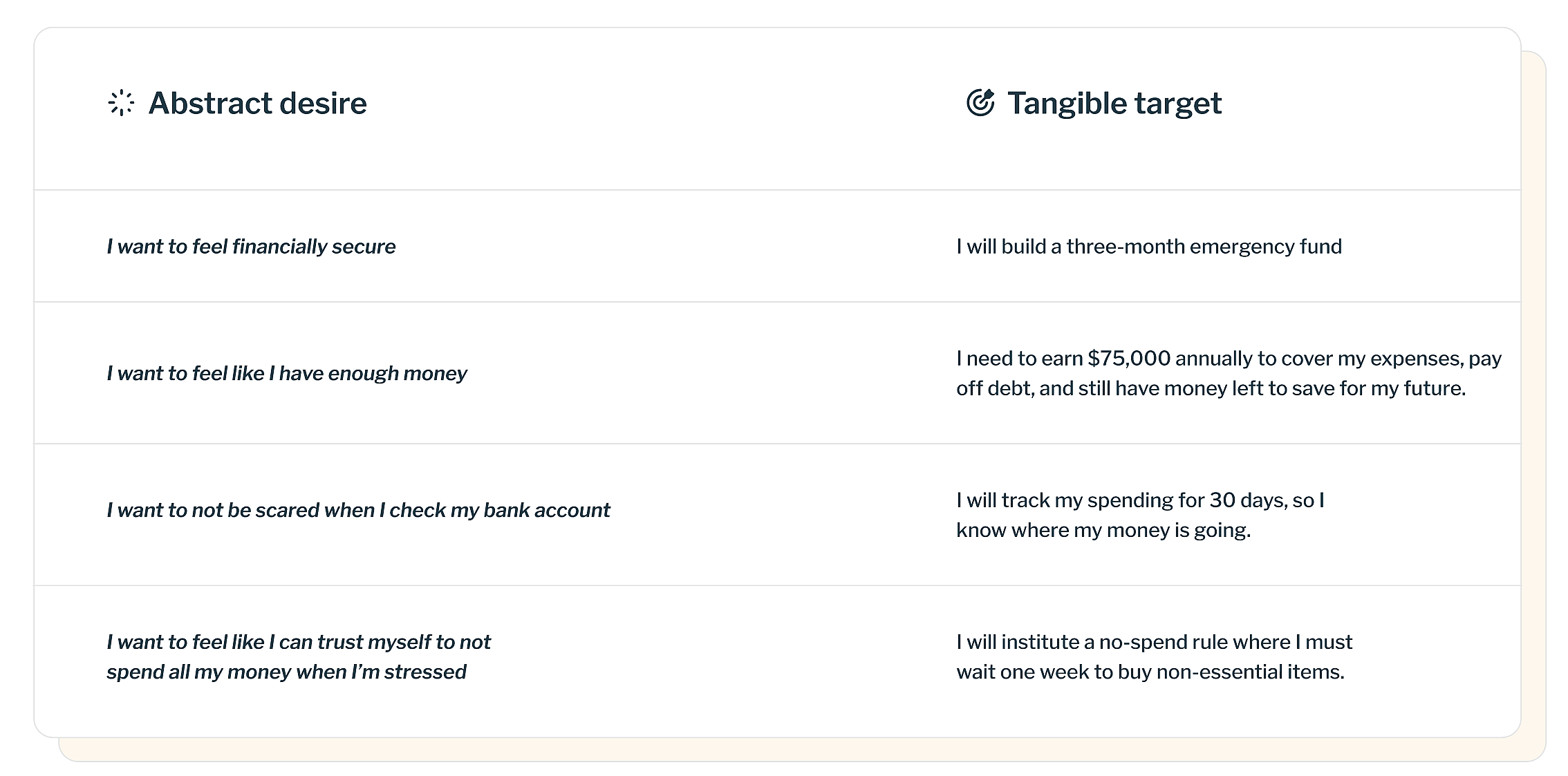
- Be specific and measurable: Vague goals are hard to achieve. Instead of saying "save more money," specify "save $10,000 in two years, so I have a three-month emergency fund." This clarity makes it easier to plan and track progress.
- Create a savings strategy: Determine how much you need to save regularly to meet your goals. Automate your savings and investments to stay consistent.
Create a budget that works for you
A budget helps you track your earnings, spending, and savings. It isn't about cutting out lattes and never allowing yourself to have fun; budgeting is about gaining a clear understanding of where your money is going so you can make intentional decisions with your finances.
- Start with your income: Know the exact amount you bring home each month. This includes your salary after taxes, any side hustles, and passive income streams.
- List your expenses: Begin with fixed expenses (rent, mortgage, insurance, car payments) and then estimate variable costs (groceries, gas, entertainment). Don't forget annual or semi-annual expenses, like property taxes or insurance premiums.
- Prioritize your goals: After you estimate expenses, decide what's next in line for the money you have left over. This could be paying down debt, building an emergency fund, or saving for retirement.
- Incorporate fun money: If you've struggled with budgeting in the past, it may be because your budget was too restrictive. Be sure to include a category for personal spending—yes, even that occasional latte.
- Review regularly: No two months will ever be the same, so review your spending at least weekly and move money around as needed. If you find you're consistently overspending in one category, adjust your target amount. Perhaps you underestimated your grocery budget or didn't account for seasonal utility bill fluctuations.
What's your budgeting flavor?
Saying budgeting doesn't work for you is like saying ice cream isn't delicious. You may not like all ice cream, but there's bound to be a flavor that delights your taste buds. The same goes for budgeting. If the first one you try doesn't work, keep sampling until you find one that clicks.
- 50/30/20: With this method, 50% of your income goes to needs, 30% to wants, and 20% to savings and debt repayments. You can adjust these percentages to match your goals.
- Zero-based budgeting method: This method requires you to assign every dollar of your income to a job—whether it's for expenses, savings, investments, or debt payments. The goal is to make sure your income minus your expenses equals zero.
- Reverse budgeting: This is where you put your money into savings first, then use whatever is left over for expenses and fun things.
Tips for tracking expenses
Tip #1: Start simple
If traditional budgeting hasn't worked for you, start with a simple approach. Track your spending for 30 days by categorizing expenses as 'needs' (rent, groceries, utilities) and 'wants' (dining out, entertainment). Use a basic spreadsheet or a notebook to do this—but don't cut out anything or make changes. Simply get in the habit of looking at your spending without judging.
Tip #2: use the right tools
Budgeting apps can simplify the process of tracking your expenses. They can connect to your bank accounts, categorize your spending, and provide insights into your financial habits.
How to deal with financial shame
If the thought of looking at your spending makes you want to run and hide, you're not alone. Money is a taboo topic, which can intensify any shame you feel around it. "We face judgments about money from many angles: personal, professional, religious, and cultural," says Eric Croak, certified financial planner, accredited wealth management advisor, and the president of Croak Capital, a wealth management firm in Toledo, Ohio. "As a result, admitting to others that we're facing financial troubles is incredibly hard."
One way to break free from this shame is to practice being kind to yourself for your past financial mistakes. "I've seen many clients who think that empathy and compassion mean letting themselves off the hook for their errors. But that's not the case," says Croak. "Recognizing a mistake, accepting responsibility for it, and not harshly criticizing yourself is a mature way to deal with errors."
Save money and start an emergency fund
An emergency fund isn't just a financial buffer—it's peace of mind in its purest form. Knowing you have funds set aside for the unknown can greatly reduce your stress and anxiety.
Whether it's job loss, medical emergencies, or sudden car repairs, an emergency fund ensures you can cover these without resorting to high-interest debt.
Beyond immediate financial relief, an emergency fund can also provide the financial independence needed to make big life decisions—like leaving a toxic job, escaping an abusive relationship, or even funding your dream business.
How to build and maintain an emergency fund
- Start small: Most experts recommend building an emergency fund that covers three to six months' worth of expenses, but this can be unattainable if you're just starting. It's okay to begin with a modest goal—like saving $500 or $1,000. From there, bump it up to one month of living expenses, then two, until you get to the recommended three to six months' worth.
- Keep it separate: Store your emergency fund in a separate high-yield savings account where you can earn interest. Separating it from your checking account will also help you avoid the temptation of spending it.
- Replenish it when you use it: If you dip into your emergency fund, prioritize topping it back up. Adjust the total amount if your monthly living expenses change.
PSA: Don't feel bad for using your emergency fund!
Once you build your emergency fund and it's sitting at a good number, you may feel guilty for using it. However, your emergency fund is not a trophy to admire but never touch. It's a fire extinguisher for you to use when your financial house is on fire. As long as you're using it on actual emergencies, it's doing its job. Don't feel guilty.
Strategies for saving money
- Focus on your largest expenses: For most people, housing, food, and transportation consume the lion's share of their budget. Reducing these even slightly can have a big impact on your finances. Consider refinancing your mortgage, downsizing, or relocating to a less expensive area to cut housing costs. Plan meals and cook at home more to save on food. Use public transportation, carpool, or sell a vehicle to slash transportation costs.
- Reduce recurring expenses: Regularly audit your subscriptions and recurring bills. Cancel services you no longer use or need, and don't hesitate to negotiate better rates on utilities, insurance, and other services.
- Use windfalls wisely: Put a portion of any unexpected cash—like tax refunds or bonuses—directly into your savings.
- Save on shopping: Consider using coupons, shopping sales, and buying secondhand goods when possible. The savings can add up quickly.
- Take it one category at a time: Rather than broadly aiming to "spend less," identify a specific area where you'll try to save. For example, one month, you might focus on lowering food costs, so you might try a less expensive grocery store for 30 days as an experiment. The next month, you might choose a new category.
- Automate your savings: Set up automatic transfers from your checking account to a savings account so money gets moved the moment you get paid. This "set it and forget it" method ensures you save regularly without having to think about it. You can also look into a debit card that rounds up your spare change.
Manage and pay off your debt
The average American household has $101,915 in debt, including a mortgage, based on recent data from Debt.org. This debt can lead to all sorts of mental health problems. A Forbes Advisor debt study found that 48% of people with debt report having difficulty sleeping, 40% have increased anxiety levels, 38% have a reduced social life and 34% indicate having depression.
There are many reasons why people find themselves in debt—high inflation, job loss, medical emergencies and chronic illnesses, poverty, divorce, relocations, overspending, or a lack of financial literacy. Some of these reasons are in your control, but many of them aren't.
Tips to pay off debt
- Assess your debt: Start by laying out all your debts. Create a spreadsheet listing each debt's balance, interest rate, and minimum payment. This will give you a clear picture of what you're facing and help prioritize which debts to tackle first.
- Choose a repayment strategy: Two popular methods for prioritizing debt are the debt snowball and the debt avalanche. The snowball method involves paying off the smallest debts first to gain momentum, while the avalanche method focuses on paying off debts with the highest interest rates first to save the most money over time.
- Set clear priorities: If you have multiple financial goals, establish an order of operations. For example, while maintaining minimum payments on all debts, you might prioritize building a starter emergency fund before aggressively paying down debt; that way you avoid adding more debt to your plate if a problem pops up.
Debt consolidation options
A debt consolidation loan is where you combine multiple debts into a single, larger loan. It's worth considering if you have good credit and will qualify for lower interest rates, a lower monthly payment—or both. You can consolidate debt in a few different ways:
- Balance transfer credit cards: If you have credit card debt, consider transferring balances to a card with a 0% introductory APR offer. You usually get 12 to 24 months to pay off the balance without accruing extra interest. There's often a balance transfer fee (usually a percentage of the transferred amount), so factor that into your costs.
- Personal loans: A personal loan is an unsecured loan from a bank, credit union, or online lender that you can use for any purpose, including consolidating debt. When used for debt consolidation, you take out a loan for the amount needed to pay off your existing debts, and then you use the funds from the loan to pay them off. You're left with one monthly payment for the personal loan.
- Home equity loans: If you're a homeowner, you can borrow against the equity built up in your home and use it to pay off debts. Home equity loans typically have lower interest rates than credit cards or personal loans because they're secured by your home. But you could lose your home if you fail to make the payments.
Develop good credit habits
Your credit score is a three-digit number ranging from 300 to 850. It acts as a summary of your creditworthiness, and lenders use it to assess the risk of lending you money.
You technically have multiple credit scores. The two most well-known models are FICO and VantageScore. These scores are calculated using information from your credit reports—like your payment history, amounts owed, length of credit history, credit mix, and new credit inquiries.
A higher credit score can lead to better loan terms and lower interest rates. It can even influence your ability to rent an apartment or get a job.
Build and maintain good credit
- Pay on time: Your payment history is the single most significant factor in your credit score. Pay your bills on time, always.
- Keep balances low: Keeping high balances on your credit cards and lines of credit can hurt your credit score. The sweet spot is to keep your credit utilization ratio below 30%.
- Hold onto old accounts: The length of your credit history matters. Keep older accounts open—even if you're not using them—to maintain a longer average credit history.
- Limit new credit inquiries: Every time you apply for credit, it can cause a small, temporary dip in your score. Apply for new credit sparingly.
- Diversify your accounts: Having a mix of different types of credit accounts—including revolving credit and installment loans—can benefit your score.
Invest in your financial future
If you want to build the kind of wealth that allows you to live a comfortable retirement, leave a legacy for your family, or donate to charities you care about, it starts with investing.
It may feel safer to keep all your money in a savings account, but these earn lower interest rates than the rate of inflation. So over time, the purchasing power of your money diminishes even though your balance is growing.
That's why investing in your future is so important. It allows your money to work harder for you by potentially earning higher returns. Although investing carries risk—including market volatility and the potential for loss—historically, the stock market has had an average 10% return over the past 30 years. Meanwhile, the current average savings account rate is 0.46%.
The power of starting young
"People will be amazed at the effect that compounding can have on their investments," says Chris Urban, certified financial planner and founder of Discovery Wealth Planning. "Even if you invest what may feel like a small amount of money in your 20's, by the time you reach your 50's, 60's, 70's, the simple power of compound interest could turn these amounts into very sizable account balances."
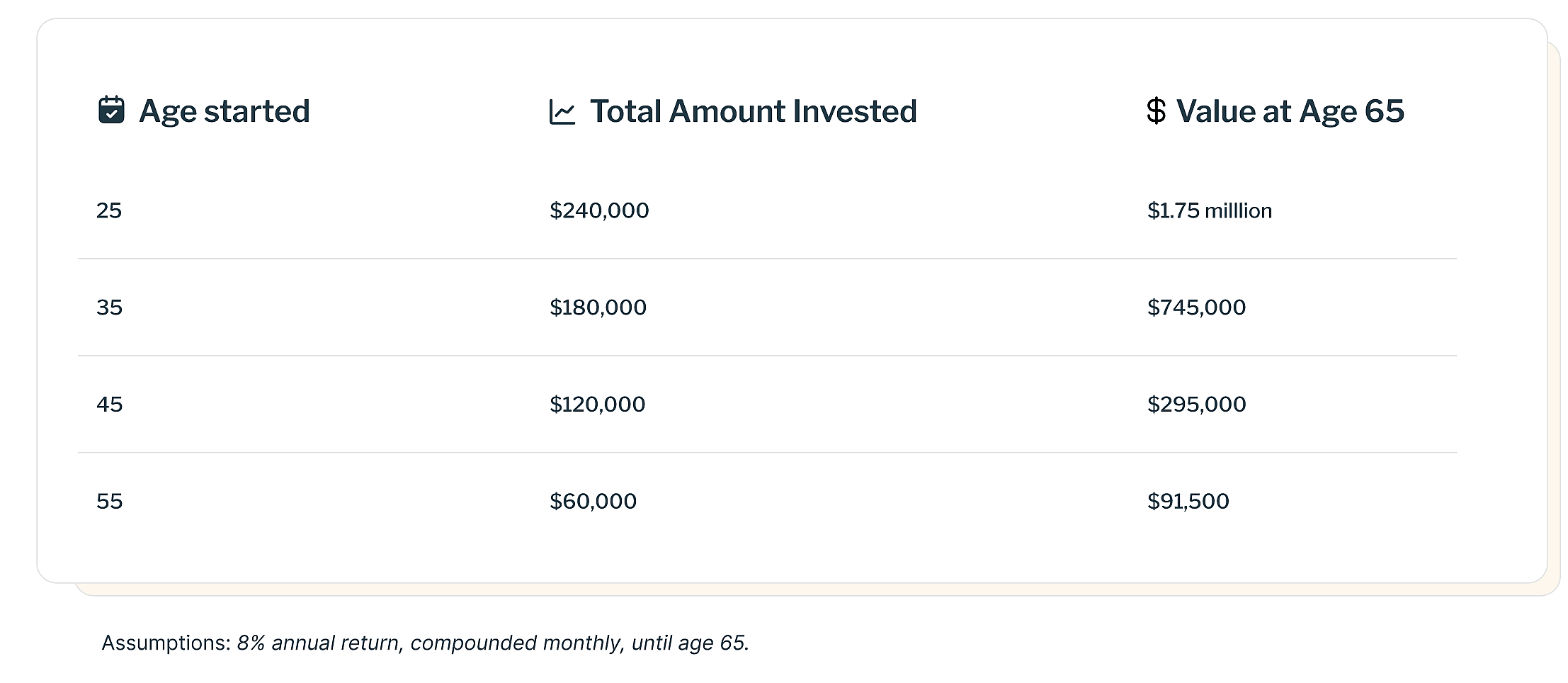
For example, say four individuals decide to start investing $500 a month until they reach age 65. They do everything the same way; the only difference is the age at which they start.
The table below shows that the earlier you start, the more you benefit from compounding. Imagine retiring at age 65 with $1.75 million even though you invested only $240,000—all because you started at age 25. That's powerful.
At the same time, don't get discouraged if you see this chart and think, "Oh shoot. I'm in my 50s. I've missed my mark. I didn't start early enough." Even at age 55, this person generated an extra $41,000 in returns. Because they chose to start anyway, they'll enter retirement with nearly $100,000 more than they had before.