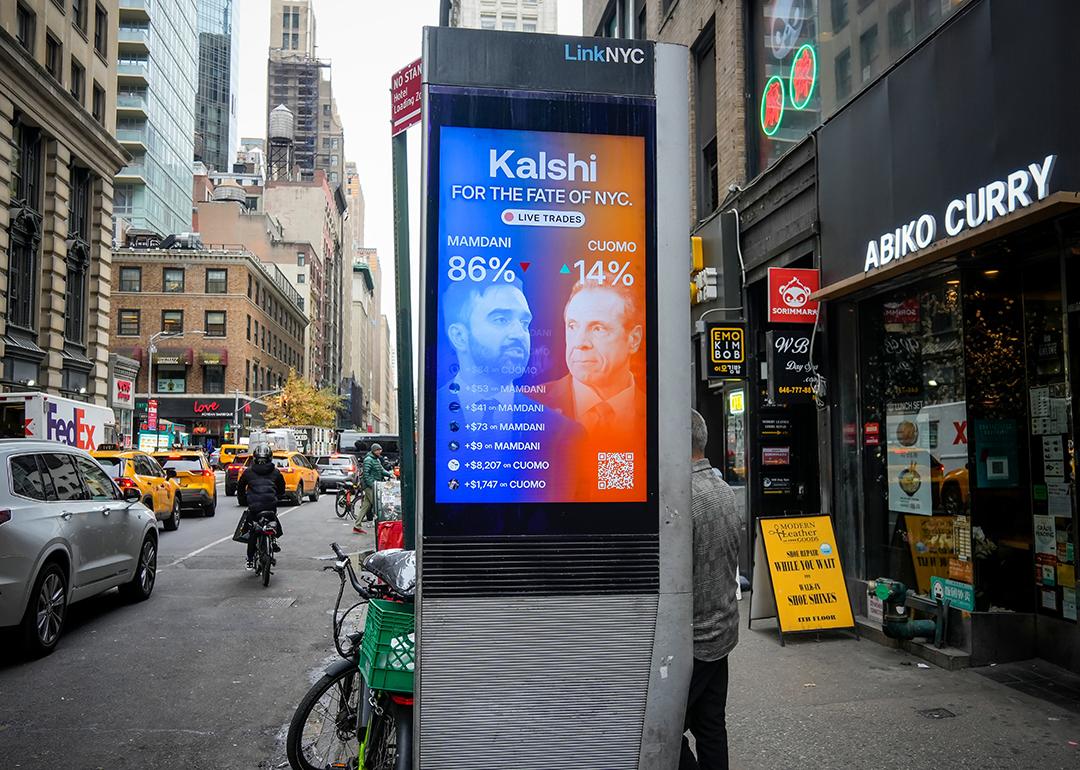
Why it’s so hard to win money betting on prediction markets
On Jan. 3, 2026, one Polymarket user made $436,000 in less than 48 hours. Their secret: They knew the United States military was about to arrest the president of Venezuela before anyone else did. The account was brand new, created just days before. They made exactly four bets, all related to Maduro’s removal. And hours later, the raid happened.
Over 3 million people have used prediction markets like Polymarket and Kalshi to gamble on things never thought possible. From what the weather will be to what will happen in your favorite TV show. And while they’ve made a big splash in gambling culture, almost nobody knows how rigged the system truly is and who really has the advantage.
In this article, CreditNinja breaks down how prediction markets work and who really wins.
Real Examples of Prediction Markets in Action
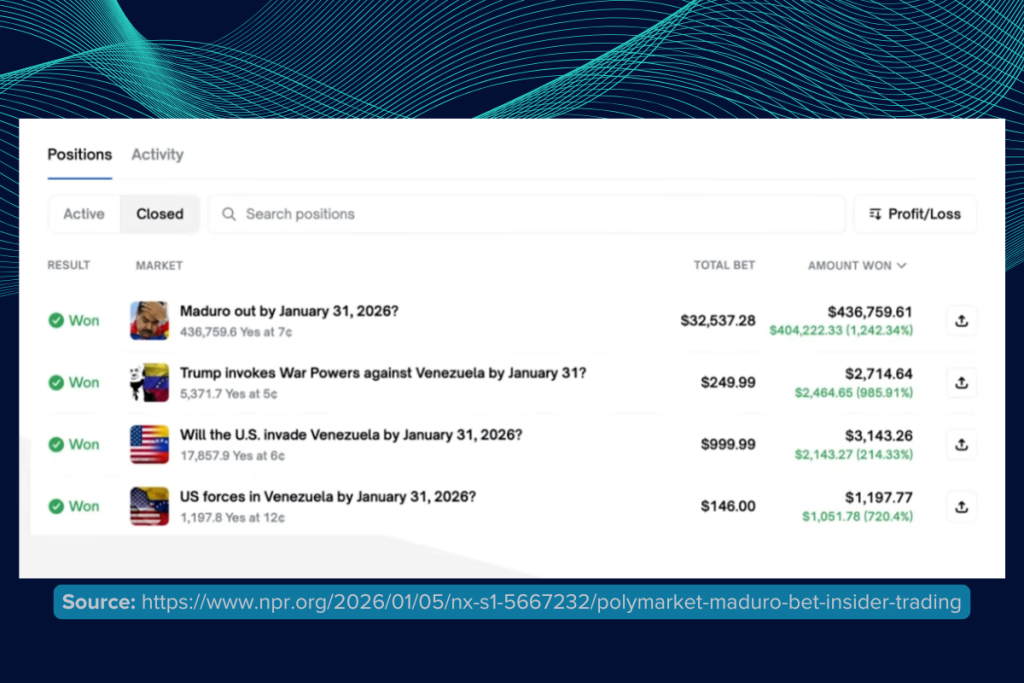
Burdenson-Mix’s Polymarket Account
Let’s look at the account named Burdensome-Mix, created one week before the Venezuela raid. Look at their bet history: $32,000 on Maduro being out by Jan. 31. $250 on Trump invoking the War Powers Act against Venezuela. $1,000 on the U.S invading Venezuela by Jan. 31. $146 on U.S. forces landing in Venezuela by the end of the month. They bet on four specific scenarios, all involving Venezuela. All within days of the actual operation.
And here’s what makes this absolutely wild. News organizations knew about the raid ahead of time. CNN, the Washington Post, they all had the story, but they held it to protect troops. Meanwhile, someone was loading up their Polymarket account with massive positions. We may never know who this person is, but it is almost a guarantee that they were one of the few people on the planet in the know.
Brian Armstrong and the 2025 Coinbase Earnings Call
And of course, there’s the infamous 2025 Coinbase earnings call. At the end of a quarterly call, Coinbase CEO Brian Armstrong said this: “I was a little distracted because I was tracking the prediction market about what Coinbase will say on their next earnings call. And I just want to add here the words Bitcoin, Ethereum, blockchain, staking, and Web3 to make sure we get those in before the end of the call.”
Now, why is he just rattling off words, you may ask? The answer is because Polymarket had props if Armstrong would say those words on the earnings call, and he admittedly read them off directly from Polymarket. Now, there’s no proof or any reason to believe he was placing bets here, but it goes to show how one person with knowledge and power could easily influence these outcomes.
What Does This Mean For Everyday People Using Prediction Markets?
Burdensome-Mix and the Coinbase earnings call are just two examples that highlight a massive problem with prediction markets: insider trading. Dennis Keller from Better Markets said, “The odds of losing money on these platforms are incredibly high.” Unless you have information nobody else has.
But it’s not just Maduro. In December 2025, someone made nearly $1 million betting on Google’s year-end search trends. They got 22 out of 23 predictions correct on specific search terms that Google controls. How do you predict what Google’s algorithm will show as the top searches of the year, unless you work there or know somebody who does?
Are Prediction Markets Rigged?
So the question becomes: Are the prediction markets another rigged system designed to take your money, or are these insider trading situations just isolated incidents in an otherwise fair market?
Well, here’s the data, and you can decide for yourself. Blockchain analyst DeFi Oasis analyzed 1.7 million Polymarket addresses. And you know what they found? Seventy percent of users have lost money. And of those remaining 30% who made money, less than 1 in 2,000 profitable users captured over 70% of all profits. We’re talking $3.7 billion concentrated in the hands of roughly 700 accounts. For context, that’s about $3.5 million each.
But when we see these numbers, these prediction markets feel like less of a degenerate gambler’s paradise and more of an inside trader's paradise. Because even though deep down it feels like gambling, these markets still make it seem like you can find an edge or an advantage that isn’t pure luck. For example, many people may look for outcomes that were between 90% to 95% and buy those outcomes. After all, the stock market index funds yield 8% to 10% on average. So, hypothetically, one or two of these wins could beat the stock market.
Reasons like this are why prediction market usage has exploded over the last year. These platforms weren’t built to feel like reckless gambling. They were made to feel accurate and that’s exactly what pulls people in.
How Prediction Markets Are Growing
These platforms have gone from obscure tech experiment to mainstream in less than a year. And the growth has been so fast that DraftKings and FanDuel, the kings of sports betting, both launched their own prediction market apps in December 2025. When the biggest gambling companies in America are scrambling to copy you, you’re not just some niche experiment anymore.
And while insider trading may seem like an issue with these markets, it isn’t exactly an unfortunate byproduct. It’s more of a feature.
Prediction markets were created many years ago because people were fed up with forecasting. Polls were unreliable. Experts wouldn’t commit to who they thought would win, and group consensus was wrong a lot of the time. So economists came up with an idea. What if you could influence people to put money behind their beliefs? The thinking was simple. When money’s on the line, people tell the truth.
And that’s where prediction markets come from. That’s why these markets use language that is very purposeful. They don’t call users gamblers. They call them participants. And they don’t say bets. They say contracts. They position these markets as skill-based, information-based, and financial, not based on chance like gambling.
Who Really Wins?
But here’s where the whole philosophy behind prediction markets falls apart. Robin Hanson, one of the leading economists who championed prediction markets, said, “The point of these markets is to get information, so the only reason you should ever be trading on them is if you think you have some information.” Read that again. The entire system is designed to encourage insider trading because it makes the prices more accurate.
Who has the edge on these? The CEO’s assistant, the academy voter, the Pentagon staffer, the Google engineer. And who doesn’t? You.
The Dangers of Prediction Markets
Another area for concern is whether these prediction markets leak information early or can be manipulated to spread fake news. Remember our friend who made $436,000 on Maduro? What if this trader started a trend where everyone is watching these markets to predict what will happen with geopolitical issues? This Maduro gambler placed wagers to make money, but imagine a nation’s government placing a big bet solely to create panic. Things could get out of hand fast.
Another concern with these markets is whether they are even legal. Polymarket was once raided by the FBI but recently rang the opening bell for the NYSE.
As for Kalshi, they have their own legal drama. They wanted to offer betting on which party would control Congress. The CFTC said no. These are gambling contracts, not legitimate financial instruments. So Kalshi sued. And in September 2024, it won. A federal judge said the CFTC overstepped its authority, and Kalshi could offer election betting. When the Trump administration took office, the CFTC dropped its appeal entirely. The case is closed. Election betting is legal.
But here’s where it gets messy. Kalshi now offers sports betting in all 50 states. States like Nevada and New Jersey sent cease-and-desist letters saying, You’re violating our gambling laws. Kalshi sued them, arguing that federal law preempts state law. It won in Nevada and New Jersey. It lost in Maryland. The system is chaotic.
Even DraftKings and FanDuel prediction markets aren’t available in all 50 states. These platforms operate in a regulatory black hole. They’re not stock markets. They’re not sports books. They exist in between where nobody’s really watching.
We all feel the financial stress. Everyday purchases are getting out of hand. People are financing burritos with buy now, pay later. Everyone feels behind, but these platforms feel like a cheat code to finally make well-deserved money. There’s a certain psychology that prediction markets tap into. Saving is slow. It’s boring, and it takes time. But prediction markets are immediate. They feel productive, and they make us feel like we’re actually doing something with our money.
Some Final Stats on Prediction Markets
Lastly, some final alarming stats about prediction markets. Polymarket raised $70 million in funding from Peter Thiel’s Founders Fund. It’s now valued at $4.6 billion. Shayne Coplan, at 26, is considered the youngest self-made billionaire in the world. Kalshi raised $300 million in Series D funding, valued at $5 billion. The investors are getting rich. The founders are billionaires.
Conclusion: Are Prediction Markets Worth the Risk?
Short answer: probably not. If you’re thinking about betting on prediction markets, ask yourself, Do I know something that everyone else doesn’t? Am I friends with the HBO CEO? Do I work at Google? Am I in the Pentagon situation room? If the answer is no, you’re not the hunter, you’re the prey.
This story was produced by CreditNinja and reviewed and distributed by Stacker.