After the buy button: How the post-purchase experience becomes your brand

After the buy button: How the post-purchase experience becomes your brand
You made the sale. Now comes the part most merchants underestimate.
Sham Aziz, founder of thecxway, put it plainly during the Experience Emphasis session at The Delivery Conference 2026: “As soon as they hit checkout, that’s when the clock begins. I think we have enough data, enough technology, enough tools, that we should be able to figure out—before the customer knows they want to know where their order is—you just tell them.”
That clock doesn’t stop at the doorstep. It runs through every tracking notification, every packing slip, every return request. The post-purchase window—everything that happens after a customer clicks buy—is where your post-purchase experience either earns loyalty or quietly loses it.
Most e-commerce merchants spend enormous energy optimizing checkout. Far fewer apply the same rigor to what comes after. This story by ShipStation looks at the operational levers—branded tracking, smart rate decisions, service mapping, and seamless returns—that turn post-purchase from an afterthought into a competitive edge.
The checkout promise is only as good as what follows
Delivery is an emotional experience. Customers aren’t just waiting for a box—they’re waiting to find out whether the brand they trusted is going to come through. Claire Bailey, founder of The Retail Champion, put it simply in the Experience Emphasis panel: “If we send the wrong product to a customer … we have a huge opportunity to lose them forever.”
That’s the stakes. Not a lost order—a lost customer. And it doesn’t take a failed delivery to break the relationship. Uncertainty is enough.
Luke Batten of Relay Technologies made the case during the Speed Doesn’t Win Loyalty session that the damage usually happens quietly.
“Reliability isn’t lost in just one moment,” he said. “It’s lost when all of these individual deviations go unnoticed.” His data point: Roughly 90% of consumers say they’ll happily wait two to three days—as long as the delivery is reliable and they know what to expect. Speed stopped becoming just one of the many ingredients that make up a great delivery experience, and it became the proxy for quality itself. Fast doesn’t automatically mean good.”
The implication for merchants: The post-purchase experience isn’t something you manage around. It’s where your brand actually lives.
Branded tracking turns anxiety into connection
Batten’s session surfaced a striking insight about tracking: Customers aren’t checking their order status because they’re excited. They’re checking because they’re uncertain. The instinct to track is a signal of eroded confidence.
Which means every tracking notification is actually a chance to rebuild it.
When tracking pages and notifications carry your branding—your colors, your logo, your voice—you’re not just delivering updates. You’re delivering a consistent brand experience from purchase to doorstep. Customers see your brand, not a generic logistics screen. Done well, it’s one of the highest-frequency touchpoints you have with a buyer.
The same applies to email and SMS notifications. Proactive, on-brand communication that tells customers where their order is before they have to ask is exactly what Aziz was describing when he called it “a surprise and delight moment rather than an ‘oh my god, where is it?'”
Custom packing slips: The unboxing moment is yours to design
Bailey shared a story that still resonates: Dreams Delivery drivers put on branded steel-toe slippers before entering a customer’s home. It made people smile. It made people talk. And it cost almost nothing compared to the loyalty it built.
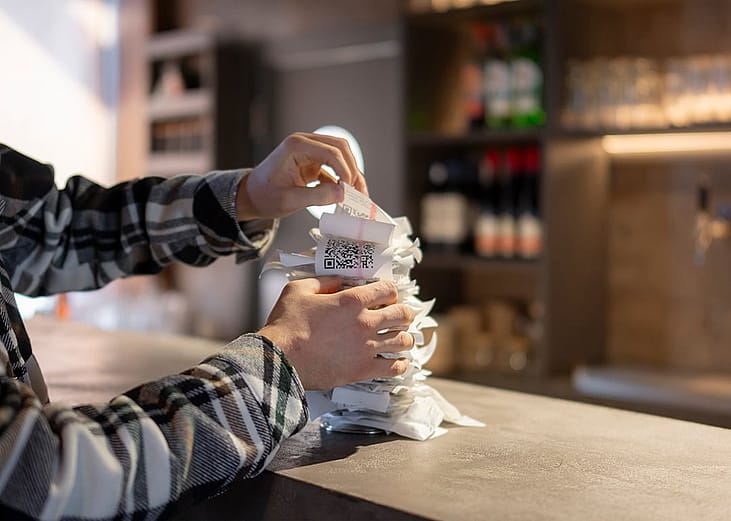
The principle translates directly to the packing slip. It’s a physical piece of your brand that lands inside every single package you ship—and most merchants treat it as a legal requirement rather than a design opportunity.
Custom packing slips that have your logo, include a personalized message, feature a QR code, or promote a loyalty program go a long way. It’s a small touchpoint, but in an era when unboxing moments get photographed and shared, it’s worth treating intentionally. The brand experience that starts at checkout can carry all the way into someone’s living room if you think it through.
Post-purchase brand quality depends on pre-ship decisions made well and made consistently. Which carrier. Which service level. Which orders need special handling. At low volume, you can weigh these by hand. At any meaningful scale, you can’t.
The Options That Win panel at TDC drove home how much customer expectation has evolved. Panelist Joe Matheron, head of Metapack at Auctane, noted that 84% of consumers will abandon their cart if they can’t see the delivery option they want—and that figure, in his view, is probably low.
“They’re gone,” he said. “They’re straight onto the next tab.”
Meeting that expectation starts with smart carrier and service selection upstream. Service mapping takes this further by connecting the delivery options you promise at checkout to the specific carrier services that can actually fulfill them. The promise and the execution stay aligned. That alignment is what makes a delivery experience feel reliable—and reliability, as Batten argued, is what actually drives loyalty.
“I think we’re underemphasizing the impact of customer loyalty as driven by a good delivery experience … what will keep me going back and buying again from a particular brand,” Matheron said.
Returns: The post-purchase experience most merchants still get wrong
If delivery is where the clock starts, returns are where it resets. And they happen more than most merchants want to admit.
Daniele Thomas, customer optimization manager for New Look, shared a direct perspective during the Beyond the Box session: “Returns are now a front-stage brand moment. Customers are committing to purchase almost knowing that a return is highly likely.” For fashion especially, the fitting room has moved into the customer’s bedroom—and the return is baked into the purchase decision before the order is even placed.
The merchants with the strongest post-purchase experience treat returns not as failure cleanup, but as relationship maintenance. Tobias Buxhoidt, CEO of parcelLab, put it sharply: “You cannot have dead ends. You cannot stop engaging with your customers ever—at least with the ones you want to keep. Post purchase becomes pre purchase—and you’re bringing back your customers over and over and over again.”
Fitz’s research at New Look found that customers want transparency most: “If you’re gonna charge for returns, tell the customer. Be really clear.” They don’t want to search, and they don’t want legalese. They want to know what to expect and to feel believed when something didn’t work out.
A returns experience that’s fast, clear, and on-brand doesn’t just reduce friction. It converts a potentially negative moment into a proof point. The customers who return easily tend to come back. The ones who fight through a bad returns process tend not to.
The whole experience is the brand
The Beyond the Box session closed with a point worth sitting with. The moderator observed it plainly: Customers don’t separate operational fulfillment from the brand experience. They don’t understand supply chain or logistics. They just bought from a brand they loved, put their trust in that experience, and want their product.
That’s the lens worth applying to every post-purchase decision. Branded tracking, thoughtful packing slips, smart rate and service decisions, a seamless returns portal—none of these are glamorous. But together, they’re what “the brand experience” actually means once the checkout is done.
This story was produced by ShipStation and reviewed and distributed by Stacker.