A ghost town revival
On the first Saturday of each December, a small miracle occurs in the extreme northeastern Oklahoma town of Picher.
Around 8:00 a.m., the first vehicles start arriving in the parking lot of an abandoned auction house at the corner of Connell Street and East 20 Road. Pickups pulling flatbed trailers, classic cars, and ATVs from the Quapaw Nation.
People spill out and get to work: decorating, catching up, sipping coffee from mugs and McDonald’s cups.
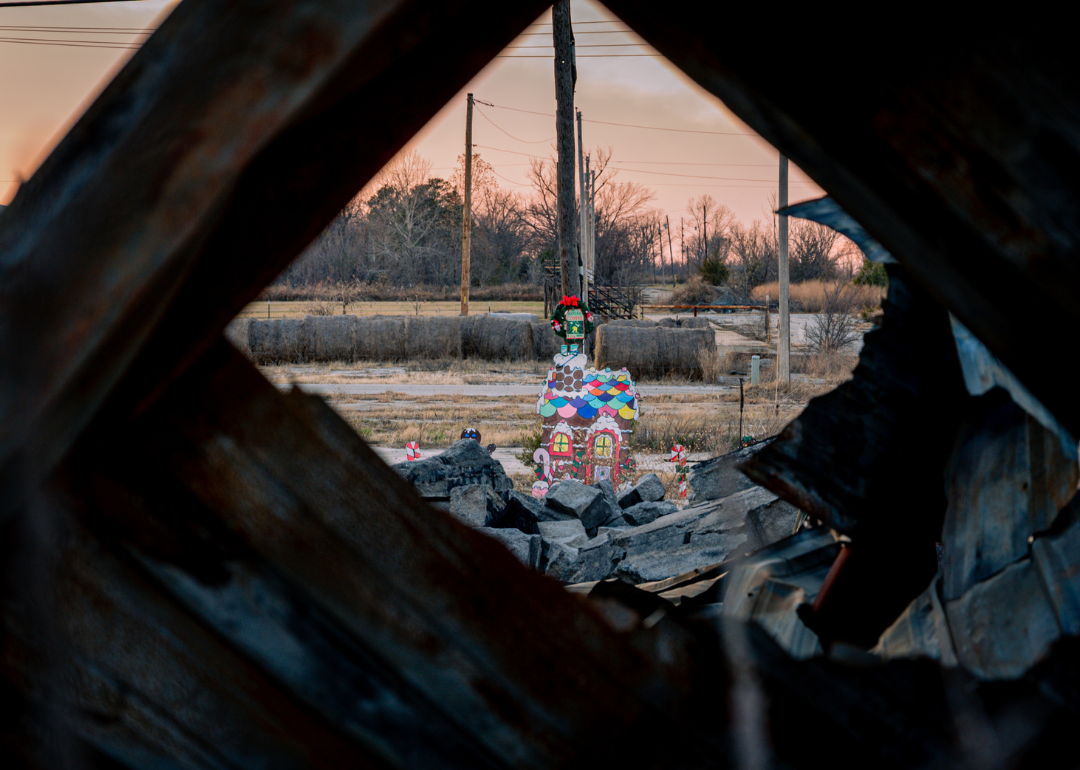
More show up. Tractors, a group of Harleys, police cars, and fire trucks. When the parking lot fills, they line the street beside what were once the youth sports fields. The area is overgrown, and only a deteriorating concession stand remains.
School buses from nearby Quapaw and Wyandotte arrive, and marching band members climb out, instruments in hand and Santa hats atop their heads.
A block south, Paula Suman and her husband, Phillip, pull their white single-cab Chevy 2500 in front of the Gary Building, a community building that was once a pharmacy owned by Gary Linderman, known as the “last man standing” in this place before he closed up shop and passed away.
Suman climbs a step ladder into the bed of the truck, sets a small speaker onto the toolbox, and plugs in a microphone.
Before long, the spectators begin to arrive, pouring in from the north and south, where Highway 69 turns into Connell Street. They pull off the road and create parking spaces in front of empty lots and dilapidated buildings. They get out, bundled against the wind, holding donuts and cigarettes. The kids bring bags they hope to fill with candy.
Just after 10:00 a.m., sirens pierce the cold air, the crowd eases closer to the street, and Suman starts talking through her makeshift sound system.
The Coming Home for Christmas parade has begun.
For the next hour-plus, Picher, Oklahoma, exists again. The mining companies never packed up and left. The abandoned mines beneath the crowd aren’t filled with toxic groundwater. The government never had to offer buyouts. The tornado never hit.
For one morning each December, the former residents of Picher bring a ghost town back to life. The Economic Hardship Reporting Project and Oxford American documented this annual tradition and the toxic legacy that scattered Picher's residents.
The Tri-State mining district stretched along the southwestern flank of the Ozark Mountains, starting in Missouri, cutting across Kansas, and into Oklahoma. Production started in Missouri in the 1850s. While surface mining on the land along the Oklahoma-Kansas border produced lead shot during the Civil War, it wasn’t until 1913 that Picher emerged after a giant ore deposit was discovered on the property of Harry Crawfish, a member of the Quapaw tribe whose reservation sat on the land.
Seemingly overnight, a town site was built around the workings and named Picher after O.S. Picher, the owner of Picher Lead Company.
By the 1920s, the town had more than 14,000 residents, and Ottawa County was the world’s largest source of lead and zinc. After 1915, more than ninety percent of the ore mined from the entire district came from the Picher field.
The field’s life was extended when, in the 1930s, modern mining practices, diesel trucks, and mechanized equipment reduced manpower costs. By 1950, the Tri-State district had surpassed $1 billion in total production.
By 1967, however, all mining had ceased in Picher. What followed were a number of missteps that led to the town’s demise. More than 14,000 mine shafts remained, along with 70 million tons of mine tailings, creating a toxic sludge that sat below the streets and seeped into creeks and contaminated yards.
The Tar Creek Superfund site was officially designated and added to the EPA’s National Priorities List in 1983. For years, Picher’s residents lived among one of the most toxic superfund sites in the nation. But in the 2000s, the government decided nobody should live there.
Now in its 11th year, the parade unfolds like clockwork, crawling past the Gary Building where Suman announces each entry with the rural drawl that dominates this stretch of land between the Midwest and the South.
Short, with wavy blonde hair and a kind smile, Suman is the unofficial face of the parade. She and a group of women planned the first parade through their now-nonexistent hometown in 2015. They call themselves the Chat Rats, a nickname that started as a kind of slur for those who grew up in Picher surrounded by the mountains of mine refuse, or chat, that towered over the town.
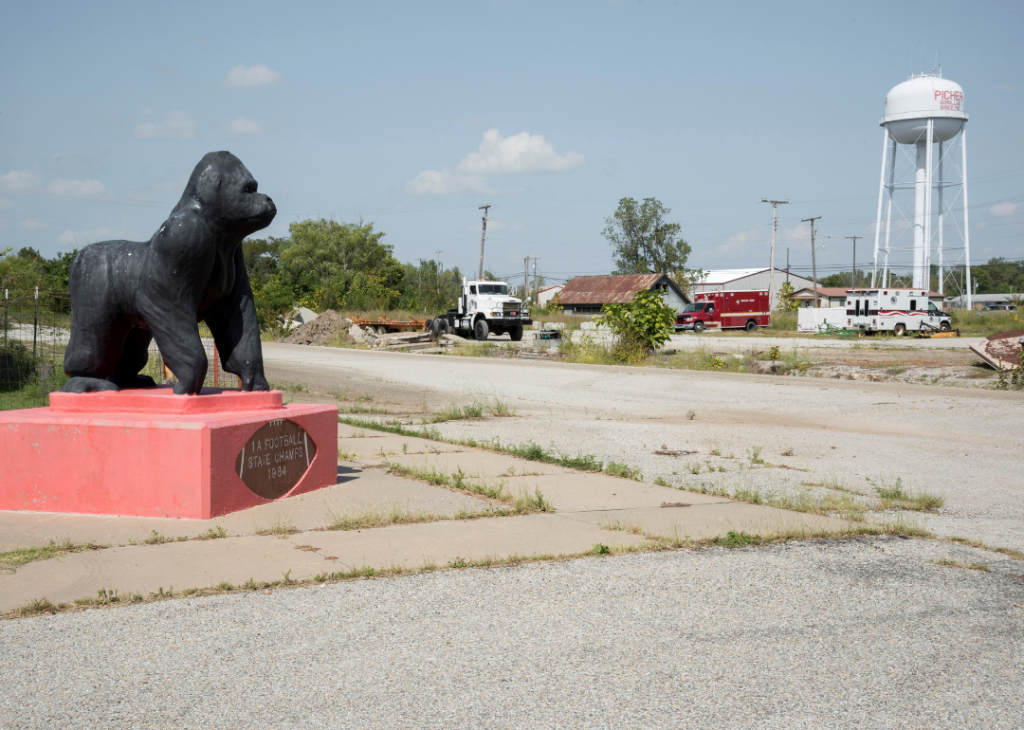
When Suman was 6 months old, her family pulled a reverse Steinbeck and left California to come home to Oklahoma. She graduated from Picher High in 1984, the year the school football team became Oklahoma 1A State Champions. The winning season is memorialized by a large statue of a gorilla, the school mascot, that now sits across the street from the Gary Building as a monument to the town’s bygone days. After high school, Suman worked a handful of jobs, got married, and started a family. She went to work for the USPS and became postmaster for the Cardin office, just a mile down the road.
The post office sat on the bottom of a handsome three-story brick building. A white lean-to was added to the east side to house the three cars used to deliver mail to the rural routes. The place was the focal point of the town.
“It was where everyone came in the morning,” Suman said. “We didn’t have a coffee shop or anything. This was the anchor to the town. Everyone would come in and mingle and gossip.”
By 2007, the postal service’s data showed it wasn’t feasible to keep the Picher or Cardin offices open. Federal buyouts had begun, but many Picher residents wanted to stay. They didn’t trust the government, and they didn’t think the hazards were great enough to leave their homes behind.
But enough people had left. In 2009, both the Picher and Cardin postal branches would cease operations. Suman was tasked with holding a meeting to deliver the news. She stood under the fluorescent lights of the Picher Community Center on an early spring evening and felt dread. She had to tell the residents of Picher and Cardin—her friends and family—they’d no longer have their own post offices. Everything was being moved to Quapaw, the next town over. She looked at the faces in front of her, ones she’d known for years, and saw anger, sadness, confusion, uncertainty, and fear.
“That’s what I remember the most, looking at these people and having to deliver yet another gut punch to them,” she said. “It felt like a big moment when people started to give up hope. Their own post office was all they had left.”
Suman moved to the Quapaw office, where she served as postmaster for 15 years, retiring in September 2025. She lives just outside Quapaw too. One and a half miles from the lot where her house once stood. It’s the farthest she’s ever been from home.
Decades of government missteps helped fuel Picher’s demise. The town’s empty streets now appear as warnings, as the Trump administration fast-tracks new mineral production projects.
In March, the administration issued the executive order Immediate Measures to Increase American Mineral Production, a move intended to “facilitate domestic mineral production to the maximum possible extent.”
Picher is a testament to the myriad human and environmental casualties of rapid and expansive mineral extraction. The town sits on the land where the Quapaw tribe was relocated when they were forced from their Arkansas home. Mining companies paid tribe members to mine beneath their land, or they relied on the Bureau of Indian Affairs to deem the landowners incompetent and sign over the rights.
Today, not far beneath the parade route, not far beneath pretty much any block in Picher, are monstrous caverns. The dark, seemingly endless voids were left behind by room-and-pillar mining, a relatively inefficient form of mining used to remove countless tons of ore, creating rooms supported by large pillars of untouched material.
After undercutting the lead and zinc, miners began blasting and drilling away the valuable material. The metals were shipped off to become, among other things, more than 75 percent of the bullets used by the United States military in World War I.
The rooms left behind after the material was removed were vast. A photograph taken somewhere below the Oklahoma-Kansas border, likely in the 1950s, gives an idea.
A miner, dressed in heavy denim, looks up, the wheat lamp on top of his mining helmet pointed nearly vertically. He stands next to a heavy jumbo extension platform, its base sitting on a set of tracks that reach the miner’s waist.
Follow his gaze up 10 feet or so. Then another 10. And another. Keep going. Seventy feet up, standing on a small platform, is another miner, only his face and the light from his wheat lamp visible. He’s trimming the roof of the mine, extracting every last piece of usable material.
Behind the machinery, dimly lit, is a mountain of refuse, dwarfed by the size of the room’s walls.
In a perfect world, once the rooms were mined, those walls and pillars were left intact, with enough material to safely support the ground, and town, above. But Picher didn’t exist in a perfect world.
When profits began to plummet after World War II, the mining companies bolted, leaving the shafts open and taking with them the sump pumps that kept the mines free of runoff water.
Down came the rain and scavengers. The scavengers went to work on the pillars, chipping away any last dollar they could see and, along with it, the support that the town above relied upon. The rainwater and runoff began to fill the open rooms, all 14,000 of them.
The water rolled through the caverns, around and over the 70 million tons of mine tailings and 36 million tons of mill sand and sludge. The oxidized minerals began to dissolve, mixing with the water to create an acidic solution that reacted with the surrounding rock, further deteriorating the walls and pillars.
The concentrations of heavy metals—iron, lead, nickel, zinc—formed a soupy orange river that coursed through the mines.
In 1979, it reached daylight, seeping from the ground near Commerce. It started spilling from mine workings, abandoned mine shafts, and boreholes.
It came to the surface around the chat piles, themselves already a major health concern.
It flowed into Tar Creek, killing most of the biota and staining the bottom of the creek red with ferric hydroxide deposits. The creek, described in 1903 by a Carmelite nun visiting the Quapaw reservation as “a spring of the finest and clearest water,” was now a stream of orange toxicity.
By 1994, an Indian Health Service test showed that 35 percent of native children living in the area had levels of lead in their blood that exceeded the Centers for Disease Control and Prevention’s threshold for health concerns.
The evening before each year’s parade, with the sun hanging low in the west and the temperature dropping, Suman and the Chat Rats meet in the Gary Building to finalize parade plans and set up the merchandise they’ll sell the next day. Sweatshirts with “Chat Rats” across the chest, Christmas ornaments, and any kind of Picher-Cardin High School clothing you could imagine (all emblazoned with the school’s Gorilla mascot). Parade attendees usually buy most of it, with the proceeds going toward Picher’s all-school reunion and the next year’s parade. When tractor-trailers rumble by, the ground bounces just a bit, a reminder of the hollow caverns below. For years, trucks weighing more than twelve tons were banned from the highway over fears the ground would collapse beneath them.
A 2006 Environmental Protection Agency report warned of more than 200 locations across the Tar Creek site that were in danger of collapsing.
In the end, it was the instability that got to everyone. It’s what got to Suman.
She and Phillip had decided in the early days of the buyout talks that they were staying in Picher. So they bought a small piece of land on the south edge of town and built their forever home. A 2,200-square-foot house. White with green shutters, custom countertops and cabinets, and tile in the kitchen. Just a few blocks away from Suman’s parents. Damn-near paid off. Staying was a foregone conclusion. But doubt started creeping in, threatening the foundation they’d put down on what had become unstable ground.
The buyouts had begun with an emphasis on relocating families with kids under 6. Maybe 10 families moved away, and the effort to empty the town felt complete. The Suman’s had believed that normalcy would return.
When another round of federal buyouts began, the EPA once again encouraged families with young children to relocate, pointing to a 2000 study by the agency showing that nearly 40 percent of Picher children had dangerous levels of lead in their blood. Another handful of families fled, leaving a sense of dread behind.
For the Sumans, this departure felt different. They heard rumors that the whole town was on the verge of collapsing. It was all folks could talk about for a few weeks. If “the big one” ever hit the New Madrid fault—some 340 miles away in Eastern Missouri—the ground would open up, and Picher would disappear into a virulent orange lake.
Officials began to warn that the town’s utilities were no longer a sure thing. They told Suman and the other residents gathered in the community building one summer Tuesday evening that they may not have electricity much longer. Also, they said, water and sewer services would likely be terminated. And wells weren’t exactly viable in a town where everything was built on hollow ground.
The Sumans sat down at their kitchen table and talked it through. They wanted to stay, wanted to tell the government officials they were going to fight. But they felt beaten down—by rumors, threats, worry, and fear of the unknown. The loss of schools, the fire department, and the post offices. It was a snowball effect. The whole town seemed to be giving up.
Suman looked at her husband. “We can’t win this anymore,” she said.
They took the government buyout, only for the government to move the house three miles down the road and try to sell it back. What the Sumans had built for about $65 per square foot, the government was selling for $100 a square foot. They could rebuild for cheaper than that. Either way, they were falling back into debt.
Two decades later, they’re still paying for the house in Quapaw, where they ultimately settled. Though Suman is happy where she is, the bitterness and pain of having to leave her hometown will never fully subside. “What I remember most is the sadness of it all,” she said. “The fear of the unknown. Losing everything. It was a whole lot of sadness. Just a lot of uncertainty around everyone.”
By 2013, the municipality of Picher was officially dissolved. Many residents who were intent on staying ended up taking buyouts after a 2008 tornado hit the south end of town, destroying 160 homes and killing six people. The class of 2009 was the last to graduate from Picher-Cardin High School. All the remaining students were sent to Quapaw the next fall.
Picher’s residents were scattered across the area. Some ended up in Commerce or Miami, just to the south. Some ended up across state lines, in Kansas or Missouri. Instead of daily conversations, they’d catch up when they ran into one another at Walmart.
“People from the outside looking in didn’t know the kind of community Picher was,” Suman said. “You’d see someone at the store you hadn’t seen in a while, and you’d just hug and cry and ask them how their mother was doing.”
A few years later, Suman and others started thinking of ways to keep Picher alive in spirit. The all-school reunion was great, but not everyone who lived in Picher went to Picher schools. That’s when the idea was first floated: What if we revive the Christmas parade?
Suman and the Chat Rats began planning. Would it be a one-year deal? Who knew, but for one Saturday in December of 2015, at least, Picher was going to have a parade.
The morning of the inaugural parade was as ideal as possible for December in the lower Midwest. Temperatures had dropped to the mid-30s overnight and hovered there as the committee gathered before dawn on North Connell Street to prepare. Clear skies began to take on light. Just a few clouds lingered.
Bill Crawford didn’t have any tasks that morning. He’d turned 91 earlier that year and was there to mingle, observe, and support his daughter, Susie Jo Stone, one of the Chat Rats.
Crawford, who died in 2019, was handsome, slender. A hard, square jaw sat below a face that looked almost youthful despite decades of hard labor. He stood straight with strong shoulders, solid as the rock he used to haul from beneath Picher. He wore what he did most every day—denim bib overalls over a blue plaid shirt. A navy-blue jacket shielded against the early morning air.
He’d spent more than 50 years as a miner for Eagle-Picher, the company that operated the lead and zinc extraction facilities across the Tri-State district. He claimed he played a game of baseball with Mickey Mantle when the superstar returned to neighboring Commerce and worked the mines during the offseason.
Crawford raised his family in nearby Cardin, an eight-block section on the southwestern edge of Picher that carried its own census designation. He built a house on one of the three lots he’d purchased with his mining salary. To protect against tornadoes, he and his wife dug a backyard cellar by hand.
That house was home to Crawford until he finally buckled and accepted a government buyout after the 2008 tornado. He moved several miles south, past Commerce’s Mickey Mantle Boulevard, and settled in Miami. Every couple of weekends, he’d drive his blue Ford pickup to Cardin, just to walk the now-vacant lots he once owned.
But he had somewhere to be that Saturday. He sat in a folding chair on a flatbed trailer as the inaugural Christmas parade committee scurried in the predawn light.
Nobody knew how many people would show up. They’d gotten the band from nearby Northeastern Oklahoma A&M College to participate. Their bus would be pulling up at any moment. Law enforcement and first responders from Quapaw and Miami were there. A group of gray-bearded men representing Bikers Against Child Abuse had started to rumble in. Whether anyone else would show up to watch was still debatable.
Stone, Suman, and the rest of the committee fought off nerves with busy work. They envisioned a grand procession crawling down an empty Connell Street, witnessed only by a few onlookers and the charred remains of businesses and scrubby lots.
Stars still flickered in the western sky as a few wispy clouds on the eastern horizon caught the vibrant oranges that shine so brightly during a flatland sunrise.
Suman had climbed onto the trailer to set up the PA system. Then, in her late 40s, she was the youngest member of the committee and the designated hype person and parade announcer. She was arranging speakers when Crawford slowly stood from his chair.
“Just look at it,” he said, his eyes fixed southward toward the end of town, where Connell Street became Highway 69.
“What is it, Bill?” Suman said, too busy to turn around.
“Just look,” he said.
The parade was still two hours away, but a string of amber headlights danced northward, toward Picher. A few at first, and then more, until the end of the line was too far away to see.
Crawford’s eyes began to water in the cold air. “They’re coming home.”
Co-published by The Economic Hardship Reporting Project’s James Ledbetter Fund and Oxford American.
This story was produced by The Economic Hardship Reporting Project and Oxford American, and reviewed and distributed by Stacker.