
Which states have the longest (and shortest) commutes?
For millions of Americans across the country, the journey to work isn’t just a quick trip. It’s a daily grind that eats into time with family or friends, hinders personal well-being, and shapes where people can afford to live. These effects have been especially prominent in recent years, after the COVID-19 pandemic reshaped work and more people switched to remote or hybrid roles.
With return-to-the-office mandates in place and traditional commute patterns in flux, there are stark differences across different states and regions. Using census data, as well as recent commuting studies from sources including the Federal Reserve Bank of St. Louis World Population Review, and more, AnyWho outlines how geography, infrastructure, and work patterns influence the hours Americans spend in transit state-by-state.
The state of American commutes: A post-pandemic reckoning
American commuting has certainly rebounded toward pre-pandemic norms even as hybrid and remote work stay a part of the workplace mix. According to census data gathered on average commute times from 2011 to 2024, with the exception of 2020, national times shook out as follows:
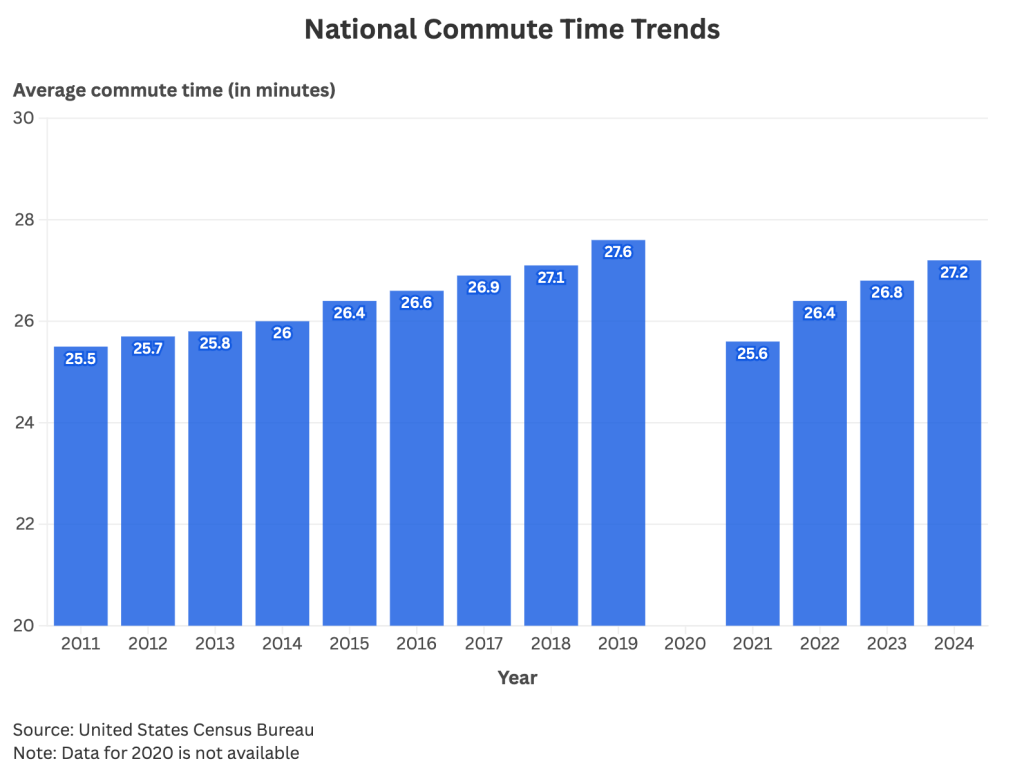
With an average one-way travel time to work of 27.2 minutes in 2024, commutes are beginning to approach pre-pandemic levels once again. This resurgence is likely reflective of several trends, including that many employers have asked workers to return to the office more regularly. This reduces the share of fully remote workers and helps to push commute volumes back up.
Data from recruiting firm Robert Half found that job postings for hybrid and remote roles have begun to stabilize, rather than increase, indicating current commute times may be reflective of the new norm.
Commuting isn’t just a number. It affects mental health, quality of life, housing decisions, and overall life satisfaction. Longer commutes can correlate to higher stress and less time for social and family life, and they’re often tied to escalating housing costs near job centers.
The 10 states where commutes consume your life
The prevalence of in-person, remote, or hybrid roles is dependent on the type of companies operating in an area and the roles they have available. Each state is known for its specific dominant industries, and these types of workplaces can cause commute times to differ drastically from state to state. Data from the 2024 U.S. Census American Community Survey reveals the following:
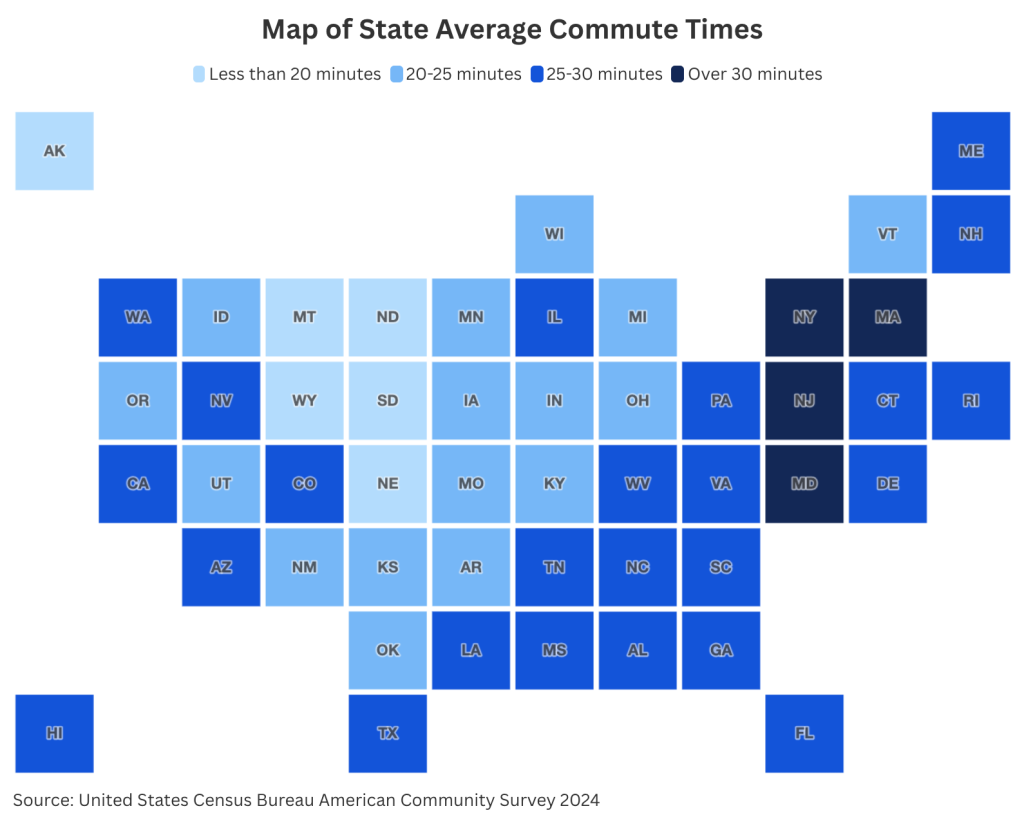
The Eastern Seaboard, Southeast, and states scattered across the West significantly differ in commute times than counterparts in the Southwest and Midwest on an average basis. In particular, the following ten states have the longest commute times in the country:
- New York - 33.2 minutes
- Maryland - 32.3 minutes
- New Jersey - 31.9 minutes
- Massachusetts - 30.6 minutes
- California - 29.7 minutes
- Georgia - 29.4 minutes
- Florida - 28.9 minutes
- Illinois - 28.3 minutes
- Virginia - 28.3 minutes
- New Hampshire - 27.5 minutes
Living in one of these states, especially if near a major metropolitan center, means that living with a tough commute might just be part of your daily life. It’s also important to be aware of these areas if you are actively looking at moving. Long commutes aren’t just uncomfortable. Every minute you’re stuck on the road is time that could have been spent on family, health, or leisure.
The other extreme: States where commutes are an afterthought
At the other end of the spectrum, states with more rural populations, lower density, and shorter distances between homes and workplaces tend to have the shortest commute times. Based on additional commute time data from World Population Review, North and South Dakota rank as the two shortest commute states with averages of 17.6 minutes and 17.3 minutes, respectively.
Following closely behind are Montana, Wyoming, and Alaska, all featuring commute times under 20 minutes on average. These shorter commute times are reflective of different economic and spatial structures throughout the states. With employment centers typically closer to residences and fewer major metropolitan centers, heavy traffic congestion is far less common.
The true cost: How commute time reshapes life decisions
Long commutes don’t just reshape your morning and evening. They influence where you choose to live, how you spend your free time, and even your mental and physical health to some extent. In fact, a comprehensive study from the University of the West of England on commuting and well-being found that longer commutes are associated with decreased job satisfaction and increased risks of mental health issues.
Commute distance naturally factors into housing decisions. One household may trade off higher rent in a centrally located city for a more affordable home in the distant suburbs, only to incur the hidden cost of hours on the road each week.
What the data reveals about America's commuting future
Commuting patterns will undoubtedly continue to evolve as shifts in remote work and housing markets continue. Remote and hybrid job postings are beginning to stabilize, so times may inch upwards slowly. High housing costs in major metro areas may continue to push existing workers farther from job centers, potentially resulting in increased commute times as people seek more affordable homes.
Despite fluctuations, commute times will certainly remain a key metric of economic geography, one correlated closely with quality of life, housing affordability, and regional growth.
Time well spent or time lost?
When it comes to America’s commute crisis, place matters. Whether you live in New York, where daily travel to work is a major part of your life, or in the open spaces of North Dakota where shorter commutes prevail, the geography of mobility often reflects broader choices about housing, work, and communities. By understanding where time is most often lost — and gained — more informed decisions can be made by workers, employers, and policymakers as all strive to make daily life better.
This story was produced by AnyWho and reviewed and distributed by Stacker.