.png?width=150&height=27&name=Stacker_Logo%20(3).png)
For SEOs, the acronym E-E-A-T has provided critical guidelines for what we need to focus on to earn high rankings. That is:
- Experience
- Expertise
- Authoritativeness
- Trust
AI doesn’t rank information, though. It assembles answers. That makes generative engine optimization (GEO) a bit different from SEO.
But that doesn’t mean E-E-A-T isn’t still a critically helpful framework for marketers to use in the generative search era.
Though, large language models (LLMs) don’t publicly say they use E-E-A-T as a scoring system, Google’s E-E-A-T framework is one of the most practical, widely-understood lenses we have for evaluating credibility online, and it maps cleanly to the signals that influence generative visibility, and thus, brand discovery.
Let’s take a look at how it can help us with GEO.
💡 New to GEO? Start from the Beginning
What E-E-A-T is (And What It Isn’t)
E-E-A-T comes from Google’s Search Quality Rater Guidelines, which teach human evaluators how to assess page quality.
It’s a quality framework that reflects what Google wants its systems to surface: helpful, reliable information created for people, not for manipulation. (Google’s own guidance on creating helpful, reliable, people-first content is the best shorthand here.)
“Trust” is the center of the model, and Google spells that out in the guidelines.
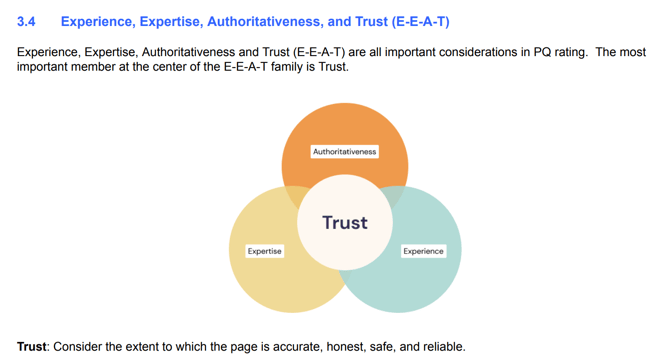
For GEO, that framing is useful because generative engines have the same core problem: They need to decide which information is safe for them to reuse in an answer.
Why E-E-A-T Can Influence GEO
Here’s the part people miss: E-E-A-T can influence GEO even if an AI system isn’t explicitly measuring E-E-A-T.
Why?
Because many AI experiences rely on retrieval.
They search. They browse. They pull sources. Google’s own documentation on AI features makes it clear that AI Overviews and AI Mode are search experiences where content can be included (or not included) based on how Google can access and evaluate it.
So the pipeline often looks like this:
- A user asks a question in an AI interface.
- The system performs a search-like retrieval step (sometimes visible, sometimes not).
- It selects sources it believes are credible enough to cite or reference.
- It synthesizes an answer, often with links.
If your content struggles to rank or be considered “reliable,” it may never make it into the pool of candidate sources.
In other words, traditional search visibility still acts like a gatekeeper for a lot of generative visibility. E-E-A-T-aligned improvements help you clear that gate more often.
How AI Systems Decide What’s Trustworthy Enough to Cite or Mention
No platform fully exposes its source-selection logic. But most citation behavior (across systems that show sources) follows the same set of practical filters.
1) Retrieval: Can the System Find You?
Many LLMs use retrieval to help them compose answers. That means they’re searching for content online that they ultimately cite in their answers.
For example:
- Google’s AI Overviews are explicitly presented as snapshots with “links to dig deeper” in Search.
- OpenAI describes ChatGPT search as providing “links to sources” via a sources/citations interface.
- Perplexity explains that answers include numbered citations linking to original sources.
So yes, the search engine result pages (SERPs) still matter. If your pages aren’t findable, indexable, or competitive enough to appear, they won’t get cited often.
2) Corroboration: Can the System Verify the Claim Elsewhere?
AI systems are risk managers. They prefer claims that appear consistently across multiple credible sources, because it lowers the chance the answer is wrong.
That means one isolated blog post rarely becomes “the truth” unless it’s uniquely authoritative.
On the other hand, widely repeated facts are easier to reuse, and why earned media has become uniquely valuable.
3) Reputation: Is This a Source People Already Treat as a Reference?
Even outside of SEO, reputation acts like a shortcut.
A helpful reference point here is research on what tends to get linked in Google AI summaries. Pew found that sites like Wikipedia, YouTube, and Reddit are among the most frequently cited sources in AI summaries and standard results.
That doesn’t mean “be Wikipedia.” It means become the thing people cite when they explain your category.
4) Extractability: Is Your Content Easy to Quote?
Generative systems work by pulling chunks of text. If your key point is buried in:
- Vague copy
- Overly long intros
- Unclear structure
- Vague marketing language
…it’s harder to safely reuse.
Remember: Write like someone might screenshot your paragraph and share it as the answer.
5) Safety and trust: Is it Risky to Repeat?
Google’s rater guidelines define Trust in very practical terms: accuracy, honesty, safety, reliability, and context-dependent expectations (ex. secure payment and customer service for online stores).
AI systems have the same pressure. If it’s a topic that could cause harm (medical, financial, legal, safety), the bar goes up fast.
Now let’s translate that into actions based on each element of E-E-A-T.
Experience Signals
Experience is proof you’ve actually done the thing. It’s the fastest way to make your content feel “real” in a web full of generic summaries.
Google explicitly calls out first-hand experience as a factor raters should consider when assessing quality. This is a large reason why sites like Reddit and Quora have exploded in citation frequency as of late.
And for GEO, experience has an extra advantage: It creates details that are harder for competitors to copy.
What “Experience” Can Look Like to an AI Engine
Experience is content that contains:
- Original observations
- Real constraints and tradeoffs
- Steps that match reality
- Evidence that the author interacted with the product, process, or environment
Credibility Signals That Tend to Matter
Start with these:
- “How we tested” sections: A short methodology box makes your claims easier to trust and easier to cite.
- Original visuals: They reinforce that you actually did the work, and they make your content more reference-worthy.
- First-person specifics: Not storytelling for storytelling’s sake. Just enough detail to prove the point: what you tried, what happened, what you’d do differently.
As an example, Car and Driver has a page dedicated to explaining in detail how it tests out cars across a variety of criteria.
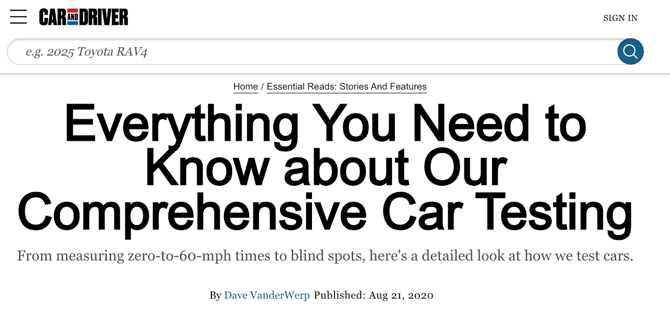
When you’re able to show your team has hands-on experience, it can make a huge impact in credibility.
Expertise Signals
Expertise is knowing the topic deeply enough to be accurate, consistent, and helpful across edge cases.
In the rater guidelines, expertise is framed as the knowledge or skill needed for the topic, and it varies based on what the page is trying to do.
What “Expertise” Can Look like to an AI Engine
Expertise shows up when your content:
- Answers the obvious question and the follow-ups
- Distinguishes between similar concepts cleanly
- Explains caveats without hedging everything into uselessness
Credibility Signals That Tend to Matter
Focus on signals that remove uncertainty:
- Clear authorship and accountability: Real author pages. Real bylines. Real credentials where relevant. A way to contact the organization.
- Editorial standards: A simple public statement about how you review, update, and correct content is a trust accelerant.
- Primary sources when stakes are high: If you’re making a factual or technical claim, cite the original source, not a chain of summaries.
What this looks like in practice: Publish a short “How we review and update content” page, then link to it from templates (reviews, comparisons, guides). It’s boring, but it’s useful.
For example, when we asked ChatGPT about the health benefits of yoga, this BuzzRX article was a citation, along with a ton of highly credible sites like the NIH and the CDC. What helps make them look authoritative is how they list who their writer is and who medically reviewed the article, with both names linking to multi-paragraph bios.
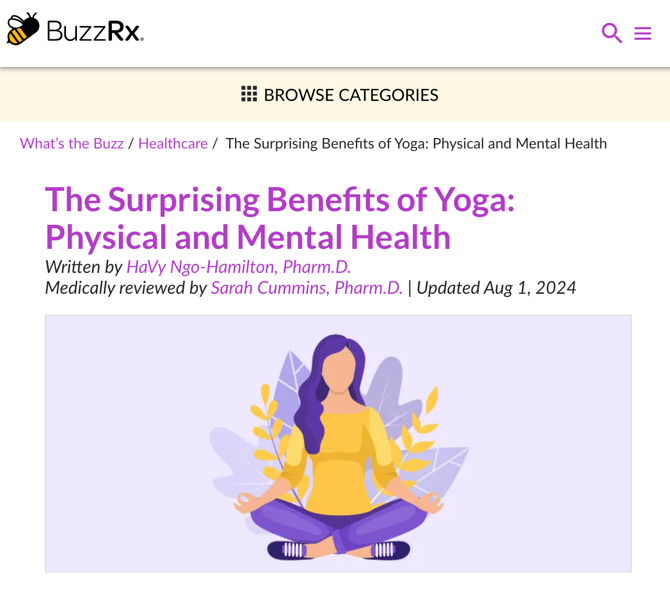
Readers, LLMs, and Google’s algorithm all want to see some sort of proof your content can be trusted. Don’t leave them with any questions.
Authority Signals
Authority is what other credible places say about you.
This is where GEO looks a lot like classic digital PR: mentions and references are the raw material that generative engines reuse.
What “Authority” Can Look Like to an AI Engine
Authority might show up as:
- Repeated references across trusted sites
- Citations in roundups and explainers
- Inclusion in “lists of record” for a category
- Being quoted as a source, not just linked as a vendor
Credibility Signals That Tend to Matter
- Earned editorial mentions: Especially in category-defining publications and niche trade sites.
- Consistent third-party profiles: Your company description, leadership, location, and positioning should match across major platforms.
- Being present on the “default sources”: In many categories, there are a handful of domains that keep showing up. Your goal is to earn mentions there, not just chase random coverage.
When we asked Perplexity about the best vacation spots for 2026, one of its sources was an Axios article citing a Kayak study.
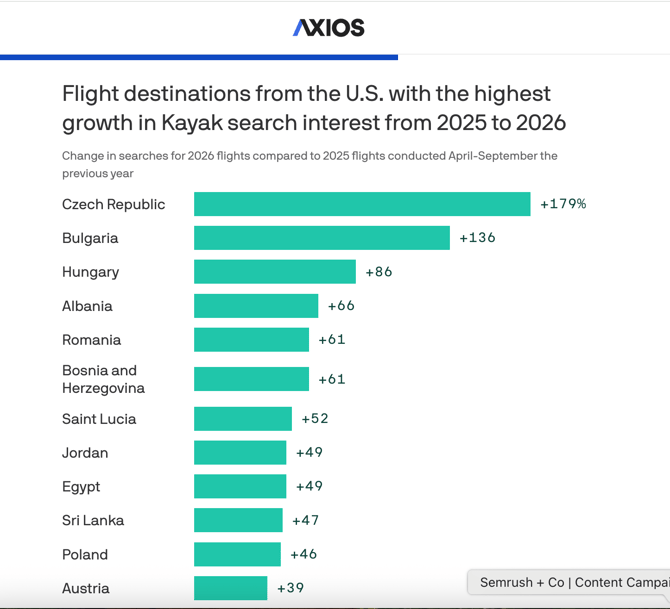
We’ve seen time and time again how sometimes a brand’s content might not get cited until it appears on a more authoritative publication.
📖 Read More: Why Brand Mentions Matter for GEO
Trust Signals
Trust is the deal-breaker.
Google says it plainly: trust is the most important member of the E-E-A-T family, and untrustworthy pages have low E-E-A-T no matter how experienced, expert, or authoritative they look.
Trust also tends to be where brands accidentally block their own GEO progress. Not because they’re shady, but because they leave gaps.
What “Trust” Can Look Like to an AI Engine
Trust is the ability to confidently answer:
- Is this accurate?
- Is this honest?
- Is this safe to recommend?
- Is the business real, reachable, and accountable?
Credibility Signals That Tend to Matter
- Real-world legitimacy
- Clear About page
- Clear contact details
- Clear customer support path
- Clear policies (returns, refunds, privacy, security where relevant)
- Reputation signals
- Reviews that include specifics, not just star ratings
- Third-party validation (industry associations, certifications, verified profiles)
- Community sentiment that aligns with your claims
- Accuracy hygiene
- Visible update dates (when meaningful)
- Corrections when you get something wrong
- Consistent claims across pages
For example, when we asked ChatGPT about the best video games released in 2025, it immediately defaulted to using Metacritic for its answer.
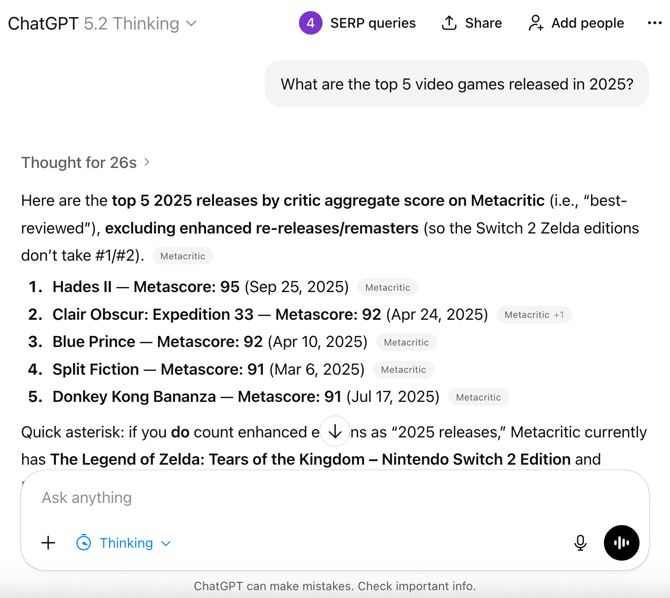
If your product or service isn’t appearing on top third-party validation/review sites, it’s hard to trust.
Your Next 7 Days of Credibility Work
If you want a simple plan you can actually execute:
- Pick 10 prompts you want to win in AI answers.
- Identify which sites and sources show up most often for those prompts.
- Upgrade one “proof asset” (case study, benchmark, teardown) to lead with experience and methodology.
- Fix the top three trust gaps on your highest-intent page (About, Contact, Policies, accuracy signals).
- Start one earned mention stream (quotes, trade pubs, category roundups) and keep it consistent.
- Identify partners that can help you scale your earned strategy. Stacker, for example, is a way to earn 100+ earned pickups in weeks.
💡 If you do only one thing, make your content easier to verify and easier to quote. That’s the shortest path to more brand mentions in generative answers.