.png?width=150&height=27&name=Stacker_Logo%20(3).png)
AI search has changed what “visibility” looks like.
Ranking still matters. But a lot of journeys are now brutally short. Someone asks a question, gets an answer, and moves on. No SERP scrolling. Sometimes not even a click.
That’s what makes citations such a clean visibility metric in AI search.
Because you’re not trying to guess intent from indirect signals like impressions or position. You’re looking at the thing that actually shapes the user’s decision: did the AI include your brand in the answer as a mention and/or a link, or did it skip you entirely?
In this guide, we’ll break down what LLM citations are, how to track them, and why “citation lift” is a useful way to connect earned media to AI visibility.
What Is An LLM Citation?
An LLM citation is any time an AI response includes your brand name (even if it’s not linked) and/or a link to your website.

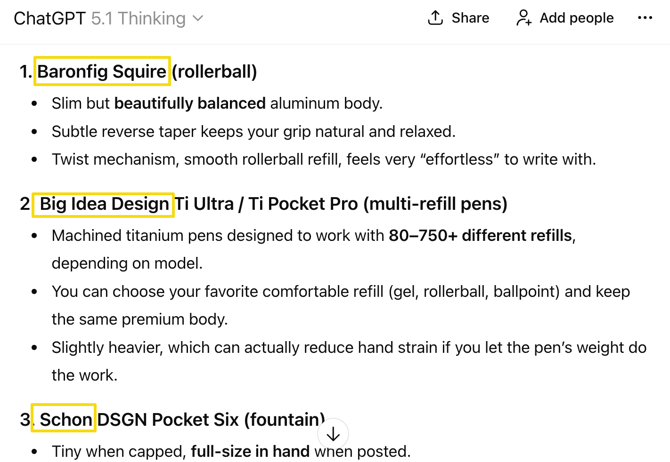
Citations can show up in a few common ways:
- A linked brand name in the body of the answer
- A source list that includes your domain
- A “Sources” or “Learn more” section that links to you
- A brand mention without a link (as shown above)
Why LLM Citations Matter
Citations are a practical metric because they answer a simple question:
When someone asks AI for help in your category, does your brand show up at all?
That matters for a few reasons:
- Citations Signal Trust: If an engine includes your brand in the response, it’s a strong indicator you’re considered relevant and credible for that topic.
- Citations Capture Zero-Click Visibility: People don’t always click. But they still form opinions and shortlists from what the AI says.
- Citations Create A New Competitive Layer: Your “competition” is no longer just who ranks next to you. It’s who gets pulled into the answer.
How Different LLMs Decide What To Cite
Not all AI engines produce citations the same way.
To walk through the process, it helps to split “citation” into two behaviors:
- Whether the engine mentions your brand at all
- Whether the engine attaches sources or links
They often happen together, but one can increase while the other stays flat (or even drops), depending on how the model answered.
How LLMs Decide What Brands To Mention
A brand mention can show up even when an engine isn’t pulling live sources. In other words, the model can mention brands based on what it already “knows” or can infer from patterns it learned.
What tends to influence brand mentions:
- Prompt intent: “Best tools for X” prompts trigger brand lists more than “how to do X” prompts.
- Category familiarity: Mainstream categories (CRMs, payroll, flights) usually produce more brand mentions than niche categories.
- Entity strength: Brands with a strong, consistent footprint across the web are easier to recall and include.
- Clarity of fit: If your brand is tightly associated with a use case (“for freelancers,” “for enterprise,” “for Shopify”), it’s more likely to be mentioned for that specific framing.
- Answer style: Some engines are more conservative and avoid naming brands unless asked; others default to giving examples.
The big takeaway: brand mentions don’t require retrieval. They can happen from the model’s internal knowledge alone.
How LLMs Decide What To Link To
Links and explicit source lists are a different story. They’re much more dependent on whether the engine is running some form of retrieval or grounding, where it looks up documents and then generates an answer based on what it found.
When retrieval is active, the engine typically first pulls a set of candidate documents (web pages, indexed sources, or another curated corpus). Then it selects passages that best address the prompt, generates an answer, and attaches links/sources for traceability.
Here’s what tends to influence which sources get linked:
- Direct relevance: The page answers the specific question without forcing the engine to stitch together assumptions.
- Extractability: Clear headings, tight definitions, and “answer-first” sections make it easier to cite.
- Perceived credibility: Sources that look trustworthy for the topic are more likely to be linked.
- Freshness: For time-sensitive prompts, newer sources can be favored.
- Redundancy and corroboration: If multiple sources support the same point, engines may link a subset (and sometimes this is where co-citations show up).
The takeaway: Links are more tied to retrieval than mentions are.
Why Some Prompts Have Citations And Others Don’t
You’ll often see the same engine behave differently across prompts.
Common reasons:
- The engine decides retrieval isn’t necessary for a generic question
- The query is broad enough that the model can answer from internal knowledge
- Retrieved sources don’t meet a confidence threshold for linking
- The engine is tuned to provide fewer citations by default
This is also why it’s normal to find prompts where:
- you get a brand mention, but no links
- you get links to third-party coverage but not to your site
- you get no citations at all
Why Citations Change Over Time
Even if you run the same query repeatedly, citations can shift. That can happen because:
- newly published content enters the retrieval set
- older pages decay in visibility or relevance
- competitors publish clearer, more extractable answers
- the engine changes how aggressively it retrieves or cites sources
So instead of treating citations as a one-time pass/fail, treat them as a trend: track a stable query set and look for directional movement.
How To Earn More Citations
Citations are not a “one trick” outcome. They’re usually the result of two forces working together.
Making Your Owned Content Easier To Cite
You want pages that are simple for an AI system to reuse without guessing.
That usually means:
- answer-first formatting (clear takeaways near the top)
- question-matching headings
- definitions, examples, and specifics (not vibes)
- clean explanations of methodology when you use data
Building Credibility Off-Site
If citations are a visibility metric, distribution is a visibility lever.
Earned media and publisher pickups can expand the number of trusted domains that mention your company, meaning you’re simultaneously building more brand authority while providing LLMs more options for citations when they’re gathering information for their answers.
FAQ
Do All AI Engines Provide Citations?
Some do consistently. Some cite intermittently. Some provide answers with no citations at all. That’s why a prompt-based approach gives you a clearer view than a single spot check.
Are Citations The Same As Backlinks?
No. Citations are about inclusion inside the AI response (mentions and/or links). Backlinks are a web graph signal. They can overlap, but they’re not interchangeable.
Can A Brand Get Cited If It Doesn’t Have Much Content On Its Own Site?
Yes. Brands can still earn citations through third-party coverage, reviews, directories, community discussions, and other pages that mention the brand. That said, having at least a few strong “explainers” on your own site makes it easier for engines to cite you directly.
Can A Single Great Article Improve Citations Across Multiple Queries?
Sometimes. One clear, deeply useful piece can get cited for related queries if it answers multiple adjacent questions well. But most citation gains come from a small cluster of pages that each nail a specific intent.
Do Product Pages Ever Get Cited, Or Mostly Editorial Content?
Product pages can get cited, especially for specs, pricing, integrations, or official policies. But editorial-style pages (guides, explainers, comparisons, research) tend to earn more citations because they answer questions more directly with more context and higher authority.
Do AI Engines Prefer Fresh Content For Citations?
For time-sensitive topics, yes—fresh sources often win. For evergreen topics, freshness matters less than clarity, credibility, and how directly the page answers the question, though many LLMs do show a recency bias, suggesting that consistent publishing is key. Distribution can help extend the shelf life of your content.