Medical Technology Schools
1 / 1Transportation availability and free time can hamstring screenings
Screening can help diagnose cancer early, increasing the chances a person has of surviving it—which makes the fact the majority of women in one New York study reported they faced difficulty getting mammograms all the more concerning.
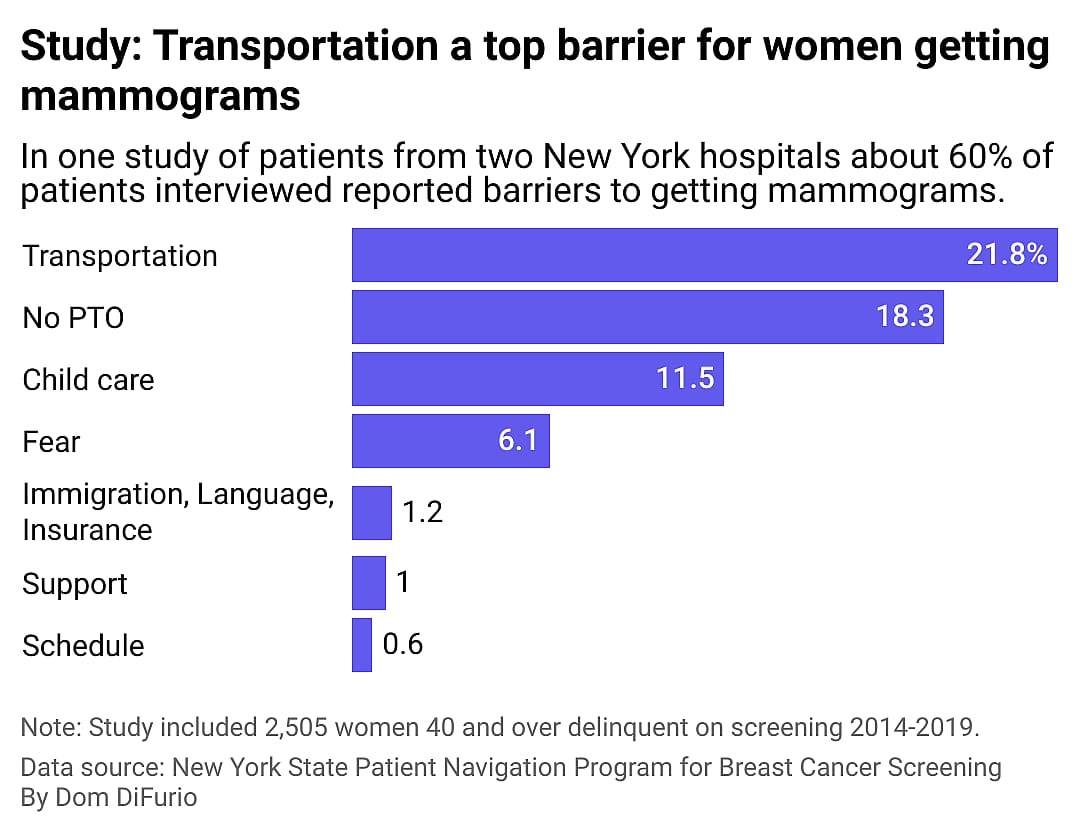
Transportation was the most common barrier to care cited by women over the age of 40 who used the New York State Patient Navigation Program for Breast Cancer Screening between 2014 and 2019. Researchers described the program as one of the most aggressive campaigns to get women screened nationwide.
Of the survey respondents who cited transportation as a barrier, only 30% got screened regardless of their income, suggesting transportation is a universal issue. The next most significant barrier reported was a lack of paid time off from their jobs, followed by a lack of child care. The CDC recognizes these as common barriers, along with language and the inability to visit the screening clinic frequently.
The COVID-19 pandemic presented yet another significant barrier to cancer screening appointments. Researchers estimate the health crisis delayed screening tests for as many as 9.4 million Americans in 2020. These delays have the potential to increase breast cancer deaths through 2030 by 0.5%, researchers suggest.
It's a setback physicians have worked to address.
As part of the Return-to-Screening study, a joint effort by the American Cancer Society and the American College of Surgeons, 748 clinics around the country worked to increase screening for breast and other cancers from June to November 2021. Strategies implemented included raising awareness about cancer screenings and taking concerted measures to increase the number of screened, such as providing financial support and extending hours of operation.
Some clinics, like the Detroit-based Henry Ford Health, focused efforts on reducing barriers to mammograms for Black and Hispanic people, whose mammography rates were disproportionately low even before the pandemic. The organization found that fear of results and simply not realizing they needed screening were key factors preventing people from getting it. In the six-month study, improving education, among other strategies, helped increase the number of mammograms at the clinic for Black and Hispanic women by 18% and 35%, respectively.
Editor's note: Stacker recognizes the language used to talk about gender has shifted to meet the understanding that gender is a spectrum. In this article, we have used gender-neutral terms when possible. We use gendered language in the case of direct quotations and in the characterization of data to stay true to how sources collected and presented the information.
Story editing by Ashleigh Graf. Copy editing by Kristen Wegrzyn.