As AI ascends, education experts debate which aspects of teaching should remain human
This story was produced by The Hechinger Report, a nonprofit, independent news organization focused on inequality and innovation in education, and reviewed and distributed by Stacker Media.
As AI ascends, education experts debate which aspects of teaching should remain human
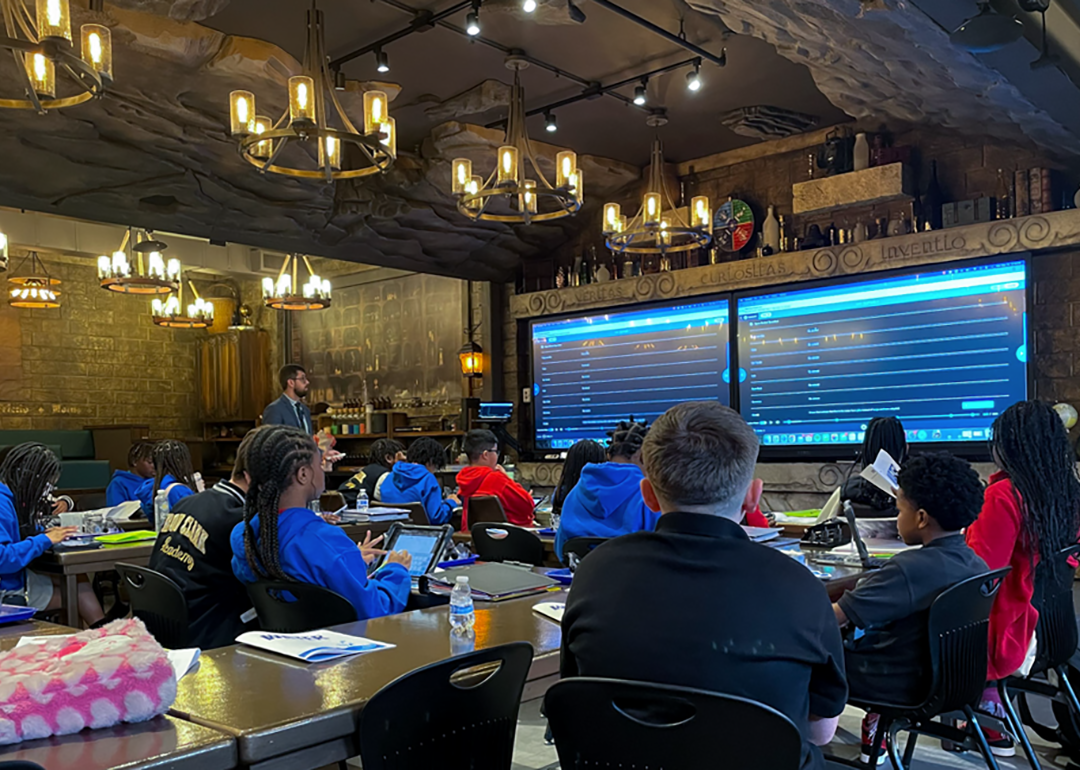
Science teacher Daniel Thompson circulated among his sixth graders at South Atlanta's Ron Clark Academy on a recent spring morning, spot-checking their work and leading them into discussions about the day's lessons on weather and water. He had a helper: As Thompson paced around the class, peppering them with questions, he frequently turned to a voice-activated artificial intelligence to summon apps and educational videos onto large-screen smartboards.
When a student asked, "Are there any animals that don't need water?" Thompson put the question to the AI. Within seconds, an illustrated blurb about kangaroo rats appeared before the class.
Thompson's voice-activated assistant is the brainchild of computer scientist Satya Nitta, who founded a company called Merlyn Mind after many years at IBM where he had tried, and failed, to create an AI tool that could teach students directly. As The Hechinger Report explains, the foundation of that earlier, ill-fated project was IBM Watson, the AI that famously crushed several "Jeopardy!" champions. Despite Watson's gameshow success, however, it wasn't very good at teaching students. After plowing five years and $100 million into the effort, the IBM team admitted defeat in 2017. "We realized the technology wasn't there," said Nitta, "and it's still not there."
Since the November 2022 launch of OpenAI's ChatGPT, an expanding cast of AI tutors and helpers have entered the learning landscape. Most of these tools are chatbots that tap large language models — or LLMs — trained on troves of data to understand student inquiries and respond conversationally with a range of flexible and targeted learning assistance. These bots can generate quizzes, summarize key points in a complex reading, offer step-by-step graphing of algebraic equations, or provide feedback on the first draft of an essay, among other tasks. Some tools are subject-specific, such as Writable and Photomath, while others offer more all-purpose tutoring, such as Socratic (created by Google) and Khanmigo, a collaboration of OpenAI and Khan Academy, a nonprofit provider of online lessons covering an array of academic subjects.
As AI tools proliferate and their capabilities keep improving, relatively few observers believe education can remain AI free. At the same time, even the staunchest techno optimists hesitate to say that teaching is best left to the bots. The debate is about the best mix — what are AI's most effective roles in helping students learn, and what aspects of teaching should remain indelibly human no matter how powerful AI becomes?
Skepticism about AI's place in the classroom often centers on students using the technology to cut corners or on AI's tendency to hallucinate, i.e. make stuff up, in an eagerness to answer every query. The latter concern can be mitigated (albeit not eliminated) by programming bots to base responses on vetted curricular materials, among other steps. Less attention, however, is paid to an even thornier challenge for AI at the heart of effective teaching: engaging and motivating students.
Nitta said there's something "deeply profound" about human communication that allows flesh-and-blood teachers to quickly spot and address things like confusion and flagging interest in real time.
He joins other experts in technology and education who believe AI's best use is to augment and extend the reach of human teachers, a vision that takes different forms. For example, the goal of Merlyn Mind's voice assistant is to make it easier for teachers to engage with students while also navigating apps and other digital teaching materials. Instead of being stationed by the computer, they can move around the class and interact with students, even the ones hoping to disappear in the back.
Others in education are trying to achieve this vision by using AI to help train human tutors to have more productive student interactions, or by multiplying the number of students a human instructor can engage with by delegating specific tasks to AI that play to the technology's strengths. Ultimately, these experts envision a partnership in which AI is not called on to be a teacher but to supercharge the power of humans already doing the job.
How Well Are Students Engaging in AI?
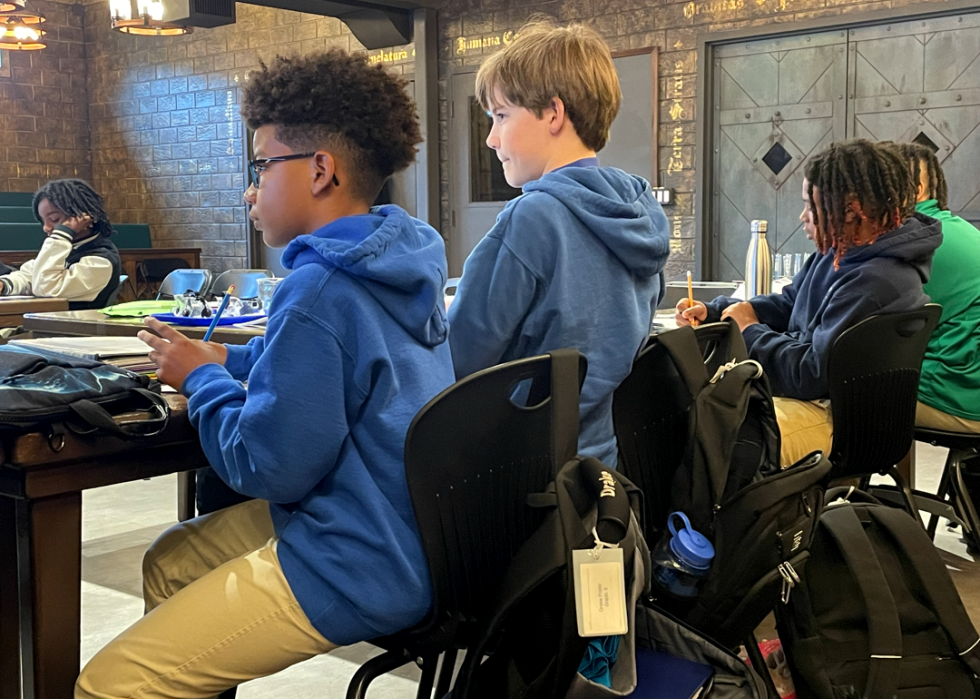
Merlyn Mind's AI assistant, Origin, was piloted by thousands of teachers nationwide this past school year, including Thompson and three other teachers at the Ron Clark Academy. The South Atlanta private school, where tuition is heavily subsidized for a majority low-income student body, is in a brick warehouse renovated to look like a low-slung Hogwarts, replete with an elaborate clocktower and a winged dragon perched above the main entrance.
As Thompson moved among his students, he wielded a slim remote control with a button-activated microphone he uses to command the AI software. At first, Thompson told the AI to start a three-minute timer that popped up on the smartboard, then he began asking rapid-fire review questions from a previous lesson, such as what causes wind. When students couldn't remember the details, Thompson asked the AI to display an illustration of airflow caused by uneven heating of the Earth's surface.
At one point, he clambered up on a student worktable while discussing the stratosphere, claiming (inaccurately) that it was the atmospheric layer where most weather happens, just to see if any students caught his mistake (several students reminded him that weather happens in the troposphere). Then he conjured a new timer and launched into a lesson on water by asking the AI assistant to find a short educational movie about fresh and saltwater ecosystems. As Thompson moved through the class, he occasionally paused the video and quizzed students about the new content.
Study after study has shown the importance of student engagement for academic success. A strong connection between teachers and students is especially important when learners feel challenged or discouraged, according to Nitta. While AI has many strengths, he said, "it's not very good at motivating you to keep doing something you're not very interested in doing. The elephant in the room with all these chatbots is how long will anyone engage with them?" he said.
The answer for Watson was not long at all, Nitta recalled. In trial runs, some students just ignored Watson's attempts to probe their understanding of a topic, and the engagement level of those who initially did respond to the bot dropped off precipitously. Despite all Watson's knowledge and facility with natural language, students just weren't interested in chatting with it.
At a spring 2023 TED talk shortly after launching Khanmigo, Sal Khan, founder and CEO of Khan Academy, pointed out that tutoring has provided some of the biggest jolts to student performance among studied education interventions. But, there aren't enough human tutors available nor enough money to pay for them, especially in the wake of pandemic-induced learning loss.
Khan envisioned a world where AI tutors filled that gap. "We're at the cusp of using AI for probably the biggest positive transformation that education has ever seen," he declared. "And the way we're going to do that is by giving every student on the planet an artificially intelligent but amazing personal tutor."
One of Khanmigo's architects, Khan Academy's chief learning officer, Kristen DiCerbo, was the vice president of learning research and design for education publisher Pearson in 2016 when it partnered with IBM on the Watson tutor project.
"It was a different technology," said DiCerbo, recalling the laborious task of scripting Watson's responses to students.
Since Watson's heyday, AI has become a lot more engaging. One of the breakthroughs of generative AI powered by LLMs is its ability to give unscripted, human-like responses to user prompts.
To spur engagement, Khanmigo doesn't answer student questions directly, but starts with questions of its own, such as asking if the student has any ideas about how to find an answer. Then it guides them to a solution, step by step, with hints and encouragement (a positive tone is assured by its programmers). Another feature for stoking engagement allows students to ask the bot to assume the identity of historical or literary figures for chats about their life and times. Teachers, meanwhile, can tap the bot for help planning lessons and formulating assessments.
Notwithstanding Khan's expansive vision of "amazing" personal tutors for every student on the planet, DiCerbo assigns Khanmigo a more limited teaching role. When students are working independently on a skill or concept but get hung up or caught in a cognitive rut, she said, "we want to help students get unstuck."
Some 100,000 students and teachers piloted Khanmigo this past academic year in schools nationwide, helping to flag any hallucinations the bot makes and providing tons of student-bot conversations for DiCerbo and her team to analyze.
"We look for things like summarizing, providing hints and encouraging," she explained. "Does [Khanmigo] do the motivational things that human tutors do?"
The degree to which Khanmigo has closed AI's engagement gap is not yet known. Khan Academy plans to release some summary data on student-bot interactions later this summer, according to DiCerbo. Plans for third-party researchers to assess the tutor's impact on learning will take longer.
Nevertheless, many tutoring experts stress the importance of building a strong relationship between tutors and students to achieve significant learning boosts. "If a student is not motivated, or if they don't see themselves as a math person, then they're not going to have a deep conversation with an AI bot," said Brent Milne, the vice president of product research and development at Saga Education, a nonprofit provider of in-person tutoring.
Since 2021, Saga has been a partner in the Personalized Learning Initiative (PLI), run by the University of Chicago's Education Lab, to help scale high-dosage tutoring — generally defined as one-on-one or small group sessions for at least 30 minutes every day. The PLI team sees a big and growing role for AI in tutoring, one that augments but doesn't replicate human efforts.
For instance, Saga has been experimenting with AI feedback to help tutors better engage and motivate students. Working with researchers from the University of Memphis and the University of Colorado, the Saga team fed transcripts of their math tutoring sessions into an AI model trained to recognize when the tutor was prompting students to explain their reasoning, refine their answers or initiate a deeper discussion. The AI analyzed how often each tutor took these steps.
When Saga piloted this AI tool in 2023, the nonprofit provided the feedback to their tutor coaches, who worked with four to eight tutors each. Tracking some 2,300 tutoring sessions over several weeks, they found that tutors whose coaches used the AI feedback peppered their sessions with significantly more of these prompts to encourage student engagement.
While Saga is looking into having AI deliver some feedback directly to tutors, it's doing so cautiously, because, according to Milne, "having a human coach in the loop is really valuable to us."
In addition to using AI to help train tutors, the Saga team wondered if they could offload certain tutor tasks to a machine without compromising the strong relationship between tutors and students. Specifically, they understood that tutoring sessions were typically a mix of teaching concepts and practicing them, according to Milne. A tutor might spend some time explaining the why and how of factoring algebraic equations, for example, and then guide a student through practice problems. But what if the tutor could delegate the latter task to AI, which excels at providing precisely targeted adaptive practice problems and hints?
The Saga team tested the idea in their algebra tutoring sessions during the 2023-24 school year. They found that students who were tutored daily in a group of two had about the same gains in math scores as students who were tutored in a group of four with assistance from ALEKS, an AI-powered learning software by McGraw Hill. In the group of four, two students worked directly with the tutor and two with the AI, switching each day. In other words, the AI assistance effectively doubled the reach of the tutor.
Experts expect that AI's role in education is bound to grow, and its interactions will continue to seem more and more human. Earlier this year, OpenAI and the startup Hume AI separately launched "emotionally intelligent" AI that analyzes tone of voice and facial expressions to infer a user's mood and respond with calibrated "empathy." Nevertheless, even emotionally intelligent AI will likely fall short on the student engagement front, according to Brown University computer science professor Michael Littman, who is also the National Science Foundation's division director for information and intelligent systems.
No matter how humanlike the conversation, he said, students understand at a fundamental level that AI doesn't really care about them, what they have to say in their writing or whether they pass or fail algebra. In turn, students will never really care about the bot and what it thinks. A June study in the journal "Learning and Instruction" found that AI can already provide decent feedback on student essays. What is not clear is whether student writers will put in care and effort — rather than offloading the task to a bot — if AI becomes the primary audience for their work.
"There's incredible value in the human relationship component of learning," Littman said, "and when you just take humans out of the equation, something is lost."