What the Roe v. Wade reversal means for abortion access across America
What the Roe v. Wade reversal means for abortion access across America
When a Supreme Court draft ruling that would overturn Roe v. Wade was leaked in May, it sparked shock, outrage, and protests. Those who saw the document as a harbinger of what was to come had their worst fears realized on June 24 when the decision came down and the Court's 6-3 conservative majority did indeed eliminate the constitutional right to abortion after nearly 50 years. The fall of Roe is expected to result in abortion bans in roughly half of states across the country.
The landmark 1973 Roe v. Wade decision put federal protections for abortion rights in place for the first time in U.S. history, marking a major victory for reproductive freedom. But the integrity of Roe eroded over the last few decades. Particularly in recent years, states like Mississippi and Texas have brought legal challenges to the decision by imposing increasingly restrictive abortion laws. These challenges coincide with the new conservative majority on the Supreme Court.
To see what exactly overturning Roe v. Wade means for abortion access across the United States, Stacker analyzed data from the Guttmacher Institute's driving distance dataset that aggregates population data at a geographic unit between 600 and 3,000 people. This dataset further determines the median distance from abortion clinics for women of reproductive age—defined in this analysis between the ages of 15 and 49—across states likely to ban or severely restrict abortion access now that Roe has been overturned. Although Guttmacher's data relies on census data, which collects gender data as binary, abortion access impacts people beyond those who identify as women.
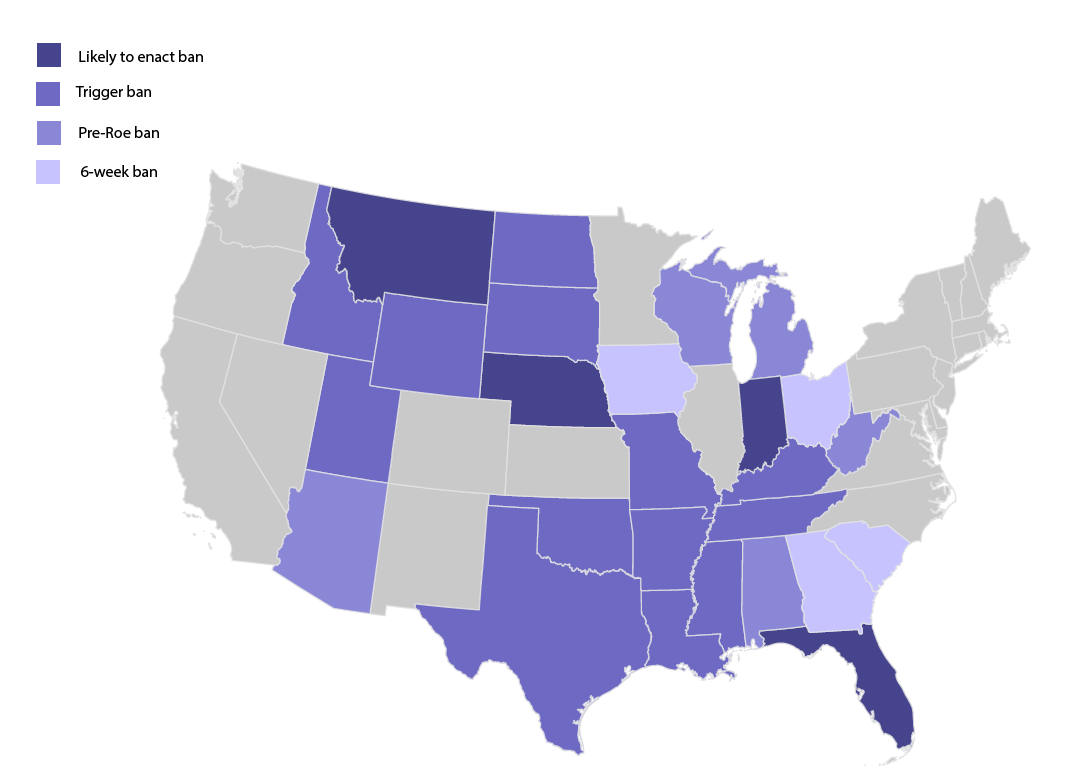
An estimated 26 states will certainly or are likely to ban abortion now that Roe is overturned, according to the Guttmacher Institute. But the decision will disproportionately impact abortion access for those with limited financial resources. The most commonly cited reason for seeking an abortion was "socioeconomic concerns," according to a 2017 study of people who got abortions across 14 countries, including the U.S. Abortions in the U.S. can cost up to $750, depending on the state, clinic, and health insurance coverage, a number that does not include the additional costs associated with crossing state lines, including travel and lodging.
Between 2012 and 2017 alone, at least 276,000 people received abortions outside their home states. And while restrictive bans have been unenforceable until now, some legal experts warn conservative states may next attempt to criminalize traveling to other states for abortion services should Roe be overturned.
Christie Citranglo contributed reporting for this story.
Related: Abortion laws around the world
13 states with trigger bans could ban abortion almost immediately
Overturning Roe v. Wade does not immediately outlaw abortion across the U.S., where it has been legal in all 50 states and Washington D.C., but it does give states the right to determine the legality of the procedure.
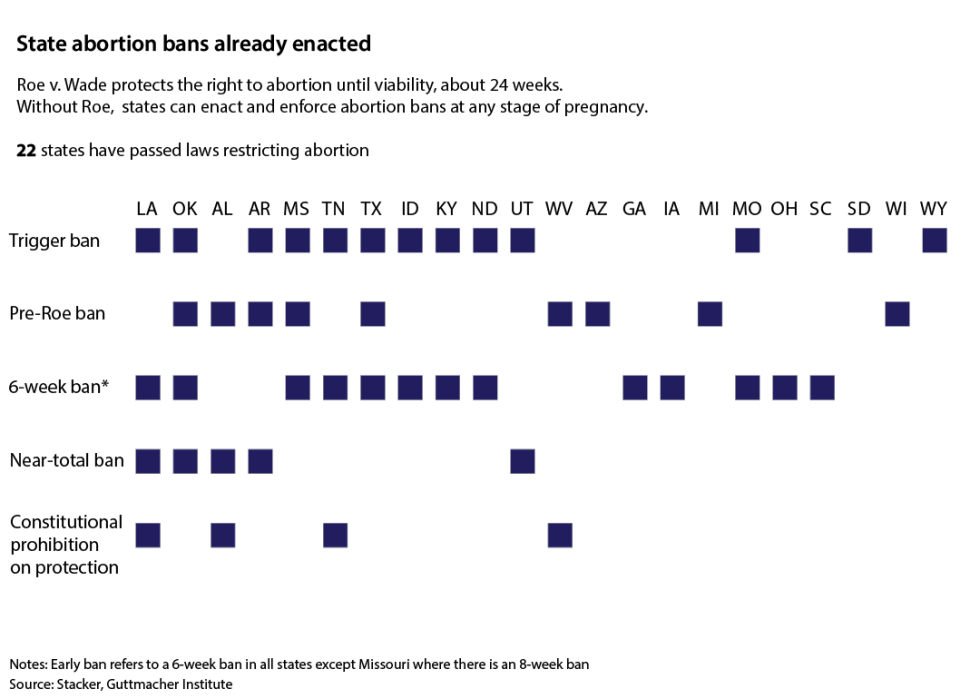
Up until now, at what stage and under what circumstances abortions can be performed varies from state to state. In those with the tightest restrictions, multiple bans exist to limit access. Bans on abortions after six weeks of pregnancy are enacted in 13 states and are among the most restrictive laws on the books.
Thirteen states have trigger bans that effectively signaled intent and established preemptive legislation to ban abortion in the event that Roe was overturned. Now that a reversal ruling has been reached—acting as the trigger—the proactive laws established in these states are expected to take effect almost immediately.
Near-total bans include laws that restrict all abortions with certain exceptions like saving the life of the parent or cases of sexual assault.
Some states had abortion bans in place prior to the Roe decision, which became unenforceable after 1973. These states could seek to reinforce these bans assuming they were never declared unconstitutional.
Four state constitutions have amendments that declare they are not obligated to protect a right to abortion
Travel distance for legal abortion access will increase by hundreds of miles
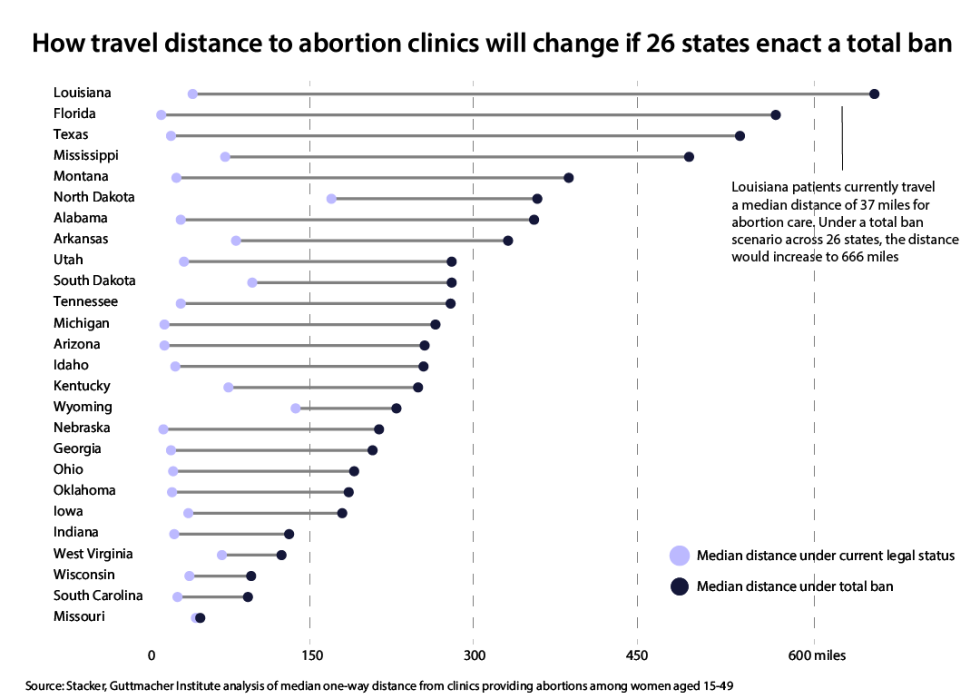
Up until now, a person seeking a legal abortion in the U.S. travels on average 25 miles to reach a clinic. With the reversal of Roe, however, that average distance could increase to 125 miles as clinics in states with abortion bans would likely be forced to close, according to the Myers Abortion Facility Database.
This travel burden becomes more severe in regions experiencing disproportionately low access to reproductive health care and states with restrictive anti-abortion legislation. The north-to-south corridor between North Dakota and Texas, for example, has a high concentration of counties already traveling roughly 250 miles to reach an abortion provider. Some even travel up to 350 miles.
Disparities in abortion access similarly exist in the southern U.S. With Roe overturned, travel distances in Louisiana could increase from 37 miles, or around half an hour of driving time, to 666 miles just one way—representing more than 11 hours of nonstop driving, and the largest increase in distance of any state.
Residents could have to travel as far as Maryland for legal abortions, according to Michelle Erenberg, director at reproductive health advocacy group Lift Louisiana, in an email interview with Stacker in May.
"Lawmakers have become much more radicalized in their views on abortion," Erenberg said, "which has led to more radical policies." She pointed to legislation that was up for review in her home state at the time, HB813, or "The Abolition of Abortion in Louisiana Act of 2022."
"Under this law, Louisiana could refuse to comply with decisions of the U.S. Supreme Court," Erenberg said of the legislation, which ultimately failed. "Abortion would be considered a homicide, and attempting to get an abortion could be prosecuted as attempted murder or criminal battery."
Increased travel distances bring increased travel costs, potentially longer wait times to receive care, and time away from work and familial responsibilities. These barriers will disproportionately affect low-income Americans' access to safe and legal abortions.
A 2021 study published in the Journal of the American Medical Association revealed that increases in distance to the nearest abortion care facility were associated with significant reductions in legal abortion rates. Conversely, when travel distances were reduced, legal abortion rates increased. Researchers estimated there would be more than 70,000 additional legal abortions each year if disparities in travel distances were eliminated.
It should be noted determining the exact number of illegal abortions and pregnancies reluctantly carried to term due to a lack of care is difficult to quantify as this data on this is often not reported or logged.
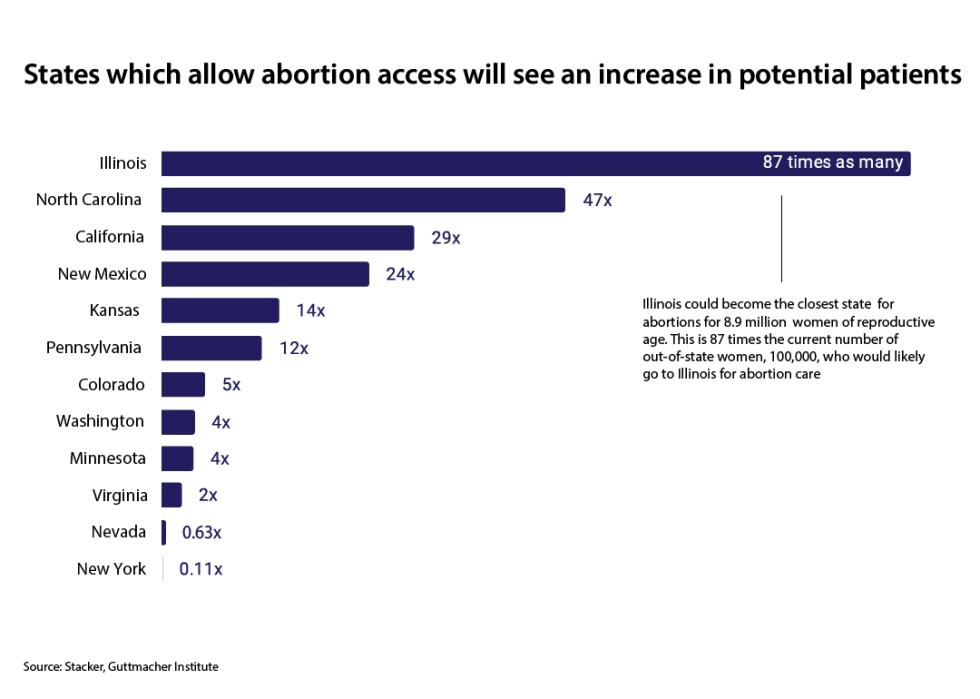
Clinic states are bracing for an influx of abortion patients
About 100,000 people seeking abortions will be unable to access a provider within the first year of a Roe reversal. As a result, 75,000 of them will likely give birth, according to predictions released on May 6, 2022, by Caitlin Myers, an economics professor at Middlebury College and co-Director of MiddData. Myers' predictions are based on state policy changes as of the time of release.
These predictions also assume that the people from ban states seeking an abortion are able to get an appointment with remaining providers, which Myers notes may not be possible due to high demand and long wait times.
The influx of abortion seekers to so-called clinic states—or states that have legal protections for abortion in place—is predicted to be large should Roe v. Wade be overturned. Projecting which states will see the largest increases has everything to do with geography.
A large influx of abortion-seekers is projected to look for services in North Carolina due to its proximity to many southeastern states where abortion is certain or likely to be banned with Roe now overturned. But unlike Illinois, the legal status of abortion in North Carolina is tenuous.
Clinics in North Carolina have already seen an increase over the past year of out-of-state abortion seekers, with some coming from as far as Texas in search of services, according to Amber Gavin, the vice president of Advocacy and Operations at A Woman's Choice, a group of North Carolina and Florida-based abortion clinics. And with Roe overturned, Gavin expects those numbers will keep climbing.
"I do think we're going to see probably well over 50% to 80% [more] patients than what we're currently seeing," she told Stacker in an interview in May.
Gavin also said A Woman's Choice clinics are considering hiring more staff and physicians to accommodate the influx. "We're working really hard with our staff, with abortion funds, with advocates on the ground to make sure that people who need and want that care are able to get it," she said.
Illinois has long been a reproductive care hub for Midwesterners. Out-of-state patients seeking abortions rose from 2,970 in 2014 to 9,686 in 2020, according to Illinois Department of Public Health data. These numbers are projected to continue to rise as people come from Michigan, Indiana, Wisconsin, Ohio, Missouri, and even some Southern states. To increase access, two Planned Parenthood clinics have opened in recent years along the Illinois border. The state is one of the few in the Midwest where the right to abortion is certain to be protected long-term.
Many clinic states have made moves since 2019 to fund abortion services and codify abortion. Vermont, for instance, passed Act 47, which preserves the right to reproductive choice, including abortion, in the year following the appointment of Justice Brett Kavanaugh to the Supreme Court. Several other states followed suit, including California, Connecticut, Oregon, Maine, and Illinois. The subsequent appointment of Amy Coney Barrett to the Supreme Court in 2020 cemented the court's conservative supermajority and encouraged legal challenges to Roe v. Wade in 2021.
Some states have already taken steps to ensure access to safe abortions for people crossing state lines.
In 2019, New York funded the New York Abortion Access Fund, intended to help low-income abortion seekers from other states travel to New York for services. In March 2022, California passed SB 245, an act that eliminates out-of-pocket costs for abortions for those who have private insurance, as well as those on California's Medicaid. In Oregon, legislators passed the Reproductive Health Equity Fund, which allocates $15 million to expand abortion services, including helping to cover expenses of those traveling to Oregon for abortions. And Connecticut Governor Ned Lamont signed a bill that will shield Connecticut abortion providers and out-of-state patients from being sued by states where abortion—even outside the state—is illegal.
Related: Abortion in America: How access and attitudes have changed through the centuries