The 46% ready for commitment: What the data really says about what singles want in 2026
If social media and new outlets are to be believed, many Americans have given up on dating. From hookup culture to dating app fatigue, it seems more and more that “situationships” are the norm.
However, survey data points to something else entirely. Spokeo broke down the statistics from leading sources, including the Kinsey Institute, PR Newswire, Fortune, Coffee Meets Bagel, Nerd Wallet, and more, to show just how ready many Americans are for a long-term relationship. Not eventually, but now.
The data shows that modern singles aren't taking a romantic retreat and they’re hopeful for light at the end of the tunnel.
The ‘relationship reset’: What singles actually prioritize
The clearest theme across all data is intentionality. Based on the 14th Annual Singles in America Study by Match and the Kinsey Institute, which surveyed 5,001 singles, 46% of people claim they are ready now for a long-term relationship.
In January 2026, the dating app Coffee Meets Bagel published its 2025 Dating Realness Report, which also outlined some interesting facts that aligned with the Match and Kinsey Institute data. In a survey in partnership with YouGov of over 1,000 working professionals aged 21 to 35, at least 9 in 10 (92%) daters indicated they were seeking either marriage or a long-term partner. Of that group, 3 in 5 (61%) specifically mentioned seeking a spouse.
However, more than 9 in 10 (93%) of those same participants said that dating was difficult, with over half mentioning that commitment to a relationship was harder than asking for a raise at work. Aspiration among younger daters is clearly high, but the problem lies in execution.
Corroborating data from the Institute for Family Studies’ 2026 State of Our Unions report offers further insight. This survey, drawn from a nationally representative sample of nearly 5,300 unmarried adults aged 22 to 35, found that only 30% of young adults were actively dating. Active was defined as going on dates at least once a month. The gap between wanting a relationship and actively pursuing one has never been more real or wider.
Importantly, this divide over actually committing to a relationship isn’t driven by fear. The State of Our Unions report shows that most young adults indicated that a lack of confidence and the skills required to navigate dating effectively led to disinterest in actually going on dates. In 2026, singles know the destination they’re seeking, but they’re not sure how to actually read the map to achieve their goals.
What differs by gender and generation
Across multiple studies, men and women report wanting the same things: commitment, emotional connection, and a real relationship.
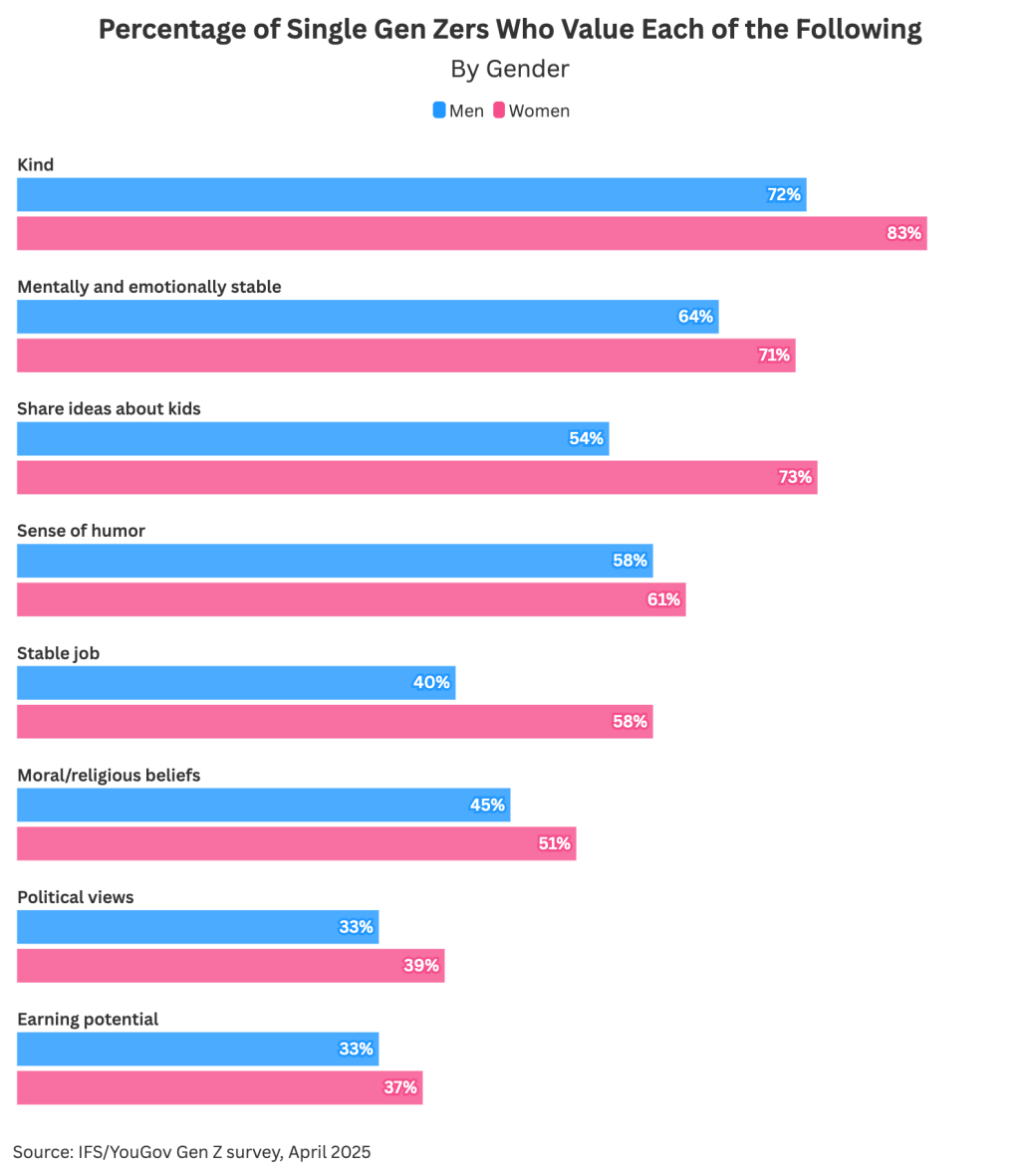
Despite wanting the same things, young daters are still going on fewer dates. In November 2025, Hinge, another popular dating app, published its 2025 Gen Z D.A.T.E. Report and noted 42% of heterosexual Gen Z women who use Hinge believe the men they date don’t want to have deep conversations from the get-go. Yet, 65% of heterosexual Gen Z men say they actually do want those conversations.
Something is clearly lost in translation, but the cause may lie in a telling statistic: an additional 48% of Gen Z men indicated they hold back from emotional intimacy early on because they’re afraid of coming across too strongly. The result? A lot of dates where nobody says what they actually want to say, leading to burnout that stops those people from going on more dates.
It’s not just Gen Z, though. Generational differences also emerge in modern dating. According to BMO’s 2026 Real Financial Progress Index, millennials are spending an average of $252 per date. This is a 32% jump from just 2025. At a national level, the average amount spent per date is at $189, which is up 12.5% year over year. This represents an annualized spend of $2,323 for dating during the entire year at just an average of 12 dates, which is down from an average of 14 in 2024.
This spending figure outpaces general inflation, meaning people are spending more than they likely should while going on fewer dates to try to succeed.
The real deal-breakers in modern dating
A 2026 dating survey run by NerdWallet found that being dishonest about finances was the top dealbreaker for 54% of those polled, with asking for money as the runner-up. Just 17% said that carrying any amount of credit card debt would end things. It’s not the debt itself that’s a dealbreaker for modern daters; it's the lack of communication and transparency that is problematic.
Additional BMO data supports this. As cited by 94% of respondents in a survey, the most attractive financial trait in a partner was financial responsibility, rather than having a large sum of money. Financial transparency came in just behind at 89%. Being dishonest about where you stand is the clearest dealbreaker for modern daters, with the underlying problem of poor communication rearing its head again.
Addressing the communication gap and vulnerability shift
Communication issues are ultimately leading fewer people to go on dates. It’s clear something must be done.
The desire among daters to build deep emotional connections is almost universal, but the execution needs work. In the Hinge 2025 Gen Z D.A.T.E. Report, this issue is dubbed the “communication gap.”
More than half of daters polled indicated they’ve felt shame or second-guessed themselves after being emotionally vulnerable with someone, yet only 19% say they felt uncomfortable when someone opened up. Modern daters are afraid to be vulnerable, but it’s almost universally safe to do so. Gen Z is more hesitant than millennials to initiate deep conversations, by about 36%, but that hesitation still comes with a strong desire to have those conversations.
Modern daters don't dislike depth. Rather, they’re waiting for permission and a sign that it’s safe to open up. Someone has to go first. Addressing this issue requires having the courage to simply speak up, make your feelings known, and take a leap of faith.
The future of dating in 2026
Today’s daters aren’t afraid of relationships but lack the practical skills to build them. This is a solvable problem.
When all the noise around hookup culture and dating app exhaustion is stripped away, the data centers around a few main points. Most singles want commitment, find dating hard, and want to learn to navigate a real tension between desiring emotional depth and initiating it.
The 46% who say they’re ready for a long-term relationship aren’t outliers; they're more likely representative of a much larger group who want the same thing and are still figuring out how to ask for it.
This story was produced by Spokeo and reviewed and distributed by Stacker.