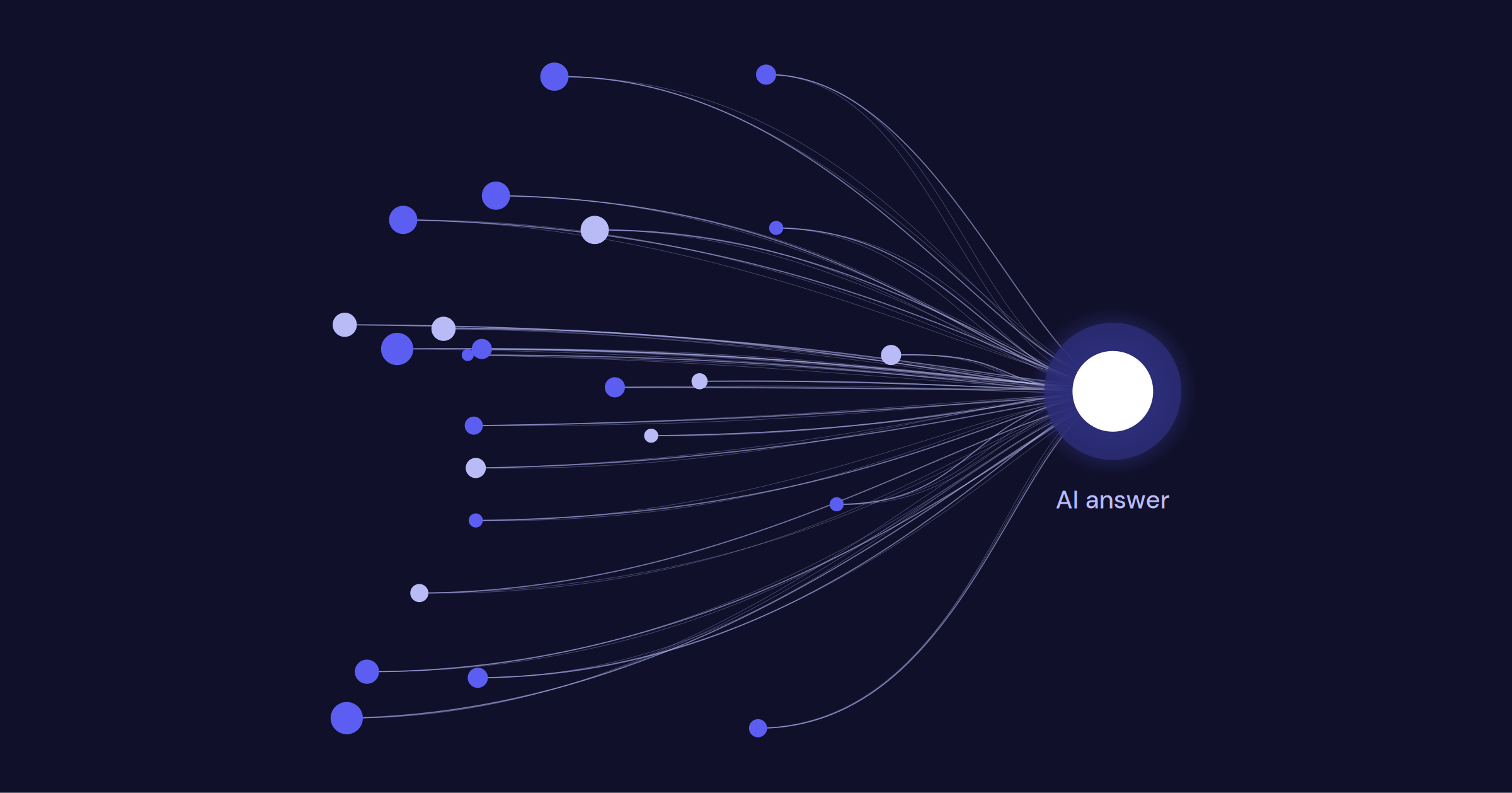
While we know that earned distribution helps to create citation opportunities that wouldn't otherwise exist, the stories that earn the most publisher pickups aren't always the ones that AI search platforms cite the most.
That gap has been widening all year. And in Q2 2026, it became measurable enough to change how editorial teams should think about their content calendars going forward.
Here’s a look at how that gap shows up in story performance and how content teams can build strategies to bridge it.
Some stories will help brands to reach a large audience while others will help boost AI visibility, so teams should know what metrics matter most to them and establish a strong plan for both.
Methodology: How We Measure GEO Performance
Stacker tracks AI search visibility in partnership with Scrunch, monitoring how six major AI platforms (ChatGPT, Claude, Perplexity, Google Gemini, Google AI Overviews, and Google AI Mode) respond to 30 topic-relevant prompts per story. Each story goes through five measurement phases: a pre-distribution baseline, then weekly checks for four weeks after distribution.
The key metric is Citation Lift, which Stacker defines as the increase in AI citations that a brand gains as a result of earned media distribution. We calculate this by comparing a brand's total presence with the number of citations the brand earned across Stacker's network. We also look at Citation Rate, or the share of AI-generated citations (links) in Weeks 1–4 that point to the brand's domain or a Stacker network publisher that picked up the story. It counts only when AI actually links to you.
GEO Insights: Q2's Top Performers
We tracked 367 stories in Q2 through Stacker's GEO monitoring.
There's no single category that "wins" in GEO. The top five stories span consumer protection, immigration policy, B2B logistics, personal finance, and credit card education. They share editorial characteristics rather than a common topic.
Here, we ranked the top-performing GEO stories according to Citation Lift and analyzed why they earned AI citations.
1. "The AI wall: How travel companies' use of bad AI can ruin your travel experience"
This story investigated how travel companies' poor AI implementations actively harm consumers, a critical angle on a topic most brands treat with generic optimism. It's a contrarian take, and AI platforms rewarded it.
The client's own domain earned almost no citations on its own. But when the story was distributed across Stacker's publisher network, AI platforms began citing publisher versions. The brand's visibility was almost entirely created by distribution.
The lesson: Generic AI how-to content averaged just 174 pickups and near-zero citation rates in Q2. But critical, investigative AI angles can break through in both channels.
2. "Portugal put golden visa renewals online. The paper trail still matters."
Immigration and regulatory content is one of Q2's most surprising GEO performers. This story paired a specific policy change (Portugal's digital shift for golden visa renewals) with a practical "what it means for you" angle, which is exactly how real people search for information about visa programs.
Citations came from a diverse set of publishers, with KNSI Radio and the Miami Herald each appearing in a significant number of AI responses. That diversity matters: when AI engines see the same information cited across multiple trusted editorial sources, they treat it as more authoritative.
The lesson: Regulatory and policy content may not earn blockbuster pickup numbers, but it fills a gap AI platforms are actively trying to answer. When users ask "What changed with Portugal's golden visa?", there are very few authoritative sources, so the brand was well-positioned to capture citations on this topic.
3. "How high-volume shippers save hours by automating rate decisions"
B2B logistics content isn't what most people think of as exciting or viral, but it's the kind of business content AI platforms are hungry for. This story answered a specific operational question (how to automate shipping rate decisions at scale) that has very few competing authoritative sources online.
The lesson: AI engines lack other authoritative sources for niche business topics, which means a well-constructed explainer can own the citation slot for its query. The more specific the operational question, the less competition there is.
4. "What a roommate can save you in 100 US cities: 2026 study"
Geographic data studies have been the most reliable GEO format across every quarter we've tracked, and this roommate savings study shows why. The 100-city structure gave AI platforms citable, specific, locally relevant data points.
The lesson: State and city data is the most consistent GEO format because AI engines rely on local publisher citations to answer location-specific queries. Additionally, proprietary rankings are highly citable because AI cannot retrieve the exclusive data elsewhere.
5. "How do no preset spending limit credit cards work, and who qualifies?"
This credit card explainer posted Q2's highest total citation rate, and the most balanced split between brand and network citations.
The combination of definitional authority plus editorial distribution locked in its position across all six AI search platforms.
The lesson: Definitional explainers ("What is X?" / "How does X work?") dominated the top of Q2's GEO leaderboard because they align directly with how people query AI. When you answer the question AI users are asking, in language that matches their search intent, you earn the citation slot.
Where GEO and Pickups Align and Where They Diverge
One of the most strategically important findings from Q2 is that the stories AI platforms cite and the stories publishers pick up aren't always the same.
Four content types are straightforward: they perform well (or poorly) in both channels.
Health content, workplace mental health, and geographic data studies all work for both GEO and pickups. These are the categories where you don't have to choose between strong pickup numbers and strong AI citation rates. If you're building a content program and want to minimize strategic risk, these are the safest bets.
Generic how-tos should be avoided across the board. They underperform in pickups and post zero citation rates. The format is oversaturated in both channels; publishers have seen too many, and AI has too many competing sources to cite yours. Across 44 AI-focused stories, average pickups came in at 174, 15% below the network average, and generic how-to formats posted near-zero AI citation rates. This could indicate a fatigue or oversaturation of AI-related stories. However, critical or investigative AI angles still performed well on both fronts, underscoring the value of having specificity and unique findings leading those stories.
But two categories are divergent, and that's where the strategic trade-offs show up.
B2B financial explainers averaged around 190 pickups (slightly below the 205 network average) but posted citation rates of 10–20%, among the highest of any category.
Immigration and regulatory content showed a similar pattern: softer pickup numbers (~150) but a 13% citation rate. These stories fill gaps in AI platforms' knowledge bases. Few other sources provide that kind of specific, authoritative coverage. For brands in these spaces, maintaining volume here is a GEO investment, even when pickup numbers don't look impressive on their own.
Put differently: content strategy is no longer just about pickups. Brands need to decide, story by story, whether they're optimizing for distribution breadth, AI visibility, or both, and build editorial calendars that allocate volume accordingly.
What This Means for Content Teams
Q2's GEO data reinforces a few principles that should shape content planning for the second half of 2026:
- Pickups and AI visibility often diverge. A story with 190 pickups and a 20% citation rate can be worth more to a brand's long-term visibility than a story with 220 pickups and zero GEO presence. The two metrics measure different things, and the most effective content strategies account for both.
- Distribution creates AI visibility that brands can't earn alone. In four of the five top GEO stories, network citations exceeded brand citations. The publisher network doesn't just amplify a brand's content — it also creates citation pathways that wouldn't exist otherwise.
- Specificity wins in both channels. The stories that earned the highest citation rates weren't broad overviews. They were specific answers to specific questions. "How do no preset spending limit credit cards work?" outperforms "Understanding business credit cards" in AI search for the same reason it outperforms in traditional distribution: it matches what people are actually looking for.
- Consider the tradeoff. Not every story needs to maximize both metrics. A real estate brand might accept lower pickups on a regulatory explainer if it earns a 14% citation rate that builds long-term AI visibility. A health brand might not need to make that tradeoff at all, because health content performs well in both channels. The key is knowing which stories are for reach and which are for AI positioning, and planning for both.
- Freshness signals matter. Year references, policy changes, and timely regulatory framing all correlated with higher citation rates. AI platforms are increasingly sensitive to timeliness signals, and content that communicates "this is current" earns citation preference over evergreen pieces that feel dated.
The content teams seeing the best results are treating distribution and AI visibility as complementary strategies, not competing ones.
We took a deeper look at the biggest trends of the quarter in our new report titled "Stacker's Q2 2026 Performance Report: Pickups, Citations, and the Content That Won." This report walks through the five biggest takeaways from Q2, introduces our Golden Formula for high-performing headlines, and shows what separates content that wins with publishers from content that wins with AI search.
Download the full report here.
Diana Shishkina is Stacker's Senior Lead of Content Operations. She has worked in content for over 8 years, contributing to Stacker as a writer, editor, data journalism lead, and content strategist. In her current role, Diana works in both editorial operations and strategy, analyzing our network data and publisher needs in order to directly help clients across different industries construct digital content that meets their SEO and GEO goals.