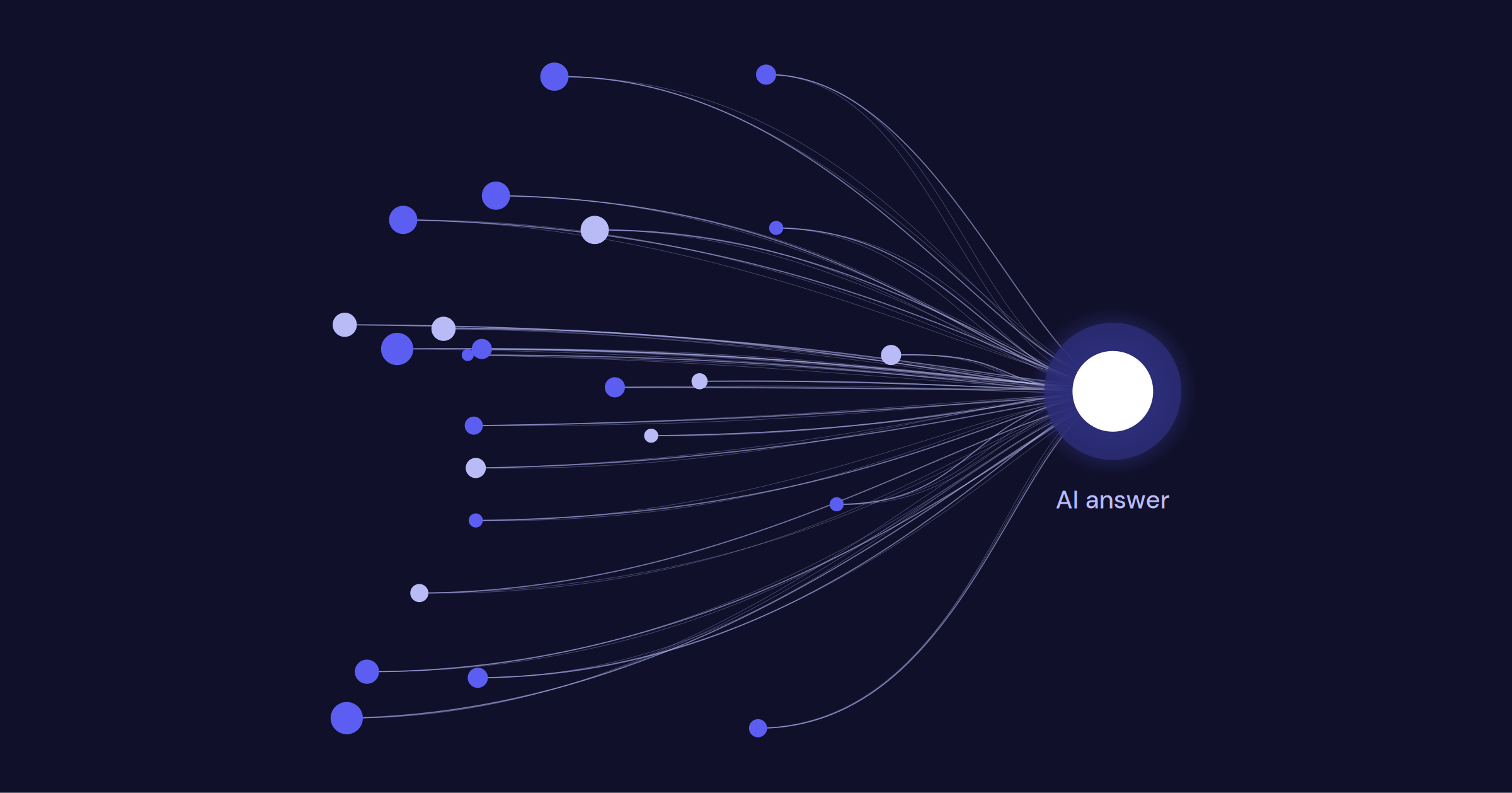

Every content leader building a GEO strategy is asking the same first question: How do we show up in AI answers? But that's just the entry point.
What do you do when you’ve gone from zero to one already– or even zero to two?
That’s where so many brands have been stuck at the moment. The next step is figuring out how to make your citations stickier within LLMs and extend the shelf life of your citations.
This is pivotal because it can help you answer how often you should be shipping or distributing content so that you can strategically plan around your team’s goals and resources.
So, we sought to answer the question: how do you stay cited?
Because showing up consistently, across platforms, over weeks and months is where investments can really be defended and ROI can be proved.
Through our ongoing research partnership with Scrunch, we've started tracking exactly how long sources persist in AI-generated citations across platforms. We're calling this measurement source decay, and the findings reframe how content teams can think strategically about their GEO strategies, shifting from simply an-all LLMs strategy, to a strategic modal or industry performance-informed strategy.
Click here for a first look at the data
The Headline
Content across non-network domains had a citation half-life of roughly 4.5 weeks. Content on the domains in the Stacker publisher network, had a citation half-life of nearly 10 weeks.
That's a 2.1x durability advantage.
In practical terms: a piece of content that fades from AI answers in about a month versus one that stays relevant for most of the quarter.
How We Measured It
This is the largest citation persistence study we've conducted. The scope spanned:
- 3M+ citation events analyzed
- 120K+ non-network domains tracked as the comparison baseline, representing the web as a whole
- 8 industries, 6 AI platforms
- 26-week observation window (September 2025 – March 2026)
- 200 bootstrap simulations for statistical validation
- Cohort-based survival analysis with shrinkage estimation, post-stratified to reflect the live citation mix
- Cross-validated across two methodological variants
Non-network sources include everything outside the Stacker network: trade publications, brand-owned sites, social platforms, other publishers, and more.
This was structured as a broad comparison of Stacker network partners measured against a sample representative of the wider web as AI models encounter it.
The Effect Holds Across Every AI Platform
The durability advantage showed up across each and every model. This wasn’t just a quirk with Chat or Claude. Instead, this suggests that it’s a more structural point across LLMs.
Platform-level citation half-life (weeks):
|
Platform |
Non-Network |
Stacker Network |
Weeks Gained |
|
Gemini |
4.6 |
10.9 |
+6.3 |
|
Perplexity |
5.7 |
10.4 |
+4.6 |
|
Google AI Overview |
4.7 |
9.9 |
+5.2 |
|
Google AI Mode |
4.3 |
8.2 |
+4.0 |
|
OpenAI (ChatGPT) |
3.4 |
7.2 |
+3.8 |
|
Other LLMs |
3.5 |
5.6 |
+2.1 |
The platform level data shines a light on the structural differences between the models.
Each AI engine has a different refresh cadence and a different appetite for recency. OpenAI, for instance, cycles through its source pool faster than any other platform we measured: a 3.4-week non-network half-life means content can fall out of ChatGPT's answers within weeks of publication. Stacker network sources on OpenAI last 2.1x longer, but the tighter baseline means every week of additional persistence carries more weight on that platform than on others.
Perplexity on the other hand, has the highest durability-level of the dataset. Stacker network sources on Perplexity hold citations for over 10 weeks, which is more than 3x the average non-network ChatGPT citation. Meaning, if you’re earning Perplexity citations through distributed content, those citations are working for you longer than anywhere else.
The takeaway here though shouldn’t just be observations about stickiness from one model to the next. The bigger takeaway is that there is a model-level strategic approach that brands can take to their GEO strategy.
Consistent Across Every Industry
The durability gap held across all eight verticals we tracked, from +2.6 weeks in Tech & SaaS to +6.4 weeks in Real Estate.
Industry-level citation half-life (weeks):
|
Industry |
Non-Network |
Stacker Network |
Weeks Gained |
|
Real Estate |
4.2 |
10.6 |
+6.4 |
|
Financial Services |
4.6 |
10.4 |
+5.8 |
|
Retail & e-Commerce |
4.1 |
9.1 |
+5.0 |
|
Healthcare |
4.0 |
8.6 |
+4.6 |
|
Marketing & Advertising |
4.5 |
8.9 |
+4.4 |
|
Insurance |
4.8 |
8.8 |
+4.0 |
|
Media |
4.3 |
7.4 |
+3.0 |
|
Tech & SaaS |
4.4 |
7.0 |
+2.6 |
If this were category-specific, you could explain it away to the fact that some industries have quicker news cycles or require more authority to move the needle.
The fact that it holds across eight industries with different competitive dynamics and content norms suggests a structural difference in regards to how AI models treat distributed content differently than single-domain content.
Editorial Distribution as Durability
While we can't claim causation, the data indicates that AI models treat editorial sources as more durable citation material than the broader web. That's consistent with how these models are designed to evaluate source authority and trustworthiness, and, thus, it makes sense that our network of editorial publishers seem to be stickier.
Content that lives across a limited set of sources gives an AI model fewer places to encounter it. If those sources lose relevance for a given query, or the model refreshes its retrieval pool, the citation drops off.
When that same content exists across dozens of trusted editorial domains through earned distribution, the model has many more touchpoints. Even as individual sources cycle in and out of the answer set, the underlying information persists because it lives in enough credible places to stay above the citation threshold.
Meaning, distribution creates staying power.
This tracks with what we saw in our first citation lift study, and connects directly to the coverage breadth research we published earlier this year, which showed that earned distribution expands how broadly a brand surfaces across AI platforms, with a median increase from 5.4% to 17.9% cross-platform coverage.
Source decay adds the time dimension. Distribution gets you cited in more places and keeps you cited for longer.
Breadth x durability is the compounding equation.
Building a Data-Backed GEO Strategy with Durability in Mind
The data reinforces something we've been saying: there's no such thing as a one-and-done GEO strategy. The brands that maintain visibility are the ones with a system behind their stories.
What's new here is that we can now attach numbers to that decay. And those numbers make the case for treating citation strategy as both offense and defense: earning new citations while actively working to retain the ones you have.
You can think of every piece of content you produce as having a durability profile.
With source decay data, content teams can start to understand how sticky their citations actually are across different AI platforms, and plan their production and distribution cadence accordingly. If you know that ChatGPT churns faster than Gemini, or that your industry's non-network half-life sits closer to four weeks than five, that changes how you prioritize platforms and how often you need fresh content in the pipeline.
Of course, this isn’t the full story. A citation that persists for twelve weeks on a prompt nobody is asking is still a citation nobody sees. The real strategic value comes from pairing durability data with deep knowledge of your audience, so that your prompt sets actually have an impact.
A few implications worth acting on:
- Monitor citation performance as an ongoing practice.
- Prioritize the platforms where your audience is searching.
- Leverage editorial distribution tools like Stacker to extend your citation window.
For the first time, GEO teams can evaluate their content strategy against a persistence benchmark and make informed decisions about where and how often to invest.
Where Does the Research Go Next?
The natural follow-up question is one we're already digging into: if citation durability is a function of distribution, what's the optimal cadence?
- How often should a brand be shipping and distributing content to maintain and grow its AI visibility?
- Is there a frequency threshold where the durability advantage accelerates?
- A point where adding more volume stops moving the needle?
That research is underway, and when it's ready, you’ll be the first to know.
And don't just take our word for it. Read what Scrunch has to say about the data.

Benjamin Chipman is a GenZ brand and content marketer at the intersection of media and storytelling. Informed by his experiences across the creator economy and the TODAY Show, Benjamin has a unique perspective about where traditional and new media converge. Passionate about where brands come together with culture and community, he brings this to all things brand and content at Stacker.
Featured Image Credit: Photo Illustration by Stacker // Canva