
Every quarter, we comb through performance data from across the Stacker network to see what's actually landing with publishers and with AI platforms.
One important finding from both our Q2 and Q3 2026 analyses: Headlines can make or break a story's performance more than the topic or category of the story itself.
The good news is that by tracking performance data across thousands of stories every year, we have identified consistent headline patterns that lead to success more often than not.
The Golden Formula
Back in Q2, we introduced what we coined the Golden Formula. When you combine:
-
a timely hook,
-
a data point or stat,
-
a geographic or audience angle, and
-
actionable value for the reader,
those stories tend to perform the best.
In other words, let the headline give the reader a reason to care about the story now, back it up with a statistic, make it specific to them, and tell them what to do next.
Q3's top story was "US population trends by state: Winners and losers in 2026." It was the winner among pickups, readership, and DR 50+ placements, and it contains all elements of the golden formula.
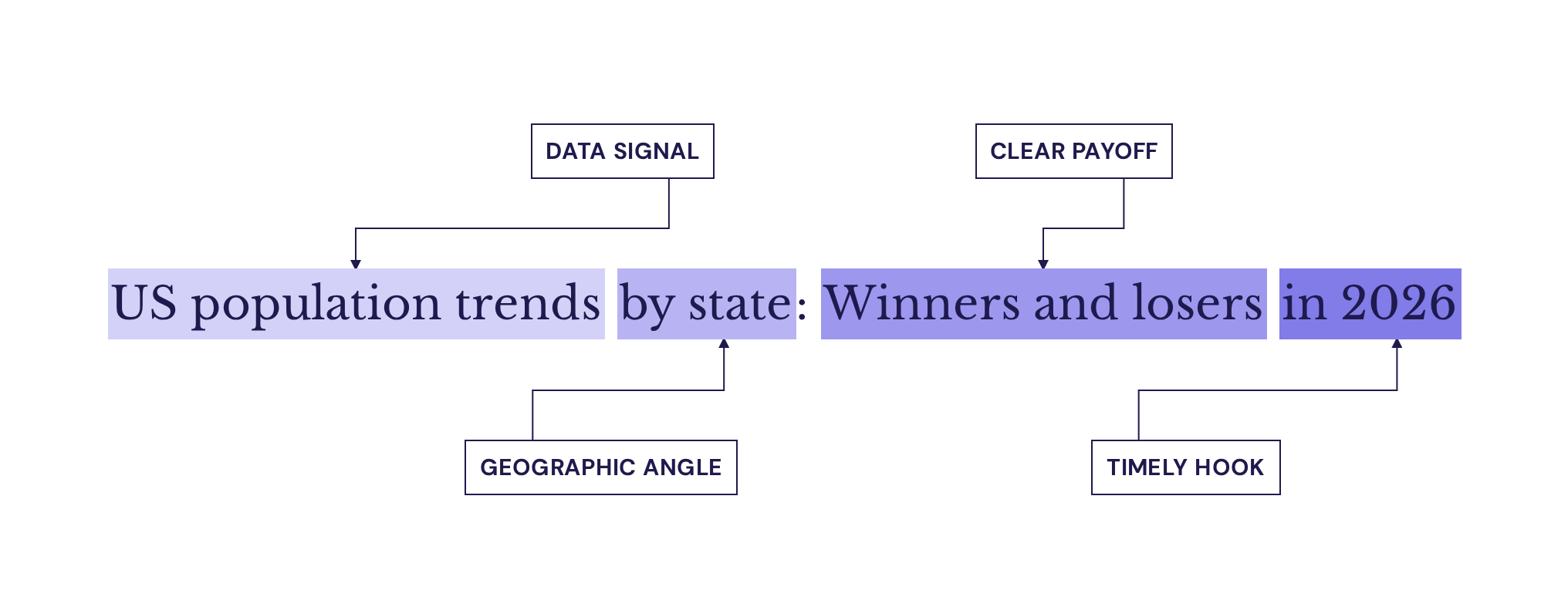
Not all headlines need to contain all four elements every single time, but even hitting at least two or three of them can be successful. For example, other top Q3 stories include "Weight loss can weaken your bones. Here's how to keep them strong" (audience angle + actionable value + data) and "Americans are relocating less than ever, but still frustrated by packing" (timely hook + data + audience angle).
Specific beats general
Part of the reason the Golden Formula works so well is because of another pattern we've been seeing in headlines: naming a specific condition, pain point, or audience almost always outperforms writing in generalities. "What women 35+ need to know about perimenopause" would beat a story like "Understanding hormonal changes." A story about ADHD procrastination beats a story about productivity in general.
This showed up most clearly in Health content, which dominated the top 10 most-picked-up stories in both Q2 and Q3. These stories were the ones that got specific, naming a condition or a medication rather than talking around it. General wellness topics underperformed during both quarters.
While you don't want your content to be so niche that it is only relevant to a small section of a publisher's audience, identifying who the story is for helps publishers know how to best promote the story on their site. Additionally, your story is more likely to stand out in AI search than a broader piece on a topic that may have been covered by other brands countless times.
Match how people actually ask questions
Diving more into what works best for AI search and GEO results means considering how a person might prompt an LLM. Readers and AI platforms respond best to headlines phrased the way people actually search. The best examples of that are including a question or comparison within a headline (such as "Morning vs. night: Does it matter when you take blood pressure, statin, antidepressant and other common medications?", which contained both and was a top performer in Q3). If you can allude to the fact that you will be answering the question directly in the story, that's even better.
What consistently lagged in both quarters were generic "How to…" and "What is…" headline openers. They read more like a definition than an engaging story. If your current headline starts with "How to" or "What is," ask yourself whether a stat, question, or comparison would do the job better.
Geographic data continues to outperform, including in headlines
By-state and by-city framing in a headline held up as a strong performer in both quarters, driving publisher pickups and AI citations alike. Not only does this framing immediately signal to publishers that the story will have rich data, but when people ask AI platforms location-specific questions, those platforms look for data they can break down at a granular level. A story that breaks down a topic by state enables AI platforms to cite your brand for "near me" queries and gives more hyperlocal publishers in our network a reason to pick up a national story.
What this means for the next headline you write
These trends held steady over two full quarters of network-wide data, and we have already seen evidence that they will hold up again in Q4. As we learn more about what works best for AI search and as editors adjust their publishing strategies in response, it's likely we'll see additional patterns you can follow to get your content directly in front of the readers you want to reach.
Diana Shishkina is Stacker's Senior Lead of Content Operations. She has worked in content for over 8 years, contributing to Stacker as a writer, editor, data journalism lead, and content strategist. In her current role, Diana works in both editorial operations and strategy, analyzing our network data and publisher needs in order to directly help clients across different industries construct digital content that meets their SEO and GEO goals.