25 American folk heroes and the stories behind them
25 American folk heroes and the stories behind them
Folk tales serve as a cultural binder of sorts, bringing people together with a fomented sense of shared identity. They're also used as explainers, similarly to how mythology worked for ancient Greeks. American folk heroes are richly textured and many-layered: Contemporary characters like Paul Bunyan explained the creation of America's rivers and lakes and served as inspiration for workers exposed to grueling conditions while carving a way West and extracting resources for trade or infrastructure. Other tales, like those of Sacagawea and Pocahontas, helped prop up a version of American history that neatly sidesteps the Native American genocide enacted by early colonists, Western explorers, and even the U.S. government. Despite progress such as the renaming of Columbus Day to Indigenous Peoples Day—celebrated this year on Oct. 13, 2025—these myths persist in popular culture today.
Revisionist histories aside, Native Americans themselves have hundreds of stories rooted in folklore, including the Sleeping Ute Mountain and Kokopelli. For enslaved African Americans, meanwhile, folklore provided subjugated people with heroic tales of bravery, defiance, and escape, from Br'er Rabbit to Stack-O-Lee. Many other folk heroes, such as Hugh Glass and Annie Oakley, are based on actual people, while others are pure fiction, such as the Maid of the Mist and Bud Billiken. These tall tales come in the form of nursery rhymes, children's tales, mascots, and cautionary myths and speak to us of strength, perseverance, and the celebrated intrepidness of rugged American individualism.
As is the case with any hero, much of American folklore features flawed characters. Some would certainly be villains today, whether Billy the Kid for his unchecked aggression against officers of the law or Hannah Duston for her violent slaughter of Native Americans.
Stacker scoured American history and mythology from books, news accounts, history lessons, and journal articles to curate a diverse gallery of 25 American folk heroes and the stories behind them. Some are well-known characters like Johnny Appleseed and Molly Pitcher, and others are much more obscure.
See how many you already know, and read on to learn about all the rest.
Br'er Rabbit
Br'er Rabbit is a character with roots in African folklore who hit the mainstream when a white man, Joel Chandler Harris, published "Uncle Remus, His Songs and His Sayings," a collection of stories told to him as a child by "Uncle Remus," an elderly man who had been enslaved his entire life. Br'er Rabbit is known as a trickster, getting his way with debatably questionable ethics and reverse psychology (asking for any punishment from Br'er Fox except to be thrown into the briar patch, which is of course exactly where Br'er Rabbit wishes to go). Publishing the tales undoubtedly served as a way to archive them and share them with the world, however, there has been much debate around whether Harris unfairly cashed in on Uncle Remus' stories.
Some scholars have argued that those who see Br'er Rabbit as amoral have it all wrong and that, in fact, Br'er Rabbit represents a world where friendship and ethical boundaries are highly valued, and his stories served as inspiration for enslaved people seeking a means of survival.
Johnny Appleseed
Johnny Appleseed of American folklore was a bohemian eccentric who wandered the countryside in a tin-pot hat while planting apple trees. The character is based on a real man named John Chapman, a religious extremist born in 1774 in Massachusetts.
Chapman's father, widowed while fighting the Revolutionary War, came home to care for his family. He taught Chapman to farm, and when the boy was older he apprenticed at an apple orchard. At that time, all it took to stake land as your own was to plant at least 50 apple trees. So Chapman did just that—across Illinois, Indiana, Ohio, Pennsylvania, and West Virginia—while handing out religious pamphlets and claiming the land as he went. He returned to Massachusetts as needed to restock his supply. Chapman resold parcels of property to white settlers as the trees grew. He still owned 1,200 acres when he died in 1845.
Molly Pitcher
Many of us remember the story about Molly Pitcher, brave wife of a Revolutionary War soldier who carried pitchers of water to men at the Battle of Monmouth in 1778. According to legend, she also used water to cool the cannon and took her husband's place among the gun crew when he couldn't fight anymore (either due to collapsing or injury). The mythology paints a picture of American determination and loyalty to country by men and women on the battlefield.
The folk hero and her story came 100 years after the end of the Revolutionary War, and the person Molly Pitcher is supposedly based on—Mary Ludwig Hays McCarthy—doesn't appear in any records (nor does her husband) of that time or location. In fact, Molly Pitcher is widely considered a "composite figure" of different women who did perform duties during the revolution such as bringing water to soldiers.
There was, however, another woman by a similar name who existed around that time but who lived further north and had a starkly different reputation. Moll Pitcher was a fortune-teller in Massachusetts whom sailors visited for insights before going out to sea.
John Henry
The John Henry ballads that gained popularity in the 1870s tell a story of a highly skilled Black railroad worker who could drill into mountainsides faster than machines to make way for explosives used to blast open railroad paths. As the folklore goes, the steel-driver outran a steam-powered drill, digging a 14-foot hole to the machine's nine feet before it quit. At the conclusion of the contest, John Henry dropped dead from overexertion.
The folk hero is lauded for his strength, determination, and grit, and "John Henry" is one of the most-covered folk songs in American history. But there's more to the folklore than one might expect—namely, that the story is likely true. In his book, "Steel Drivin' Man: John Henry, the Untold Story of an American Legend," historian Scott Reynolds Nelson posits that John Henry served as a Union soldier before being arrested for theft while working in Richmond, Virginia. Henry and other inmates from the Virginia State Penitentiary were put on work detail blasting tunnels to make way for the Chesapeake & Ohio Railway, which was being run directly through the Allegheny Mountains.
Nelson found records of Henry's name on assignments for drilling the Lewis Tunnel section of the C&O Railway in West Virginia. The trail runs cold in 1874, suggesting Henry died while working. Even the ballad lyrics—"They took John Henry to the white house, and buried him in the san',"—point to a clue, as the penitentiary's front was painted white at the time.
Henry and his crew were indeed likely to have worked faster than the machines doing the same work, as the machines were notorious for failing. Nelson did make one distinction, which is that rather than overexertion, Henry was more likely to have died from silicosis, a lung disease caused by breathing in silicon dust broken loose during boring through the mountainous rock, which killed hundreds of workers at the time.
Paul Bunyan
One of the most universally recognizable characters of American folklore, Paul Bunyan became the mythological hero of lumber camps during the late 19th and early 20th centuries. Folklore tells us he was born a giant and gifted a large blue Ox named Babe for his first birthday. The two eventually set out into the wilderness to clear forests. The lumberjack is credited with carving out the Colorado River while dragging his axe behind him and the Great Lakes when he dug out watering holes for Babe.
Bunyan's character is most likely based on a real French-Canadian logger called Fabian "Joe" Fournier, who was born in 1845 in Quebec, Montreal. Fournier came to the States following the Civil War, settling in Michigan in order to capitalize on lucrative logging gigs at the time. He was highly respected and feared by other loggers, gaining a reputation for being tall (6 feet) and baring two sets of teeth (supposedly). Fournier was 30 when he was hit in the head with a mallet during a fight and died. Rumors and tall tales about Fournier persisted and, over time, intermingled with those about Bon Jean, another war hero from Canada.
Red River Lumber Company in 1914 paid William Laughead to illustrate pamphlets about Bunyan for an advertising campaign that went viral. Soon there were Bunyan books, comics, and a lasting place in American folklore for the giant.
Harriet Tubman
Harriet Tubman more than earned her nickname of "Moses" from abolitionist William Lloyd Garrison. While the hero of the Underground Railroad has had her story embellished as much as any folk legend, the crux of Tubman's story is entirely true.
Born enslaved in Bucktown, Maryland, and named Araminta Ross, she married John Tubman, a free Black man, in 1844 and escaped Maryland for Philadelphia in 1849. She was helped along the way by members of the Underground Railroad and vowed to return to rescue her loved ones.
Return she did, rescuing 70 friends and family in all through repeated trips back to Maryland. To get back and forth, Tubman navigated by rivers and stars, wore disguises and used bribery, and sang two songs—"Go Down Moses" and "Bound for the Promised Land"—at different speeds to indicate when it was safe for people who were hiding while awaiting her arrival to come out.
Hugh Glass
Hugh Glass, on whom the 2015 film "The Revenant" is based, was a legendary fur trapper who made his way hundreds of miles after being left for dead following a bear attack. The mythology of the frontiersman's survival begins with a simple goal of revenge and turns into a lesson in forgiveness for those who left him behind.
Kiviuq
Kiviuq is an adored wanderer and heroic shaman from Inuit mythology, among Greenland, Canada, and Alaska. The compassionate hero—who also has an uncanny ability to stave off sea monsters—travels by foot, dog sled, kayak, and occasionally by fish, and is as heroic as he is cunning. His origin story legend comes in many parts that include rich, descriptive tales running the gamut from thwarting witch attacks and outsmarting bears to disguising himself as a seal. The stories also function as creation tales for natural phenomena such as fog.
Annie Oakley
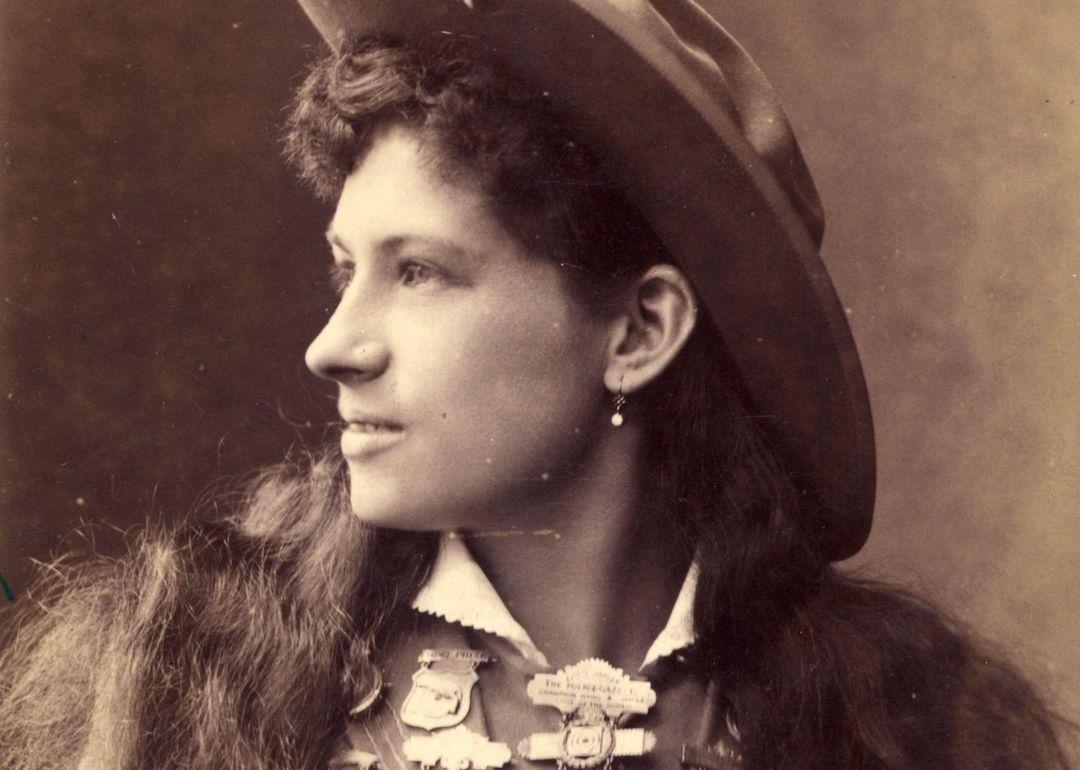
Annie Oakley was born Phoebe Ann Moses in 1860 in rural Ohio. From a young age, she preferred hunting and trapping with her father over playing with dolls or other hobbies traditionally considered more appropriate for little girls. Oakley claimed to have made her first shot at 8 years old (she shot a squirrel off the fence in her family's front yard), and the rest, as they say, is history. Her kills were sold to a nearby grocery store that in turn sold the meat to Cincinnati establishments; one was a hotel where the innkeeper was so impressed with Oakley, he set up a contest between the 15 year old and traveling entertainer and sharpshooter Frank Butler.
Butler hit 24 of the 25 live bird targets; Oakley hit all 25. The two were married the following summer in August 1876 and went on the road together, most famously performing with Buffalo Bill Cody's Wild West Show for 17 years. Things were put on hold when Oakley was partially paralyzed in a train accident, but she returned to show business and lived until 1926. A fictionalized version of her life's story is the basis for the Broadway musical "Annie Get Your Gun."
Wild Bill Hickok
Few frontiersmen can hold a candle to the life and times of Wild Bill Hickok, a vigilante of the Wild West who served as a sheriff and marshall and hung around with the likes of Buffalo Bill Cody and Calamity Jane. The famed Wild Bill was widely known as the best shot in the West and is credited with shooting down around 100 bad guys throughout his tenure.
Hickok today is largely remembered as a hard-lined sharpshooter, thanks largely to an exaggerated 1867 article in Harper's New Monthly Magazine that cast his celebrity coast-to-coast and around the world. In truth, Wild Bill was in his lifetime also a respected Civil War spy and scout who was soft-spoken and quite polite.
Stack-O-Lee
No one—and especially not "Stack" Lee Shelton himself—could have predicted the mythology born one Christmas Eve night in 1895 when Shelton shot and killed his friend, Billy Lyons, for grabbing Stack's white John B. Stetson hat off his head in the midst of an argument. The Black men's fight and Lyons' subsequent death led to Shelton's arrest and imprisonment until 1909. Following the shooting, countless murder ballads were written about the feud. Along the way, words got changed around and names muddled (most people today are more familiar with songs like the Grateful Dead's "Stagger Lee" or Lloyd Price's tune of the same name), but the folklore itself stands as a testament to southern Black reverence for a trickster hero similar to those found throughout cultures around the world from ancient Greece (Hermes) to Native American culture (the coyote).
Upon his release from prison, the real Shelton killed again and added another level of notoriety to his reputation. Folk tales remember Stack-O-Lee as a man living between slavery and freedom who was willing to break societal rules and norms once he discovered so many of those rules worked against men like him.
Calamity Jane
Calamity Jane was a real frontierswoman named Martha Jane Cannary born just before the Civil War. Her status as American folk hero comes from her larger-than-life persona that featured traits considered masculine at the time, such as stubbornness, alcohol consumption, an uncanny accuracy with firearms, and outspoken drive. The sharpshooter's jobs as a young adult most likely included laundry work, dancing, and even prostitution. Eventually, Calamity Jane put her experience riding horses as a kid to use rounding up Native Americans and helping sequester them in reservations.
Pecos Bill
Pecos Bill never actually existed, but his folklore is popularly attributed to Edward S. O'Reilly's early 20th-century collection of short stories published in The Century Magazine. Pecos Bill the literary character was separated from his parents while crossing the Pecos River and ended up being raised by a band of coyotes. Eventually, he was inspired by a cowboy he met and went on to pursue a life of ranching—a feat made more manageable by Bill's superhero abilities like getting animals to work for him. Bill demonstrated the best of the inimitable American West spirit and is credited with first using a lasso to catch cattle, employing a brand to tag livestock, and even with "inventing" scorpions and tarantulas.
John Brown
John Brown was a fiercely unapologetic white abolitionist who hunted and killed pro-slavery crusaders. Depending on who was making the claims, Brown—whose work against slavery coincided with the lead-up to the Civil War—was either a hero or a terrorist. He was eventually tried, convicted, and killed by hanging at 59 years old.
Rip Van Winkle
Washington Irving's famous short story, "Rip Van Winkle," about a man who falls asleep on a mountain and wakes up 20 years later, may actually be based on true events. Steven Press, a former theater professor at Dutchess Community College in Poughkeepsie, New York, scoured files at the Museum of the City of New York, libraries, and documentation to track down information suggesting the real Rip Van Winkle was a Dutch American born in 1727.
While the fictionalized account has Rip Van Winkle heading into the Catskills with his dog to get away from his overbearing wife (only to meet bearded men playing nine-pin, drink with them, and sleep for two decades), Press claimed to the Associated Press the real character was an alcoholic. That man drank his way through his sizable inheritance, Press said, was a terrible husband and father, and abandoned his family in 1767 for two decades, shuffling between New York City Dutch taverns and mooching off fellow bar patrons and tavern owners while telling stories and singing songs. When his daughter found him acting in a stage show called "The Old Dutcher," she took him home. He's the one who came up with the story of being asleep for 20 years as a cover for his drunken wanderings.
You may also like: Classic baby names that are going extinct
Buffalo Bill
Buffalo Bill is an American folk hero who was also a real Wild West character. William F. Cody, who eventually gained the stage name, Buffalo Bill, had his hands in just about everything—from exploring the Western frontier and riding in the Pony Express to fighting in the Civil War. He started touring in a traveling Western show in 1883, and by the 1890s Cody was known as the most famous entertainer in the world. His fans included Teddy Roosevelt, who incidentally named his famed volunteer cavalry the Rough Riders after Buffalo Bill's show, "Buffalo Bill's Wild West and Congress of Rough Riders of the World."
High John the Conqueror
High John the Conqueror is a trickster hero from African American folklore. According to the story, John was an African prince captured and sold as a slave to the Americas. But instead of being crushed by the weight of enslavement, he found ways to get out of the work and punishments of subjugation.
Huck Finn
Mark Twain's controversial 1885 novel on its face appears to be about a boy traveling along the Mississippi River by raft with a man (Jim) who has escaped slavery. In fact, the book confronts American racism and the history of slavery with the raft representing freedom from those societal ills. Huck Finn's moral compass and openness to grow and change made him a folk hero for the last 135 years, while many still debate whether Jim was the real hero of "The Adventures of Huckleberry Finn" or an offensively caricatured stereotype.
Lozen
Lozen was a real-life Apache warrior whose tribe in the 1870s was contained in Arizona's San Carlos Reservation. Her brother Victorio led a rebellion that fled the reservation in1877 and raided lands in the region, striking fear into the white settlers of Black Mountain in New Mexico. Victorio was killed in battle, leaving Lozen to seek vengeance across New Mexico in 1881. She was said to have been able to sense where her enemy was by spreading her arms out into the air.
Lozen fought alongside fellow famed folk hero, Geronimo, but ended up being captured after Geronimo surrendered. She died of tuberculosis while in custody.
[Pictured: Apache prisoners including Natchez (center front) and to the right, Geronimo and son, sit for a photograph beside Southern Pacific Railway in Texas, in 1886.]
Railroad Bill
Railroad Bill is commonly revered as a Robin Hood figure of sorts for the Black community. He earned his nickname after being tossed from a moving train for not paying for a ticket, fomenting an ongoing hunt for vengeance. Other versions of Railroad Bill folklore say Bill hitchhiked on trains while armed and evaded arrests multiple times, went on murder sprees to kill lawmen, and stole from stores to sell items at reduced costs to poor people.
[Pictured: Union Station Train Shed, Montgomery, Alabama, circa 1897.]
Maid of the Mist (Lelawala)
The Maid of the Mist is a Haudenosaunee myth about the famed Horseshoe Falls that originated well ahead of Europe's American colonization. In it, a recently widowed Seneca woman called Lelawala takes her canoe into the water above Niagara Falls with the intention of letting the current take her over the edge and to her death. She prays to Heno, the God of Thunder, to take her without pain and for her to stay courageous. Heno catches her and takes her with him back to where he lives below the falls.
Lelawala marries one of Heno's sons, has a child, and eventually asks Heno to allow her to return to her people so she can warn them of impending danger in the form of a serpent coming to destroy them. Heno granted her request, Lelawala saved her people, and Heno struck the serpent dead with a thunderbolt. The serpent's body floated to the top of the falls and got stuck, making the horseshoe shape Niagara Falls is known for. The water was rerouted and flooded Heno's home, forcing him, Lelawala, and the rest of their family to seek refuge in the sky where they watch everyone on Earth. Some say you can still hear Lelawala's voice in the falling water of Niagara Falls.
Casey Jones
Jonathan Luther "Casey" Jones was an actual Tennessean engineer who was driving the Cannonball Express train near Vaughan, Mississippi, in 1900 when it collided with the caboose of a freight train that had stalled. He was the only casualty. Jones—who had been speeding to make up for lost time—was hailed a hero for his efforts not only to stop the train but to save the lives of passengers; legend says when he died in the crash, Jones had a hand on the train's brake and the other on the train's whistle.
Jones' friend Wallace Saunders, a Black engine wiper for the Illinois Central Railroad, wrote a popular song about Jones that kept him in the collective consciousness. An American TV show called "Casey Jones" ran in the 1957–58 television season, giving the folk hero a fresh burst of fame. He returned again in 1970 when the Grateful Dead released a song in his honor.
Daniel Boone
Daniel Boone was a real man who worked for the Virginia General Assembly in the 1780s. His folk-hero status came from his time as an explorer and frontiersman who helped settle Kentucky—not his public work, service as a soldier, or his business acumen.
Davy Crockett
By his own (likely exaggerated) account, Davy Crocket killed his first bear when he was 3. Born in 1786, the rugged outdoorsman's life is wild enough without all the associated embellishments and folklore. After serving in Congress as a representative for Tennessee, he lost reelection and set off to explore Texas. There, he got tangled up in the battle at the Alamo, was shot, and killed.
Bud Billiken
Kansas City artist Florence Pretz in 1908 created a charm doll she called the Billiken. The pointy-eared doll with a tuft of hair atop its head was supposed to bring good luck and protect children, and became quite popular throughout the United States and especially the Midwest.
Robert Sengstacke Abbott, founder of the Chicago Defender newspaper, borrowed the Billiken design when he created a mascot for the paper called Bud Billiken in the 1930s. The mascot "inspired youth, progress, and pride" and served as the guardian angel of Black children. Each summer since 1929, the Bud Billiken Parade is held to bring together Chicago's South Side Black community with a procession down King Drive, music, dance, and food.